
Artificial intelligence development has become one of the most valuable skills in 2026, with businesses across every industry seeking ways to integrate intelligent systems into their operations. Whether you're a software developer expanding your skill set, a business analyst looking to automate workflows, or an entrepreneur building AI-powered products, understanding the fundamentals of AI development is essential. This comprehensive ai development tutorial walks you through the entire process, from selecting the right frameworks to deploying production-ready models that solve real business problems.
Understanding AI Development Fundamentals
AI development differs significantly from traditional software development. While conventional programming follows explicit instructions you write, AI systems learn patterns from data and make predictions or decisions based on those learned patterns.
The foundation of any ai development tutorial begins with understanding three core concepts: supervised learning (training models with labeled examples), unsupervised learning (finding patterns in unlabeled data), and reinforcement learning (learning through trial and error with rewards).
Core Components of AI Systems
Every AI system consists of distinct components that work together:
- Data pipeline: Collection, cleaning, and preprocessing of training data
- Model architecture: The structure of your neural network or machine learning algorithm
- Training process: How your model learns from data
- Evaluation metrics: Measurements that determine model performance
- Deployment infrastructure: Systems that serve your model to end users
The quality of your data directly impacts model performance. In fact, data scientists typically spend 60-80% of their time on data preparation rather than model training. This makes data engineering skills just as important as understanding algorithms.

Choosing Your AI Development Stack
Your technology stack determines what you can build and how efficiently you can build it. In 2026, several mature ecosystems dominate AI development, each with distinct advantages.
Python-Based Frameworks
Python remains the dominant language for AI development, supported by extensive libraries and community resources. The most widely adopted frameworks include:
| Framework | Best For | Learning Curve | Production Ready |
|---|---|---|---|
| PyTorch | Research, computer vision, NLP | Moderate | Yes |
| TensorFlow | Enterprise deployment, mobile AI | Steeper | Yes |
| Scikit-learn | Traditional ML, quick prototypes | Gentle | Yes |
| Hugging Face Transformers | Language models, pre-trained models | Moderate | Yes |
PyTorch has become the framework of choice for most new AI projects due to its intuitive API and strong community support. Its dynamic computation graphs make debugging easier, which is invaluable when you're learning.
TensorFlow excels in production environments where you need to deploy models across multiple platforms, including mobile devices and edge computing systems. Google's backing ensures long-term support and continuous updates.
For developers seeking structured learning paths, comprehensive developer resources provide hands-on tutorials with real code examples that demonstrate practical implementation patterns.
Cloud Platforms and Development Environments
Modern AI development happens primarily in cloud environments that provide GPU access, managed services, and scalable infrastructure:
- Google Colab: Free GPU access, perfect for learning and experimentation
- AWS SageMaker: Enterprise-grade model training and deployment
- Azure Machine Learning: Integrated Microsoft ecosystem tools
- Google Vertex AI: End-to-end ML platform with AutoML capabilities
Starting with Google Colab offers the best path for beginners in this ai development tutorial because it requires no setup, provides free GPU resources, and includes pre-installed libraries.
Building Your First AI Model
Let's walk through building a practical AI model step by step. We'll create a text classification system that categorizes customer support tickets-a common real-world business application.
Step 1: Data Preparation and Exploration
Begin by collecting and examining your dataset. For text classification, you need examples of text paired with their correct categories.
# Your data structure should look like:
# Text: "My order hasn't arrived yet"
# Category: "Shipping Issue"
Clean your data by removing duplicates, handling missing values, and ensuring consistent formatting. Create training (80%), validation (10%), and test (10%) splits to properly evaluate model performance.
Step 2: Feature Engineering and Preprocessing
Transform raw text into numerical representations that AI models can process. In 2026, the most effective approach uses transformer-based embeddings that capture semantic meaning.
Modern pre-trained models like BERT, RoBERTa, or GPT variants have already learned language patterns from billions of words. You can leverage this knowledge through transfer learning, adapting these models to your specific task with relatively little data.
Step 3: Model Selection and Training
For text classification, you have several architectural options:
- Fine-tuned transformer models (highest accuracy, requires more resources)
- Embedding + neural network (good balance of performance and efficiency)
- Traditional ML with TF-IDF features (fastest training, lower accuracy)
Select based on your constraints. If you have limited data (under 1,000 examples), start with a simpler model to avoid overfitting. The curated learning resources from leading AI providers offer detailed guidance on selecting appropriate architectures for different use cases.
Step 4: Evaluation and Iteration
Never deploy a model without thorough evaluation. Track multiple metrics:
- Accuracy: Overall correctness across all categories
- Precision: How many predicted positives are actually positive
- Recall: How many actual positives you correctly identified
- F1 Score: Harmonic mean of precision and recall
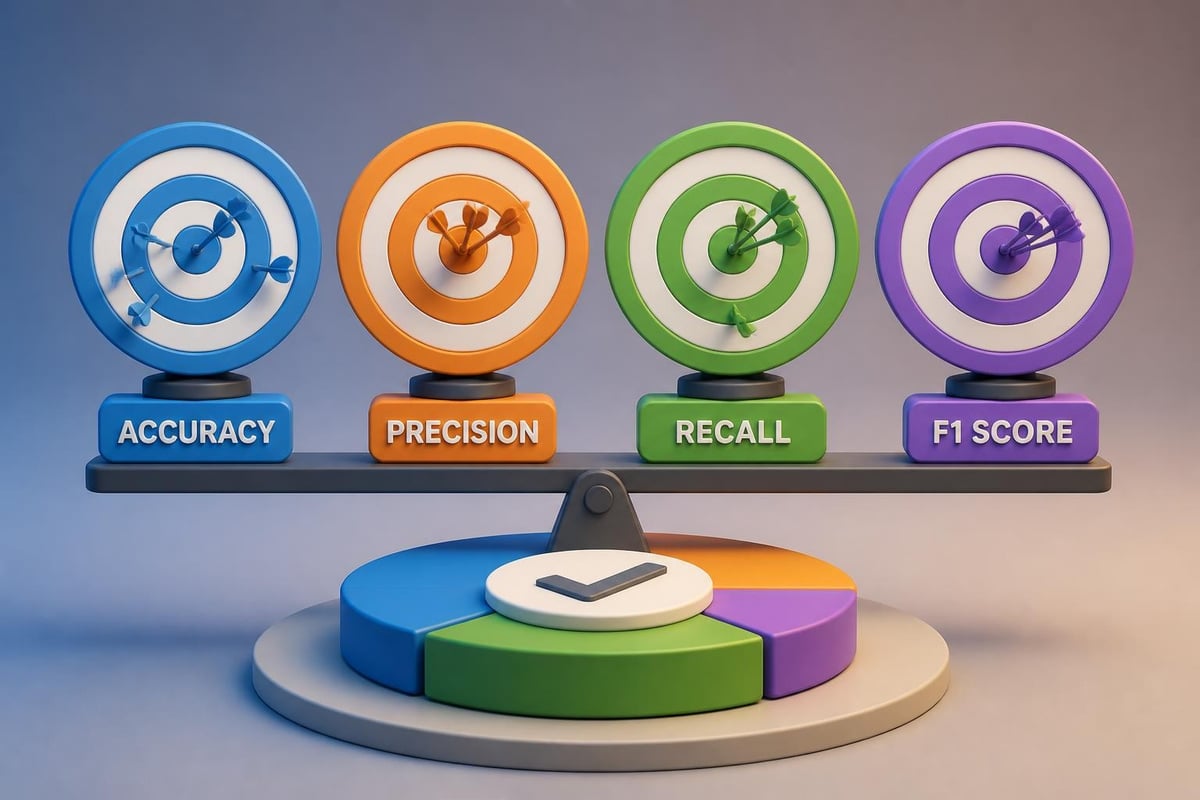
Test your model on examples it has never seen. Examine failure cases to understand where it struggles. Often, adding more examples of problematic categories or adjusting class weights solves performance issues.
Advanced AI Development Techniques
Once you've mastered basic model building, these advanced techniques dramatically improve performance and capabilities.
Transfer Learning and Fine-Tuning
Rather than training models from scratch, leverage pre-trained models and adapt them to your specific needs. This approach requires significantly less data and training time while achieving better results.
The process involves:
- Load a pre-trained model (like GPT-3.5, BERT, or ResNet)
- Freeze early layers that learned general features
- Replace the final layers with task-specific layers
- Train on your dataset, updating only the new layers
- Optionally unfreeze and fine-tune earlier layers
This technique works remarkably well across domains. A model trained on ImageNet can classify medical images. A language model trained on Wikipedia can answer customer questions.
Prompt Engineering for Large Language Models
Working with models like GPT-4, Claude, or Gemini requires different skills than traditional model training. This ai development tutorial wouldn't be complete without addressing prompt engineering-the practice of crafting effective instructions for AI systems.
Effective prompts include:
- Context: Background information the model needs
- Role definition: Who the AI should act as
- Task specification: Exactly what you want done
- Format instructions: How to structure the output
- Examples: Few-shot examples demonstrating desired behavior
For professionals looking to master these techniques systematically, Mammoth Club’s AI certification program provides comprehensive training across 3,000+ courses, including advanced prompt engineering, model fine-tuning, and production deployment strategies. This structured approach helps you build job-ready skills with practical, hands-on projects.

Model Optimization and Deployment
Development doesn't end when your model achieves good accuracy. Production deployment introduces new challenges:
Model compression techniques reduce size and inference time:
- Quantization (using lower precision numbers)
- Pruning (removing unnecessary connections)
- Knowledge distillation (training smaller models to mimic larger ones)
Deployment patterns vary based on requirements:
| Pattern | Latency | Cost | Use Case |
|---|---|---|---|
| Real-time API | Low (milliseconds) | Higher | Interactive applications |
| Batch processing | High (minutes-hours) | Lower | Analytics, reports |
| Edge deployment | Lowest (local) | Variable | Mobile apps, IoT devices |
Monitor deployed models continuously. Performance degrades over time as real-world data drifts from training data. Implement automated retraining pipelines that update models with fresh data regularly.
Practical AI Development Projects
Theory becomes concrete through hands-on projects. These project ideas span different difficulty levels and business applications.
Beginner Projects
Start with well-defined problems and abundant resources:
- Sentiment analysis tool: Classify product reviews as positive, negative, or neutral
- Email categorization system: Automatically sort emails into folders
- Price prediction model: Estimate product prices based on features
- Image classifier: Identify objects in photos using pre-trained models
These projects teach fundamental concepts without overwhelming complexity. Focus on completing the entire pipeline from data collection through deployment.
Intermediate Projects
Build more complex systems that combine multiple components:
- Chatbot with context awareness: Conversational AI that remembers previous messages
- Document summarization tool: Automatically extract key points from long texts
- Recommendation engine: Suggest products based on user behavior
- Anomaly detection system: Identify unusual patterns in transaction data
These projects require understanding how to chain multiple models together and manage state across interactions. Exploring foundations through machine learning roadmaps helps structure your learning progression through increasingly complex architectures.

Advanced Projects
Challenge yourself with cutting-edge applications:
- Multi-agent system: Multiple AI agents collaborating to solve complex problems
- Generative AI application: Create original content (text, images, audio)
- Reinforcement learning agent: Train AI to play games or optimize processes
- Real-time video analysis: Process video streams for object detection or activity recognition
Advanced projects often require specialized hardware (GPUs), larger datasets, and deeper understanding of AI architectures. Understanding generative AI architectures and mathematics provides essential background for building these sophisticated systems.
Common Challenges and Solutions
Every AI developer encounters predictable obstacles. Recognizing these challenges early helps you overcome them efficiently.
Overfitting and Underfitting
Overfitting occurs when your model memorizes training data instead of learning generalizable patterns. Signs include high training accuracy but poor performance on new data.
Solutions include:
- Collecting more training data
- Using regularization techniques (dropout, L1/L2 penalties)
- Reducing model complexity
- Implementing data augmentation
- Early stopping during training
Underfitting happens when models are too simple to capture data patterns. Both training and validation accuracy remain low.
Address underfitting by:
- Increasing model capacity (more layers, more neurons)
- Training for more epochs
- Reducing regularization
- Engineering better features
Data Quality and Bias
Poor data quality creates unreliable models. Common issues include:
- Imbalanced classes: Some categories have far more examples than others
- Biased sampling: Training data doesn't represent real-world distribution
- Label errors: Incorrect category assignments in training data
- Missing values: Incomplete information in your dataset
Address these systematically. Use stratified sampling to maintain class proportions. Implement data validation checks. Consider techniques like SMOTE for handling imbalanced datasets. The verifiable AI claims framework offers guidance on ensuring fairness and addressing bias in AI systems.
Computational Resource Constraints
Training large models requires significant computing power. If you lack access to expensive GPUs:
- Start with smaller models and datasets
- Use cloud-based free tiers (Google Colab, Kaggle)
- Leverage pre-trained models through transfer learning
- Optimize code efficiency before scaling up
- Consider model distillation to create smaller versions
Many successful AI applications use relatively small models optimized for specific tasks rather than massive general-purpose models.
AI Development Best Practices
Professional AI development follows established patterns that improve reliability, maintainability, and collaboration.
Version Control for Models and Data
Treat models and datasets like code. Use tools designed for AI workflows:
- DVC (Data Version Control): Track datasets and model versions alongside code
- MLflow: Log experiments, parameters, and metrics automatically
- Weights & Biases: Visualize training runs and compare experiments
- Git LFS: Store large model files in version control
Document every experiment. Record hyperparameters, data versions, and performance metrics. You'll frequently need to reproduce results or understand why one approach worked better than another.
Testing and Validation Strategies
AI systems require different testing approaches than traditional software:
Unit tests verify individual components (data preprocessing functions, feature engineering steps). Integration tests ensure model predictions flow correctly through your application. Performance tests validate accuracy, latency, and resource usage.
Implement continuous integration pipelines that:
- Run automated tests on every code change
- Train models on standardized datasets
- Validate performance meets minimum thresholds
- Generate reports comparing current and previous versions
Documentation and Reproducibility
Create documentation that enables others (including future you) to understand and reproduce your work:
- Model cards: Describe model purpose, training data, performance, and limitations
- Data sheets: Document dataset sources, collection methods, and known biases
- Environment specifications: List exact package versions and dependencies
- Training procedures: Step-by-step instructions for reproducing model training
Good documentation accelerates collaboration and prevents months of work from becoming unusable when team members change. Resources from PromptHero.ai demonstrate how structured tutorials with clear steps and copy-paste prompts make complex AI techniques accessible to professionals.
Emerging Trends in AI Development
AI development evolves rapidly. Understanding current trends helps you focus learning efforts on technologies that will remain relevant.
Agentic AI and Autonomous Systems
Moving beyond single-task models, agentic AI systems can plan, execute multi-step workflows, and adapt to changing conditions. These systems combine language models with tools, memory, and decision-making capabilities.
Building agentic systems requires understanding:
- Tool use and function calling
- Memory architectures (short-term and long-term)
- Planning and reasoning frameworks
- Multi-agent coordination protocols
For those specifically interested in this frontier, curated roadmaps for Agentic AI provide structured paths from foundations through production-ready implementations.
Multimodal AI Models
Modern AI increasingly processes multiple data types simultaneously-text, images, audio, and video. GPT-4V, Gemini, and similar models understand and generate content across modalities.
This creates new application possibilities:
- Analyzing documents with text and images together
- Generating images from text descriptions with context awareness
- Creating video content with coordinated visuals and narration
- Building interfaces that understand voice, gesture, and visual input
Edge AI and On-Device Models
Privacy concerns, latency requirements, and connectivity limitations drive AI deployment directly onto devices. Smartphones, IoT sensors, and embedded systems now run sophisticated models locally.
Development for edge AI requires:
- Extreme model optimization (quantization, pruning)
- Understanding hardware constraints (memory, power, compute)
- Offline-first architectures that function without connectivity
- Efficient model update mechanisms
This ai development tutorial emphasizes these trends because they represent where the industry is heading, making skills in these areas particularly valuable.
Building a Learning Path
Systematic skill development accelerates your progress from beginner to professional AI developer.
Foundational Knowledge
Before diving deep into AI frameworks, ensure you understand:
- Python programming: Variables, functions, classes, and common libraries
- Linear algebra: Vectors, matrices, and basic operations
- Calculus: Derivatives and gradients (for understanding optimization)
- Probability and statistics: Distributions, hypothesis testing, and inference
Don't wait until you've mastered all mathematics before starting. Learn concepts as you need them, deepening understanding through practical application.
Structured Learning Resources
Combine different learning formats for comprehensive understanding:
- Video courses: Visual explanations of complex concepts
- Written tutorials: Reference material and step-by-step guides
- Research papers: Cutting-edge techniques and theoretical foundations
- Hands-on projects: Practical application of learned concepts
The comprehensive AI learning resources collection includes courses, books, lectures, and papers across all AI domains, providing paths for different learning styles.
Community Engagement and Practice
Join AI communities to accelerate learning:
- GitHub: Study open-source projects and contribute code
- Kaggle: Participate in competitions and learn from top solutions
- Discord/Slack communities: Ask questions and help others
- Local meetups: Network with other AI practitioners
Teaching others solidifies your own understanding. Write tutorials, answer questions, or present at meetups. Explaining concepts reveals gaps in your knowledge and reinforces what you've learned.
Mastering AI development requires consistent practice, curiosity, and patience as you work through challenges and gradually build more sophisticated systems. The journey from understanding basic concepts to deploying production AI models becomes manageable when you follow structured learning paths and focus on practical, hands-on experience. Whether you're automating business processes, building intelligent applications, or exploring cutting-edge research, Prompt Hero.Ai offers practical tutorials with step-by-step instructions and copy-paste prompts designed specifically for professionals ready to apply AI in real-world scenarios.