
Artificial intelligence has transformed from an academic curiosity into an essential professional skill in just a few years. Whether you're a marketer automating content creation, an analyst processing data faster, or a small business owner streamlining operations, understanding AI tools isn't optional anymore. The good news? You don't need expensive courses or computer science degrees to start. Finding a quality artificial intelligence tutorial free of charge is easier than ever, with resources ranging from interactive platforms to comprehensive written guides. This guide breaks down the best free learning paths, practical applications, and actionable strategies to help you master AI tools that solve real business problems.
Understanding What You Actually Need to Learn
Many beginners get overwhelmed by AI terminology and theory. The reality is that most professionals don't need to understand neural network architecture or backpropagation algorithms. What matters is knowing how to use AI tools effectively.
Focus on these practical skills first:
- Prompt engineering for tools like ChatGPT and Claude
- Automating repetitive tasks with AI assistants
- Data analysis and pattern recognition
- Content generation and editing workflows
- Problem-solving frameworks using AI reasoning
These capabilities deliver immediate value. You can master them without coding experience or advanced mathematics. The theoretical foundations can come later if you need them.
The Gap Between Theory and Application
Traditional AI education often starts with machine learning algorithms, calculus, and linear algebra. While valuable for researchers and engineers, this approach frustrates professionals who need practical results quickly. An effective artificial intelligence tutorial free approach should prioritize hands-on projects over abstract concepts.
For example, understanding how to structure a prompt that generates accurate email responses takes minutes to learn and delivers immediate productivity gains. Learning the transformer architecture behind the model takes months and provides little practical benefit for most users.

Finding Quality Free AI Tutorial Resources
Not all free resources are created equal. Some platforms offer superficial overviews while others provide structured, comprehensive learning paths. PromptImageLab offers over 200 free AI tutorials covering everything from fundamentals to advanced prompt engineering techniques.
| Resource Type | Best For | Time Investment | Depth Level |
|---|---|---|---|
| Interactive platforms | Hands-on learners | 15-30 min/lesson | Medium |
| Video courses | Visual learners | 1-3 hours/course | Variable |
| Written tutorials | Reference material | 10-20 min/article | High |
| Academic papers | Deep understanding | 2-4 hours/paper | Very high |
When evaluating an artificial intelligence tutorial free resource, check for three qualities: practical examples, step-by-step instructions, and real-world applications. Tutorials that demonstrate actual business use cases beat theoretical explanations every time.
Structured Learning Paths vs. Random Exploration
Many learners make the mistake of jumping between random tutorials without a clear progression. AI Aimate provides a free, open-source educational resource with structured learning paths from fundamentals to advanced topics, backed by academic citations.
A solid learning path looks like this:
- Foundation week: Understanding what AI can and cannot do
- Tool mastery: Learning one primary AI assistant (ChatGPT or Claude)
- Prompt engineering: Developing effective communication with AI
- Automation basics: Creating simple workflows
- Advanced applications: Building custom solutions for specific problems
This progression ensures each skill builds on previous knowledge. Skipping steps creates knowledge gaps that cause frustration later.
Mastering Prompt Engineering Without Coding
Prompt engineering is the most valuable AI skill you can develop. It's the difference between getting generic, unhelpful responses and receiving tailored, actionable insights. The best part? It requires zero programming knowledge.
Core prompt engineering principles:
- Specificity: Vague inputs generate vague outputs
- Context: Provide relevant background information
- Format: Specify how you want information structured
- Examples: Show the AI what you're looking for
- Iteration: Refine prompts based on results
For business professionals exploring AI and machine learning tutorials, prompt engineering delivers the highest return on learning time invested.
Building Your Prompt Library
Professional AI users maintain libraries of tested prompts for common tasks. Instead of starting from scratch each time, they adapt proven templates. This approach saves hours while improving output quality.
Consider this workflow automation example:
Email triage prompt template:
"Review the following email and categorize it as: urgent_response_needed, information_only, or delegate_to_team. Provide a one-sentence summary and suggest next action if applicable."
You build this once, then reuse it hundreds of times. Your prompt library becomes a productivity multiplier.

Practical Applications That Deliver Immediate Value
Theory means nothing without application. Let's examine specific business scenarios where AI tutorials translate into measurable productivity gains.
Content Creation and Editing
Writers and marketers use AI to overcome blank page syndrome, generate outlines, and polish drafts. The process isn't about replacing human creativity but amplifying it.
Real workflow example:
- Generate five different article angles on a topic
- Select the strongest angle and request an outline
- Write the first draft yourself with AI-assisted research
- Use AI to identify weak arguments and suggest improvements
- Polish tone and clarity with editing prompts
This hybrid approach maintains your unique voice while dramatically reducing production time. A blog post that once took four hours might now take ninety minutes.
Data Analysis for Non-Analysts
Small business owners and managers often struggle with data interpretation. AI tools can analyze spreadsheets, identify trends, and generate insights without requiring Excel expertise or statistical knowledge.
Upload a sales spreadsheet and prompt: "Analyze this data for seasonal trends, identify the top three performing product categories, and suggest which underperforming items should be discontinued based on six-month trends."
The AI processes information in seconds that would take hours of manual review.
Customer Service Automation
Response templates powered by AI improve both speed and consistency. Instead of writing each customer email from scratch, service teams create prompts that generate personalized responses incorporating customer history and current context.
| Task | Manual Time | AI-Assisted Time | Efficiency Gain |
|---|---|---|---|
| Email response | 8 minutes | 2 minutes | 75% faster |
| FAQ documentation | 4 hours | 45 minutes | 81% faster |
| Report generation | 2 hours | 20 minutes | 83% faster |
| Meeting summary | 30 minutes | 5 minutes | 83% faster |
These aren't hypothetical numbers. They represent actual time savings reported by professionals using AI assistants systematically.
Avoiding Common Beginner Mistakes
New AI users consistently make predictable errors. Recognizing these patterns helps you skip painful learning experiences.
The biggest mistakes:
- Trusting AI output without verification (always fact-check)
- Using overly complex prompts when simple ones work better
- Expecting perfection on the first try (iteration is normal)
- Ignoring context windows (AI has memory limitations)
- Failing to specify output format (leading to unusable results)
Understanding these pitfalls before you encounter them accelerates your learning curve significantly. LearnAI.TV offers free streaming courses that address common mistakes through practical demonstrations.
The Verification Requirement
AI tools generate confident-sounding responses even when wrong. This "hallucination" problem requires users to maintain healthy skepticism. Never use AI-generated facts, statistics, or citations without independent verification.
For creative work, editing, and ideation, accuracy matters less. For research, analysis, and factual content, verification is non-negotiable.
Building Advanced Skills Through Free Resources
Once you've mastered basics, free resources remain available for advanced topics. Prime Learn Point provides structured tutorials on machine learning and AI concepts with step-by-step coding examples.
For professionals ready to understand algorithms without programming, J3nex offers interactive tutorials on 50 AI algorithms explained in plain English.
Understanding When to Go Deeper
Most business users never need advanced AI knowledge. However, specific scenarios benefit from deeper understanding:
- Building custom automation workflows
- Evaluating AI vendor claims critically
- Managing teams using AI tools
- Developing AI strategy for organizations
- Creating competitive advantages through AI adoption
If your role involves strategic AI decisions rather than just tactical use, investing time in intermediate and advanced artificial intelligence tutorial free resources pays dividends.
Continuous Learning in a Rapidly Evolving Field
AI capabilities expand monthly. Tools that didn't exist last year are now industry standards. This rapid evolution demands continuous learning, but free resources keep pace with paid alternatives.
Strategies for staying current:
- Dedicate 30 minutes weekly to exploring new features
- Follow release notes from major AI platforms
- Test new capabilities with real work tasks
- Join free communities discussing practical applications
- Bookmark quality tutorial sites for reference
The professionals who excel with AI aren't necessarily the ones who learned first. They're the ones who keep learning consistently.
Certification and Formal Training Options
While countless free tutorials exist, structured certification programs provide recognized credentials and comprehensive curricula. If you're serious about building job-ready AI skills, comprehensive training accelerates your progress.
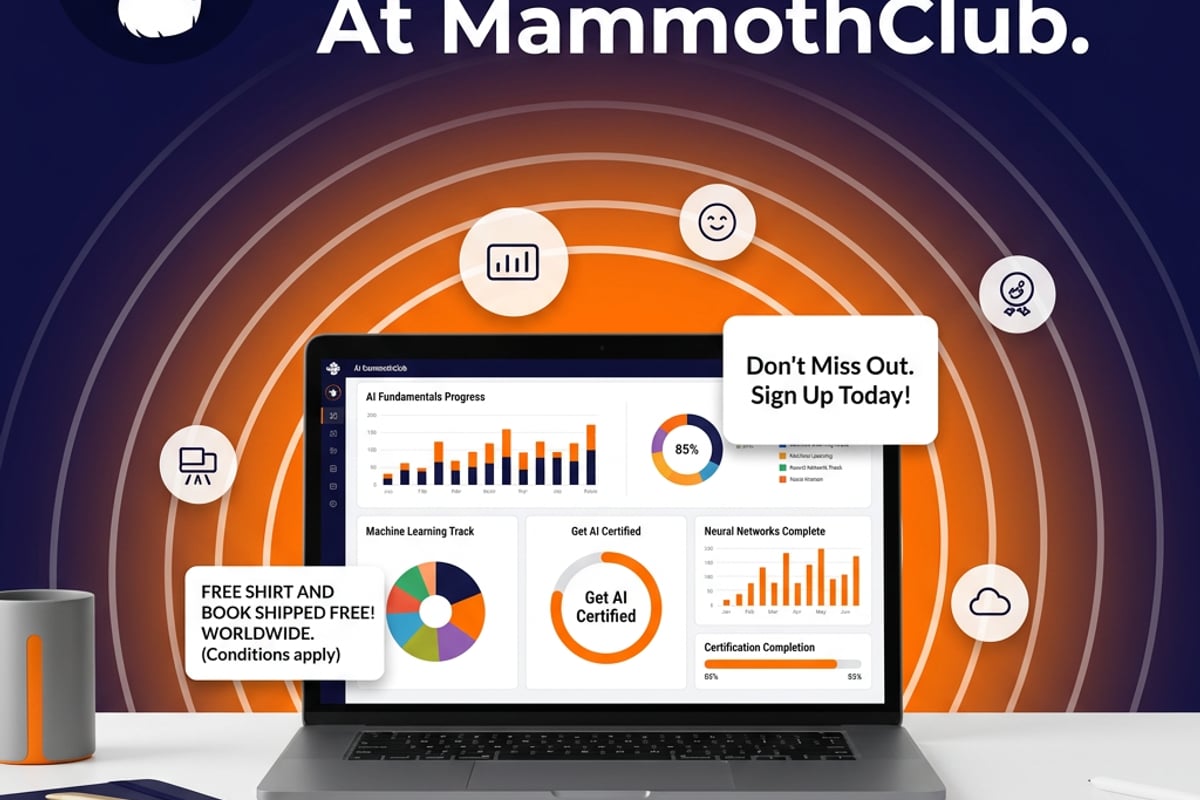
Mammoth Club offers AI certification with access to thousands of courses and practice questions, built by instructors who've trained millions of learners worldwide. The program covers everything from ChatGPT basics through advanced automation and productivity techniques that you can apply immediately in professional settings.

Creating Your Personal AI Learning Roadmap
Generic learning paths work for general education, but personalized roadmaps aligned with your specific goals deliver better results faster. Your roadmap should reflect your industry, role, and objectives.
Customizing Based on Your Role
Different professions benefit from different AI applications. A marketing manager needs different skills than a financial analyst or project manager.
Marketing professional roadmap:
- Content generation and editing (Week 1-2)
- Social media automation (Week 3)
- Campaign analysis and reporting (Week 4)
- Customer segmentation prompts (Week 5-6)
- Creative ideation techniques (Week 7-8)
Operations manager roadmap:
- Process documentation automation (Week 1-2)
- Data analysis and trend identification (Week 3-4)
- Report generation workflows (Week 5)
- Meeting management and summaries (Week 6)
- Decision support frameworks (Week 7-8)
Tailoring your learning to actual work tasks ensures immediate application and reinforcement.
Measuring Your Progress and Impact
Learning without measuring outcomes wastes time. Track how AI adoption affects your productivity, work quality, and job satisfaction.
| Metric | Baseline | After 1 Month | After 3 Months |
|---|---|---|---|
| Hours saved weekly | 0 | 3-5 hours | 8-12 hours |
| Tasks automated | 0 | 2-3 tasks | 6-10 tasks |
| Error rate | Baseline | -20% | -40% |
| Output volume | Baseline | +30% | +60% |
These improvements compound. A task that takes 30 minutes manually but 5 minutes with AI saves 25 minutes per occurrence. If you perform that task daily, you save 10+ hours monthly.
Documentation and Iteration
Keep notes on which prompts work well for specific tasks. Document your prompt library, workflow automations, and lessons learned. This personal knowledge base becomes increasingly valuable as you expand AI usage.
When a prompt doesn't work, note why and what you changed to fix it. These insights accelerate future problem-solving.
Integrating AI Into Daily Workflows
Knowledge without implementation delivers zero value. The final step in any artificial intelligence tutorial free journey is systematic integration into regular work.
Implementation framework:
- Week 1: Identify three repetitive tasks AI could improve
- Week 2: Create and test prompts for those tasks
- Week 3: Use AI for those tasks exclusively
- Week 4: Measure time savings and output quality
- Week 5: Identify three additional automation opportunities
- Week 6: Expand usage while refining existing workflows
This gradual expansion prevents overwhelm while building confidence and competence. Within three months, AI becomes a natural part of your workflow rather than an added task.
Overcoming Adoption Resistance
Many professionals resist AI adoption due to comfort with existing methods or fear of making mistakes. The solution isn't forcing change but demonstrating value through small wins.
Start with the most annoying, time-consuming task in your routine. Apply AI to that single problem. Experience the time savings and reduced frustration. Success with one task builds motivation to tackle the next.
Advanced Topics Worth Exploring
After mastering fundamentals and building solid workflows, several advanced topics offer significant value for motivated learners.
Understanding graph neural networks through accessible tutorials helps professionals grasp how AI systems process relationships and connections in data. For those interested in how AI systems model and predict outcomes, world modeling frameworks provide theoretical foundations.
These academic resources might seem intimidating initially, but they explain complex concepts in surprisingly accessible ways. You don't need to understand every mathematical detail to grasp the practical implications.
Evaluating When Theory Matters
Most business applications require minimal theoretical knowledge. However, understanding fundamental concepts helps you:
- Evaluate vendor claims more critically
- Identify appropriate AI applications for complex problems
- Communicate effectively with technical teams
- Anticipate limitations before they cause issues
- Design better prompts based on how models process information
Theory becomes valuable when you move from AI user to AI strategist within your organization.
Building Collaborative AI Practices
Individual productivity gains are valuable, but team-wide AI adoption multiplies impact. Once you've developed competence, helping colleagues adopt AI tools extends benefits across your organization.
Sharing knowledge effectively:
- Create internal prompt libraries specific to your industry
- Document workflows that combine human expertise with AI assistance
- Host informal training sessions demonstrating practical applications
- Establish quality standards for AI-assisted work
- Build feedback loops for continuous improvement
Organizations where AI knowledge spreads organically through internal champions often see better adoption than those relying solely on formal training programs.
Addressing Privacy and Security Concerns
As AI usage expands, privacy and security considerations become critical. Never input sensitive customer data, proprietary information, or confidential details into public AI tools without proper authorization and understanding of data handling policies.
Establish clear guidelines about what information can and cannot be shared with AI assistants. Most organizations benefit from creating simple classification systems: public information (shareable), internal information (restricted), and confidential information (prohibited).
Mastering AI tools through free resources is entirely achievable with the right approach, structured learning, and consistent practice. The key is moving from passive consumption of tutorials to active application in your daily work. Ready to transform your productivity with practical AI skills? Prompt Hero.Ai provides step-by-step tutorials, copy-and-paste prompts, and real-world examples designed specifically for professionals who need results, not theory. Start your AI journey today with tutorials built for actual business applications.