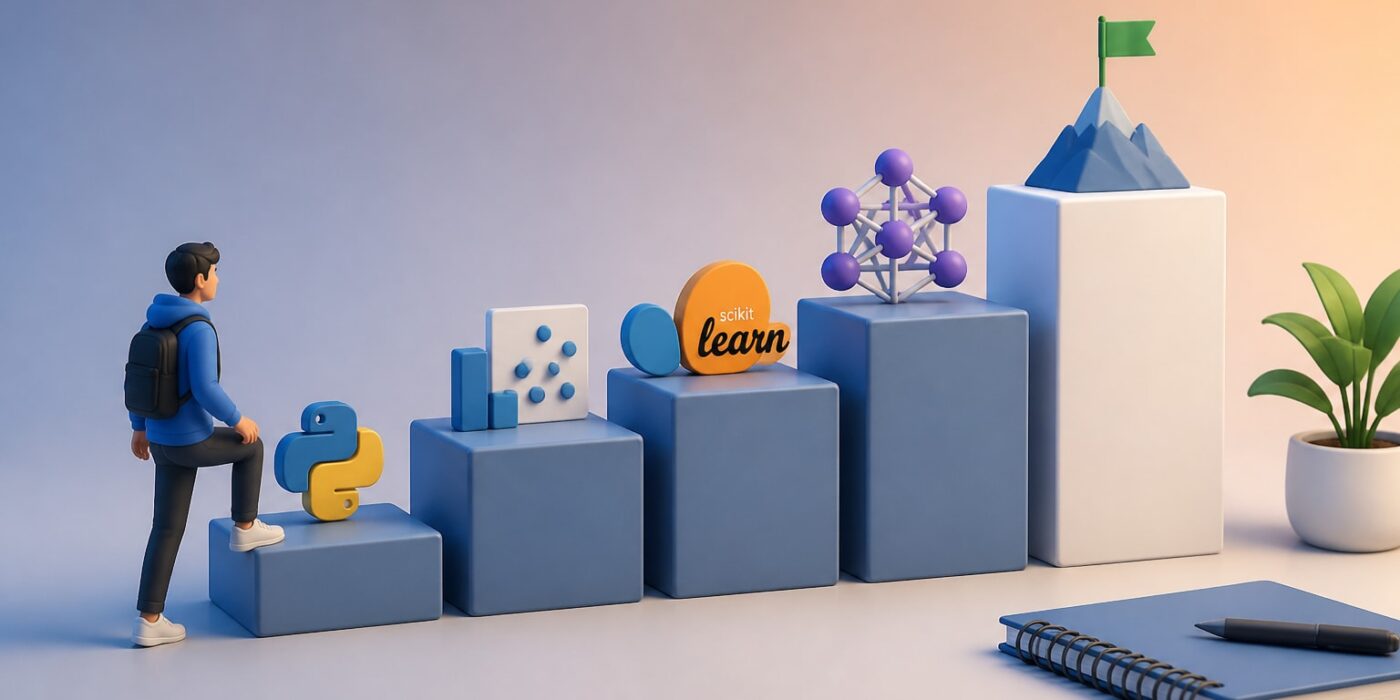
A good Python AI ML course takes you from core Python syntax through data handling, classic machine learning, and deep learning, and ends with projects you can show to someone else. If you are starting from zero, plan on roughly three to six months of steady part-time study to reach that point, and pick a course that makes you build things rather than only watch lectures.
This guide explains what such a course should cover, how to match one to your starting point, which tools matter, and how to avoid the mistakes that stall most learners.
What Does a Python AI and ML Course Actually Teach?
A solid course teaches five layers in order: Python fundamentals, data manipulation, classical machine learning, deep learning, and applied projects. Skipping a layer is the most common reason learners hit a wall around the fourth week.
Here is how those layers usually break down:
- Python fundamentals. Variables, loops, functions, lists, dictionaries, and reading files. You do not need advanced object-oriented design yet.
- Data handling. NumPy for numerical arrays, pandas for tables, and Matplotlib or Seaborn for charts. Most real work in machine learning is cleaning and understanding data, not tuning models.
- Classical machine learning. Scikit-learn covers regression, classification, clustering, train/test splits, and evaluation metrics. This is where you learn why a model that scores 99% on training data can fail on new data.
- Deep learning. TensorFlow or PyTorch, neural networks, and an introduction to computer vision or language models.
- Projects. A capstone that uses a messy, realistic dataset and ends in something you can explain.
The maths is lighter than people fear at the start. Basic statistics (mean, variance, probability) and an intuitive grasp of linear algebra and gradients are enough to begin. You can deepen the maths as you go.
Why Python Is the Default Language for AI and Machine Learning
Python is the default because nearly every major machine learning library is written for it first, and its readable syntax lets you focus on ideas instead of boilerplate. The ecosystem (NumPy, pandas, scikit-learn, TensorFlow, PyTorch) is the practical reason, not any single language feature.
The usage numbers back this up. The 2025 Stack Overflow Developer Survey technology results break down language adoption across the developer community and provide current context for Python's popularity. The survey drew responses from developers across many countries, so it is a reasonably broad snapshot.
Two practical points follow from this:
- Version matters a little. Check the Python.org version index to confirm which interpreter version your course material and libraries support. Mismatched versions cause confusing install errors for beginners.
- Other languages still have a place. R remains strong in statistics, and SQL is essential for pulling data. But if your goal is AI and ML, Python is where tutorials, libraries, and community answers are densest.
How to Choose a Python AI ML Course for Your Level
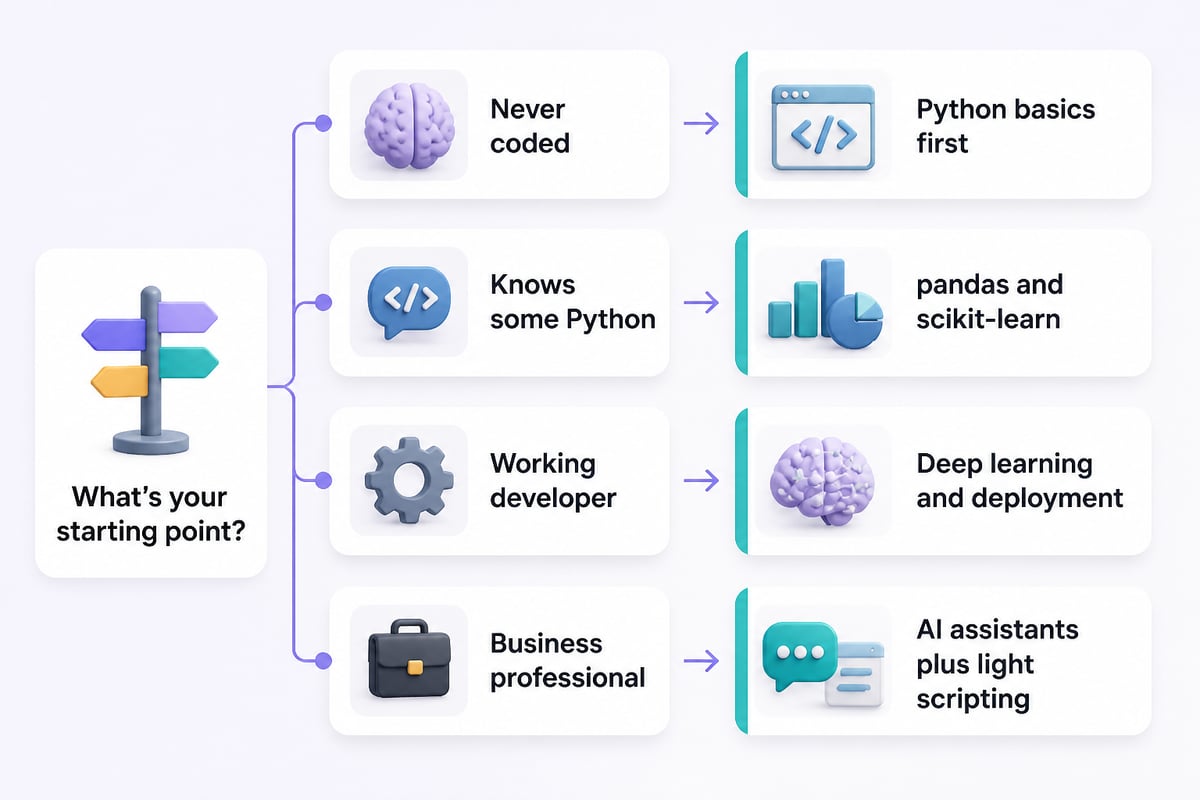
Pick a course based on where you are today, not where you want to be in a year. A beginner in an advanced deep learning course quits; an experienced developer in a basics course gets bored.
| Your starting point | What to look for | Typical focus |
|---|---|---|
| Never coded | Python basics first, gentle pacing, many small exercises | Syntax, data structures, first pandas scripts |
| Know some Python | Data libraries and scikit-learn within the first third | Cleaning data, building and evaluating models |
| Working developer or analyst | Deep learning, deployment, and model evaluation | PyTorch or TensorFlow, APIs, project work |
| Business professional using AI tools | Practical use of AI assistants plus light scripting | Automating tasks, writing code with AI help |
Before enrolling, run through a short checklist:
- Does the syllabus include evaluation (accuracy, precision, recall, overfitting), not only model building?
- Are there graded or reviewable projects, or only quizzes?
- Is the content recently updated? Libraries change fast, and a course built on old APIs will throw errors.
- Does it teach you to read documentation and debug, which is the skill you will use daily?
- Is the cost of the full path clear, including any paid cloud resources?
A reviewer-style note from a course syllabus pattern worth watching: short video courses of three to five hours can introduce vocabulary, but they rarely build the habit of working through a real dataset. Treat them as a sampler, then follow with project work.
A Realistic Learning Path From Beginner to Job-Ready
A realistic path has four stages, and each one should end with something you built. Time estimates assume five to eight hours a week.
Stage 1: Python and data basics (weeks 1 to 6)
Learn syntax, then immediately load a CSV file with pandas and answer a question about it. For example, take a public sales dataset and work out which month had the highest revenue. Small wins like this keep motivation up.
Stage 2: Classical machine learning (weeks 7 to 12)
Use scikit-learn to predict something simple, such as house prices or customer churn. Focus on the workflow: split data, train, evaluate, improve. Learn what overfitting looks like by watching training and test scores diverge.
Stage 3: Deep learning (weeks 13 to 20)
Pick one framework, PyTorch or TensorFlow, and stay with it. Train a small image classifier or a text sentiment model. Running notebooks on a free cloud service such as Google Colab removes the need for a powerful laptop.
Stage 4: Portfolio and specialization (weeks 21 and beyond)
Build two or three projects that mirror real problems: forecasting demand, classifying support tickets, or summarizing documents. Write a short README for each explaining the problem, your approach, and what you would do next.
This schedule is flexible. Many learners compress stage one if they already code, and many stretch stage three. The order matters more than the pace.
Free Versus Paid: What You Get for Your Money
Free resources can teach you almost everything, but paid courses add structure, feedback, and accountability. The right choice depends on how you learn.
Free options work well when:
- You are self-disciplined and comfortable searching for answers.
- You already know some programming.
- You want to test whether the subject suits you before spending money.
Paid options work well when:
- You need a fixed syllabus so you do not wander between tutorials.
- You want certificates, reviewed projects, or mentor feedback.
- You are learning for a job change and want a clear finish line.
If you want a single subscription that covers AI certification across many topics, Mammoth Club's AI certification and training library offers access to 3,000+ courses and over 1 million practice questions, built by a team that has sold more than 9 million online courses. It is a reasonable fit if you want structured practice and credentials alongside your Python study, particularly for learning how to use tools like ChatGPT and Claude to automate tasks.
Whatever you choose, judge a paid course by its projects and update history, not by its star rating alone.
How AI Coding Assistants Change the Way You Learn Python
Used well, AI assistants speed up learning; used badly, they let you skip the understanding you need. The difference is whether you can explain and verify the code you receive.
The data shows both the enthusiasm and the caution. In the 2025 Stack Overflow survey, most developers said they use or plan to use AI tools in their development process, up from the previous year. Yet a large share said they do not trust the accuracy of AI-tool output, and many found debugging AI-generated code time-consuming. The takeaway for a learner is simple: assistants are common, and checking their work is a core skill.
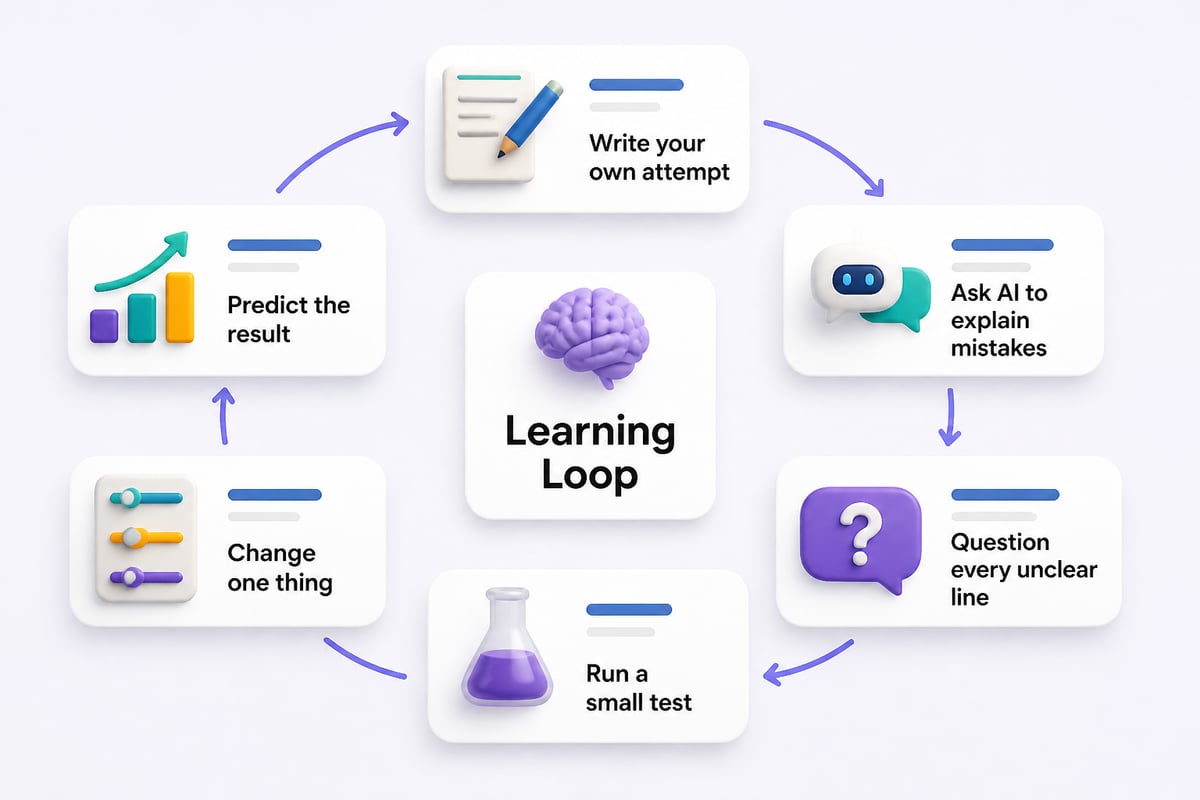
Here is a workflow that keeps you learning:
- Write your own first attempt, even if it is rough.
- Ask the assistant to review it and explain what you got wrong, not just to rewrite it.
- Ask for the explanation of any line you do not understand.
- Run the code on a small test case and compare against what you expect.
- Change one thing deliberately and predict the result before running it.
A prompt that works well for beginners: "Here is my Python function and the error I get. Explain the cause in plain language, show a minimal fix, and give me one similar exercise to practice." This turns the assistant into a tutor instead of a shortcut. For more guided examples of this approach, the tutorials on learning Python with AI walk through copy-and-paste prompts you can adapt.
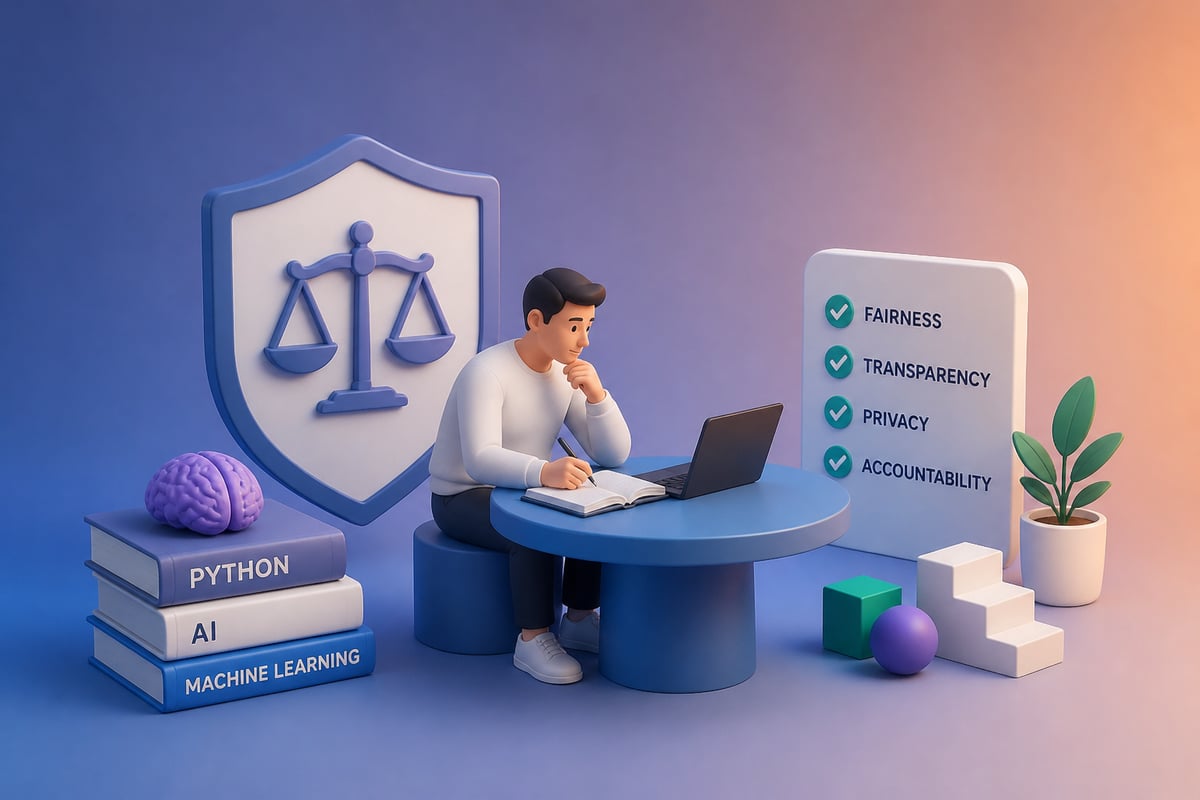
Responsible AI: A Topic Worth Learning Early
Understanding AI risk is part of being competent, and it is easy to add to your study plan from the start. Models can be biased, wrong, or misused, and employers increasingly expect practitioners to know the basics.
The U.S. National Institute of Standards and Technology describes its AI Risk Management Framework 1.0 as a voluntary framework meant to help organizations build trustworthiness considerations into AI products, services, and systems, as stated on NIST’s publication page. NIST also published a Generative AI Profile in 2024 as a companion to that framework. You can start with the AI Risk Management Framework overview to see how risk is organized.
You do not need to read the whole framework on day one. Instead, build these habits into your projects:
- Record where your training data came from and what it leaves out.
- Check model performance across different subgroups, not only overall.
- Write down what the model should never be used for.
Adding a short "limitations" section to each portfolio project shows maturity and costs you little extra time.
Which Projects Prove You Can Do the Work?
The best portfolio projects solve a specific, believable problem with real data and explain the decisions behind them. Tutorial clones, where you reproduce a famous dataset step by step, show you can follow instructions but not that you can think.
Projects that stand out include:
- Support ticket classifier. Sort customer messages into categories and measure how often it is wrong.
- Demand forecast. Predict weekly sales from historical data and compare against a naive baseline.
- Document summarizer pipeline. Use a language model through an API to condense reports, then measure quality against human summaries.
- Image quality checker. Train a small vision model to flag blurry or mislabeled photos.
For each one, include the baseline you beat, the metric you chose and why, and one failure case you found. Hiring managers read that last item closely, because it shows honesty.
If your goal is to apply AI in a business setting rather than become a full-time engineer, pair a smaller Python project with workflow automation. The guide on using Python for AI work covers practical patterns for this kind of applied learning.
Common Mistakes That Stall Learners
Most stalled learners fall into the same few traps, and all of them are avoidable.
- Tutorial hopping. Starting a new course every time progress feels slow. Commit to one path for at least eight weeks.
- Jumping to deep learning. Neural networks are exciting, but skipping scikit-learn leaves gaps in evaluation and data thinking.
- Copying without running. Reading code feels like learning; typing it, breaking it, and fixing it is learning.
- Ignoring data quality. A model is only as good as its inputs. Spend time on cleaning and checking.
- Studying in marathon sessions. Three focused hours a week across several days beats one exhausting weekend.
Continuous learning is a norm among developers. The Stack Overflow 2025 survey summary on learning habits looks at how developers pick up new techniques and languages, which is useful reassurance that ongoing study is expected rather than a sign you are behind.
Frequently Asked Questions
Can I take a Python AI ML course with no coding experience?
Yes, if the course starts with Python fundamentals. Look for a syllabus that teaches loops, functions, and data structures before touching machine learning, and expect the first month to feel slow. That investment pays off later.
How long does it take to finish?
Most beginners need a few months of steady part-time study to complete a foundation and one or two projects. Developers who already code often finish the same material considerably faster.
Do I need a powerful computer?
No. Free cloud notebooks handle most beginner and intermediate work, including small neural networks. You only need a modern browser and a stable connection.
Is a certificate worth it?
A certificate helps with structure and can support a resume, but projects carry more weight. Use a certificate to organize your study and a portfolio to prove your skill. If you want a guided option, the Python AI course overview outlines what to expect from a structured path.
Should I learn TensorFlow or PyTorch?
Pick one and learn it well. Both are widely used, and the core ideas transfer between them. Choose whichever your course or target job uses.
Is AI going to make learning Python pointless?
No. Assistants write code faster, but someone still has to specify the problem, check the output, and fix what breaks. Learners who understand Python catch errors that others miss.
Key Takeaways
- A strong Python AI ML course covers fundamentals, data libraries, scikit-learn, deep learning, and projects, in that order.
- Match the course to your current level, and check that it is recently updated and includes evaluation.
- Use AI assistants as tutors: attempt first, ask for explanations, and always verify results.
- Learn the basics of responsible AI early; it is quick to add and easy to demonstrate.
- Two or three honest, well-documented projects beat a long list of certificates.
Your next step is small: install Python, open a notebook, and load any CSV file into pandas to answer one question about it today. From there, Prompt Hero.Ai offers practical AI tutorials with step-by-step instructions, copy-and-paste prompts, and real examples for using tools like ChatGPT and Claude to automate tasks and solve business problems. If you want structured certification practice alongside your Python study, Mammoth Club is one option to consider.