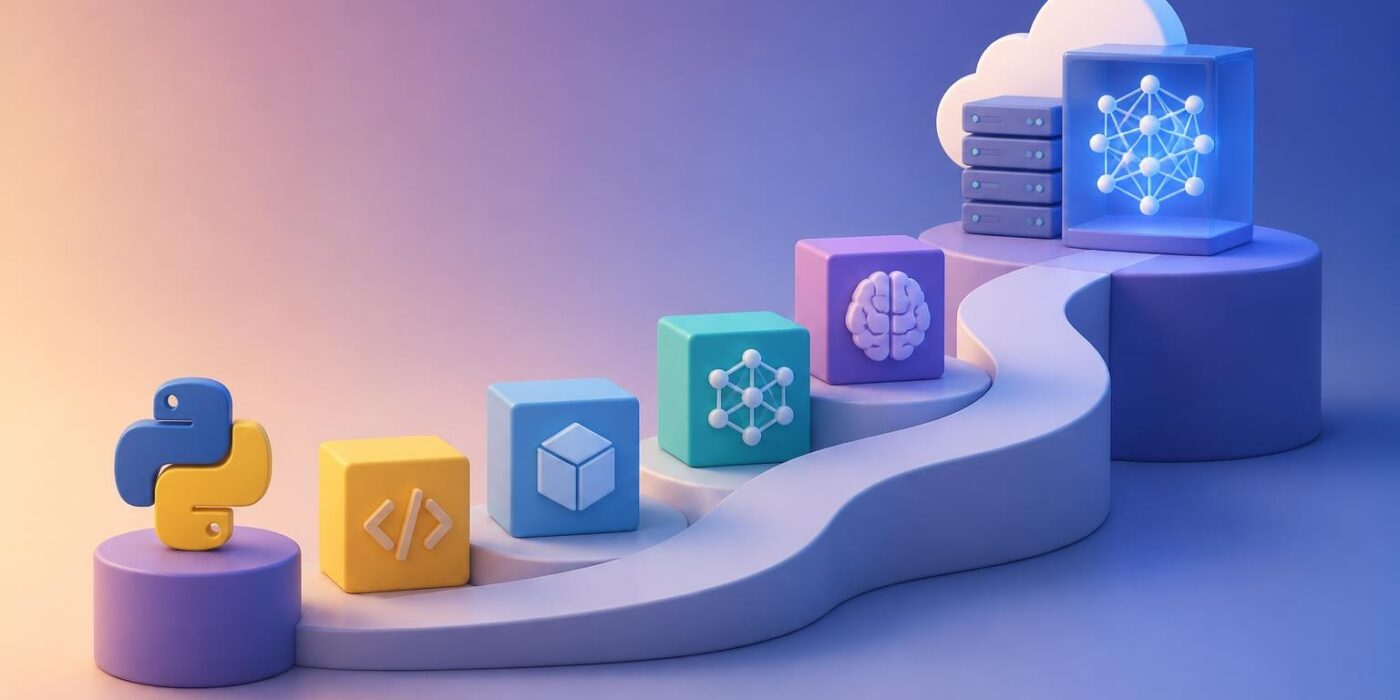
Learning artificial intelligence through Python has become one of the most valuable skills for professionals in 2026. A quality python ai course doesn't just teach you theory-it gives you the practical tools to build, deploy, and automate AI solutions that solve real business problems. Whether you're automating data analysis, creating chatbots, or building predictive models, Python remains the dominant language for AI development.
Why Python Dominates AI Development
Python's simplicity combined with powerful libraries makes it the first choice for AI practitioners. The language offers readable syntax that lets you focus on solving problems rather than wrestling with complex code structures.
The AI ecosystem built around Python is unmatched:
- TensorFlow and PyTorch for deep learning
- Scikit-learn for machine learning algorithms
- NumPy and Pandas for data manipulation
- OpenAI and Anthropic APIs for integrating large language models
- Hugging Face Transformers for natural language processing
Most importantly, Python lets you prototype quickly. You can test an AI model, evaluate results, and iterate in minutes rather than hours. This speed matters when you're learning or building production systems.

Choosing the Right Python AI Course
Not all courses are created equal. The best python ai course focuses on practical implementation rather than pure theory.
What to Look For
Hands-on projects should dominate the curriculum. You learn AI by building, not by watching lectures. Look for courses that include real datasets, debugging exercises, and deployment scenarios.
Modern frameworks matter in 2026. Courses teaching outdated libraries won't prepare you for current industry practices. Verify that the curriculum includes recent versions of key libraries and current best practices.
| Course Feature | Why It Matters | Red Flag |
|---|---|---|
| Real-world datasets | Teaches data cleaning and preprocessing | Only uses toy datasets |
| API integration | Shows how to connect AI models to applications | Focuses solely on local scripts |
| Version control | Essential for collaborative AI projects | Doesn't mention Git or GitHub |
| Model deployment | Bridges learning to production use | Ends at model training |
Harvard’s CS50 AI course exemplifies this approach by combining theoretical foundations with practical Python implementation across multiple AI domains.
Course Types and Learning Paths
Different learners need different approaches. A python ai course can range from beginner-friendly introductions to advanced specializations.
Beginner courses start with Python fundamentals before introducing AI concepts. These work well if you're new to programming entirely.
Intermediate courses assume basic Python knowledge and dive directly into machine learning algorithms, neural networks, and model training. IBM’s Python for Data Science and AI course follows this model effectively.
Advanced specializations focus on specific domains like computer vision, natural language processing, or reinforcement learning. These courses expect you to already understand core AI principles.
Essential Skills Covered in Quality AI Courses
A comprehensive python ai course should build skills in a logical sequence. You can't jump straight to building neural networks without understanding data structures and basic algorithms.
Foundational Python Programming
Every AI developer needs solid Python fundamentals:
- Data structures: Lists, dictionaries, sets, and tuples for organizing information
- Functions and classes: Writing reusable, modular code
- File handling: Reading and writing data from various sources
- Error handling: Managing exceptions in AI pipelines
These basics become critical when you're debugging why your model isn't training correctly or why your data pipeline keeps failing.
Data Manipulation and Preprocessing
Raw data is messy. Learning to clean and prepare data takes up significant time in any AI project.
import pandas as pd
import numpy as np

# Load and clean a dataset for AI model training
df = pd.read_csv('customer_data.csv')

# Handle missing values
df['age'].fillna(df['age'].median(), inplace=True)

# Create features from raw data
df['customer_lifetime_value'] = df['total_purchases'] * df['avg_purchase_value']

# Normalize numerical features for model training
from sklearn.preprocessing import StandardScaler
scaler = StandardScaler()
df[['age', 'income']] = scaler.fit_transform(df[['age', 'income']])
This code demonstrates practical preprocessing steps you'll use in nearly every AI project. The scikit-learn library provides these essential tools that any python ai course should cover thoroughly.
Machine Learning Fundamentals
Understanding algorithms matters more than memorizing formulas. Quality courses teach you when to use different approaches:
- Linear regression for predicting continuous values
- Classification algorithms for categorizing data
- Clustering for finding patterns in unlabeled data
- Decision trees and random forests for interpretable models
- Neural networks for complex pattern recognition
Each algorithm solves specific problems. Learning to match the right tool to your use case separates effective AI developers from those who struggle.

Building Your First AI Model
Theory means nothing without implementation. Here's a practical example of building a customer churn prediction model-a common business application.
Step 1: Define the Problem
You need to predict which customers will cancel their subscription next month. This is a binary classification problem: churn or not churn.
Step 2: Prepare Your Data
from sklearn.model_selection import train_test_split
from sklearn.ensemble import RandomForestClassifier
from sklearn.metrics import accuracy_score, precision_score, recall_score

# Load preprocessed customer data
X = df[['months_subscribed', 'support_tickets', 'login_frequency', 'feature_usage']]
y = df['churned']

# Split into training and testing sets
X_train, X_test, y_train, y_test = train_test_split(X, y, test_size=0.2, random_state=42)
Step 3: Train and Evaluate
# Initialize and train the model
model = RandomForestClassifier(n_estimators=100, random_state=42)
model.fit(X_train, y_train)

# Make predictions
predictions = model.predict(X_test)

# Evaluate performance
accuracy = accuracy_score(y_test, predictions)
precision = precision_score(y_test, predictions)
recall = recall_score(y_test, predictions)

print(f"Accuracy: {accuracy:.2%}")
print(f"Precision: {precision:.2%}")
print(f"Recall: {recall:.2%}")
Expected Output
Accuracy: 87.50%
Precision: 82.30%
Recall: 78.90%
This model correctly identifies churning customers 87.5% of the time. More importantly, you now have a working template you can adapt to other classification problems.
Advanced Topics Worth Learning
Once you master the basics, a python ai course should introduce more sophisticated concepts that mirror real-world AI development.
Deep Learning with Neural Networks
Neural networks power modern AI breakthroughs. Understanding architecture, layers, and training processes opens doors to computer vision and natural language processing.
Key deep learning concepts include:
- Convolutional neural networks for image processing
- Recurrent neural networks for sequential data
- Transformers for language understanding
- Transfer learning to leverage pre-trained models
- Fine-tuning models for specific tasks
Fast.ai’s approach emphasizes practical deep learning implementation, making these advanced topics accessible to intermediate developers.
Working with Large Language Models
In 2026, integrating AI APIs has become as important as building models from scratch. Professional AI developers know when to train custom models versus when to use existing AI services.
import openai

# Use GPT-4 for customer support automation
def generate_support_response(customer_query, customer_history):
    prompt = f"""You are a customer support specialist.

Customer history: {customer_history}
Current question: {customer_query}

Provide a helpful, professional response that addresses their specific situation."""

    response = openai.ChatCompletion.create(
        model="gpt-4",
        messages=[{"role": "user", "content": prompt}]
    )

    return response.choices[0].message.content

# Example usage
query = "Why was I charged twice this month?"
history = "Premium subscriber since 2024, no previous billing issues"
answer = generate_support_response(query, history)
print(answer)
This integration pattern appears throughout modern AI applications. Learning to prompt engineer and chain AI calls together creates powerful automation workflows.
If you're serious about building professional AI skills, structured learning paths make a significant difference. Mammoth Club offers comprehensive AI certification and training with over 3,000 courses covering everything from Python fundamentals to advanced machine learning, helping you build job-ready skills systematically.
Model Deployment and Production
Building a model that works on your laptop differs dramatically from deploying one that serves millions of users. Professional courses cover:
- API development for model serving
- Containerization with Docker
- Scaling with cloud platforms
- Monitoring model performance in production
- Updating models without downtime
These skills transform you from a hobbyist into a professional AI developer.
Practical Projects to Build Your Portfolio
The best python ai course includes portfolio-worthy projects that demonstrate real capabilities to potential employers or clients.
Recommended Project Types
| Project Type | Skills Demonstrated | Business Value |
|---|---|---|
| Sentiment analyzer | NLP, API integration, data visualization | Customer feedback automation |
| Recommendation engine | Collaborative filtering, data processing | Personalization systems |
| Fraud detection | Anomaly detection, imbalanced datasets | Risk management |
| Chatbot assistant | LLM integration, conversation design | Customer service automation |
| Forecasting model | Time series analysis, statistical modeling | Business planning |
Each project should include a GitHub repository with clean code, documentation, and examples of the model in action. This portfolio proves your skills more effectively than any certificate.
Example: Building a Content Classifier
from sklearn.feature_extraction.text import TfidfVectorizer
from sklearn.naive_bayes import MultinomialNB
from sklearn.pipeline import Pipeline

# Create a text classification pipeline
classifier = Pipeline([
    ('vectorizer', TfidfVectorizer(max_features=5000)),
    ('classifier', MultinomialNB())
])

# Training data: blog posts labeled by category
training_texts = [
    "Python tutorial for machine learning beginners",
    "Best practices for neural network optimization",
    "JavaScript framework comparison 2026",
    # ... more examples
]

training_labels = ["AI", "AI", "Web Development"]

# Train the model
classifier.fit(training_texts, training_labels)

# Classify new content
new_post = "How to build a chatbot using transformers"
prediction = classifier.predict([new_post])
print(f"Category: {prediction[0]}")
This classifier could automatically categorize hundreds of articles, saving hours of manual work. It's a simple but practical demonstration of AI solving a real business problem.
Common Challenges and How to Overcome Them
Every learner faces obstacles in a python ai course. Recognizing these patterns helps you push through difficult moments.
Mathematical Foundations
Many students panic when they encounter linear algebra, calculus, or statistics. You don't need a PhD in mathematics to build effective AI models.
Start with intuition over equations. Understand what an algorithm does before diving into the mathematical proof. Most Python libraries handle the complex calculations-you need to understand when and why to use them.
Focus on practical application. Research shows that AI-generated code quality continues improving, but understanding the underlying concepts helps you debug and optimize effectively.
Debugging AI Models
Unlike traditional software, AI models can fail silently. They produce results even when something's wrong-just bad results.
Common debugging strategies include:
- Checking data preprocessing steps for errors
- Validating input shapes and data types
- Monitoring loss curves during training
- Testing on small datasets first
- Comparing results to baseline models
Learning systematic debugging separates effective AI developers from those who give up when models underperform.
Staying Current with Rapid Changes
AI evolves quickly. A python ai course from 2024 might already feel outdated in 2026. Build habits that keep your skills relevant:
- Follow key researchers and practitioners on social media
- Experiment with new libraries and frameworks
- Read research papers (abstracts at minimum)
- Join AI communities and forums
- Build small projects with emerging tools
This continuous learning mindset matters more than any single course completion.
Bridging Learning to Career Application
Taking a python ai course should lead to tangible career outcomes. The transition from learning to earning requires strategic thinking.
Building Professional Experience
Contribute to open-source projects. This demonstrates your ability to work with real codebases and collaborate with other developers. GitHub activity proves practical skills.
Solve business problems. Identify inefficiencies in your current role or business and build AI solutions. A working prototype that saves time or money beats theoretical knowledge.
Document your learning journey. Write tutorials explaining concepts you've mastered. Teaching others reinforces your understanding and builds your professional brand. Platforms like Prompt Hero.Ai provide examples of how practical tutorials help others while establishing expertise.
Certification vs. Portfolio
Certificates prove you completed coursework. Portfolios prove you can solve problems. Employers and clients value the latter significantly more.
Your portfolio should showcase:
- Clean, documented code in public repositories
- Working demos people can test
- Clear explanations of your approach and results
- Business impact where applicable
- Variety across different AI techniques
This combination demonstrates both technical skills and professional judgment.
Resources for Continued Learning
A single python ai course won't make you an expert. Plan for ongoing education across multiple sources.
Academic Resources
University courses provide rigorous foundations. Python education research continues advancing teaching methods, making these resources increasingly effective for self-directed learners.
Recent AI tutor implementations in programming courses show how AI itself can enhance learning, creating personalized feedback loops.
Practice Platforms
Regular coding practice builds muscle memory and problem-solving speed:
- Kaggle competitions for real datasets and peer comparison
- LeetCode AI problems for algorithmic thinking
- Personal projects addressing your specific interests
- Freelance work on platforms like Upwork
Each approach develops different skills. Mixing multiple practice methods accelerates improvement.
Community Learning
Join communities where you can ask questions, share projects, and learn from others:
- Python AI Discord servers
- Reddit communities like r/MachineLearning
- Local meetup groups
- Online study groups
- LinkedIn AI professional groups
Learning accelerates when you engage with others facing similar challenges.
Mastering AI development through Python opens remarkable opportunities in 2026, from automating routine business tasks to building sophisticated machine learning systems. The key is choosing practical, hands-on learning resources that focus on real-world application rather than abstract theory. Ready to put AI to work solving actual business problems? Prompt Hero.Ai offers step-by-step tutorials and ready-to-use prompts that help you automate tasks, boost productivity, and implement AI solutions immediately-no theoretical fluff, just practical tools you can use today.