
Learning to program artificial intelligence doesn't require a PhD in computer science or years of theoretical study. Today's AI programming landscape is more accessible than ever, with practical tools and frameworks that let you build real applications quickly. Whether you're automating business tasks, building intelligent chatbots, or analyzing data patterns, you can learn artificial intelligence programming through hands-on practice with modern tools and clear objectives. This guide walks you through the practical steps, essential tools, and real-world applications that will get you coding AI solutions in weeks, not years.
Understanding What AI Programming Actually Means
AI programming is the process of writing code that enables machines to perform tasks that typically require human intelligence. This includes pattern recognition, decision-making, language processing, and prediction.
Unlike traditional programming where you write explicit instructions for every scenario, AI programming involves creating systems that learn from data and improve over time. You're essentially teaching computers to identify patterns and make decisions based on examples rather than hardcoded rules.
The three main approaches to AI programming include:
- Machine learning: Systems that learn from data without explicit programming
- Deep learning: Neural networks that process information in layers to recognize complex patterns
- Natural language processing: Teaching computers to understand and generate human language
When you learn artificial intelligence programming, you're really learning how to prepare data, select appropriate algorithms, train models, and deploy solutions that solve specific problems. The focus is practical application, not abstract theory.
Choosing Your Primary Programming Language
Python dominates the AI programming landscape for good reason. It offers simplicity, extensive libraries, and massive community support.
Why Python Wins for AI Development
Python's syntax reads almost like plain English, making it easier to focus on AI concepts rather than wrestling with complex code structure. The language comes with powerful libraries specifically designed for AI work.
Essential Python libraries for AI programming:
- NumPy: Numerical computing and array operations
- Pandas: Data manipulation and analysis
- Scikit-learn: Machine learning algorithms and tools
- TensorFlow: Deep learning and neural networks
- PyTorch: Research-focused deep learning framework
According to Microsoft’s AI learning resources, Python remains the primary language for both beginners and professionals working with AI systems. The ecosystem is mature, well-documented, and constantly evolving.

Alternative Languages Worth Considering
While Python should be your starting point, other languages serve specific niches. Java offers excellent performance for production systems at scale. R excels at statistical analysis and data visualization. C++ provides maximum speed for computationally intensive tasks.
For most business applications and learning purposes, stick with Python. You can always add other languages later as specific needs arise.
Setting Up Your AI Development Environment
Creating a proper development environment prevents countless headaches and lets you focus on learning rather than troubleshooting installation issues.
Step-by-step environment setup:
- Install Python 3.8 or newer from the official Python website
- Set up a virtual environment to isolate your AI projects
- Install Jupyter Notebook for interactive coding and testing
- Add essential libraries using pip (Python's package manager)
- Configure an IDE like Visual Studio Code or PyCharm
Here's the basic command sequence to create your first AI programming environment:
python -m venv ai_env
source ai_env/bin/activate  # On Windows: ai_envScriptsactivate
pip install numpy pandas scikit-learn jupyter matplotlib
jupyter notebook
This creates an isolated workspace where you can experiment without affecting your system's global Python installation. Each project should have its own virtual environment to manage dependencies cleanly.
AWS offers comprehensive AI learning paths that include detailed setup instructions for cloud-based development environments, which become useful as your projects scale.
Learning AI Programming Through Practical Projects
Theory without practice leads nowhere in AI programming. The fastest path to competence is building actual projects that solve real problems.
Project 1: Text Classification System
Start with a simple text classifier that categorizes customer feedback as positive, negative, or neutral. This teaches you data preprocessing, feature extraction, and model training.
from sklearn.feature_extraction.text import CountVectorizer
from sklearn.naive_bayes import MultinomialNB

# Training data
feedback = [
    "Great product, very satisfied",
    "Terrible experience, would not recommend",
    "Average quality, nothing special"
]
labels = ["positive", "negative", "neutral"]

# Create and train model
vectorizer = CountVectorizer()
X = vectorizer.fit_transform(feedback)
classifier = MultinomialNB()
classifier.fit(X, labels)

# Classify new feedback
new_feedback = vectorizer.transform(["Absolutely love this item"])
prediction = classifier.predict(new_feedback)
print(prediction)  # Output: ['positive']
This example demonstrates the complete workflow: preparing text data, converting it to numerical features, training a classifier, and making predictions. The code is production-ready for small-scale applications.
Project 2: Sales Prediction Model
Build a linear regression model that predicts monthly sales based on historical data. This introduces you to numerical prediction and data visualization.
| Feature | Purpose | Example Value |
|---|---|---|
| Month | Time period identifier | 1-12 |
| Marketing Spend | Input variable | $5,000 |
| Previous Sales | Input variable | 150 units |
| Predicted Sales | Output | 175 units |
Understanding how to learn artificial intelligence programming means recognizing patterns in business data and building models that generate actionable predictions.
Project 3: Recommendation Engine
Create a simple recommendation system that suggests products based on customer purchase history. This teaches you about collaborative filtering and similarity calculations.
The progression from text classification to prediction to recommendations builds your understanding systematically. Each project reinforces previous concepts while introducing new techniques.

Mastering Key AI Programming Concepts
Certain concepts appear repeatedly across AI projects. Understanding these fundamentals accelerates your entire learning process.
Data Preprocessing and Feature Engineering
Raw data rarely arrives in a format suitable for AI models. You'll spend significant time cleaning, transforming, and preparing data before any model training begins.
Common preprocessing tasks:
- Handling missing values (deletion, imputation, or prediction)
- Normalizing numerical ranges for consistent scaling
- Encoding categorical variables as numbers
- Splitting data into training and testing sets
- Removing outliers that skew model performance
Feature engineering involves creating new data attributes that better represent the patterns you're trying to capture. For example, converting transaction timestamps into "day of week" or "time of day" often reveals patterns invisible in raw timestamps.
Model Training and Evaluation
Training an AI model means adjusting its internal parameters until it accurately captures patterns in your data. Evaluation measures how well the trained model performs on data it hasn't seen before.
The IEEE Academy on Artificial Intelligence provides structured learning paths that cover these foundational machine learning concepts in depth.
Key evaluation metrics:
- Accuracy: Percentage of correct predictions
- Precision: How many positive predictions were actually correct
- Recall: How many actual positives were identified
- F1 Score: Balanced measure combining precision and recall
Never trust a model's performance on training data alone. Always evaluate on separate test data to ensure your model generalizes rather than just memorizing examples.
Leveraging AI Tools and Frameworks
Modern AI programming relies heavily on pre-built frameworks that handle complex mathematical operations behind simple interfaces.
Scikit-learn for Traditional Machine Learning
Scikit-learn provides clean, consistent APIs for classification, regression, clustering, and dimensionality reduction. It's perfect for business applications that don't require deep neural networks.
The library's documentation includes working examples for every algorithm, making it an excellent learning resource. When you learn artificial intelligence programming with scikit-learn, you're learning industry-standard approaches that transfer directly to professional work.
TensorFlow and PyTorch for Deep Learning
Deep learning frameworks handle neural networks with many layers. TensorFlow offers production-ready deployment tools, while PyTorch provides more flexibility for research and experimentation.
Both frameworks use similar conceptual models: you define network architecture, feed in training data, and optimize parameters through backpropagation. The syntax differs, but the underlying principles remain constant.
import tensorflow as tf

# Simple neural network for classification
model = tf.keras.Sequential([
    tf.keras.layers.Dense(64, activation='relu', input_shape=(10,)),
    tf.keras.layers.Dense(32, activation='relu'),
    tf.keras.layers.Dense(3, activation='softmax')
])

model.compile(
    optimizer='adam',
    loss='sparse_categorical_crossentropy',
    metrics=['accuracy']
)
This code creates a three-layer neural network ready for training on data with 10 input features and 3 output categories. The architecture works for problems from image classification to customer segmentation.
Applying AI Programming to Business Problems
The real value in learning AI programming comes from solving actual business challenges, not completing academic exercises.
Automating Customer Support
Build chatbots that handle common customer inquiries, freeing human agents for complex issues. Natural language processing models can classify questions, extract intent, and trigger appropriate responses.
Modern approaches often combine traditional rule-based systems with machine learning for robustness. The ML component handles pattern recognition while rules ensure consistent handling of known scenarios.
Improving Marketing Campaign Performance
AI models predict which customers are most likely to respond to specific campaigns. This targeting reduces wasted spend and improves conversion rates significantly.
You can also use AI to optimize email subject lines, generate personalized product recommendations, and predict customer lifetime value for better resource allocation.
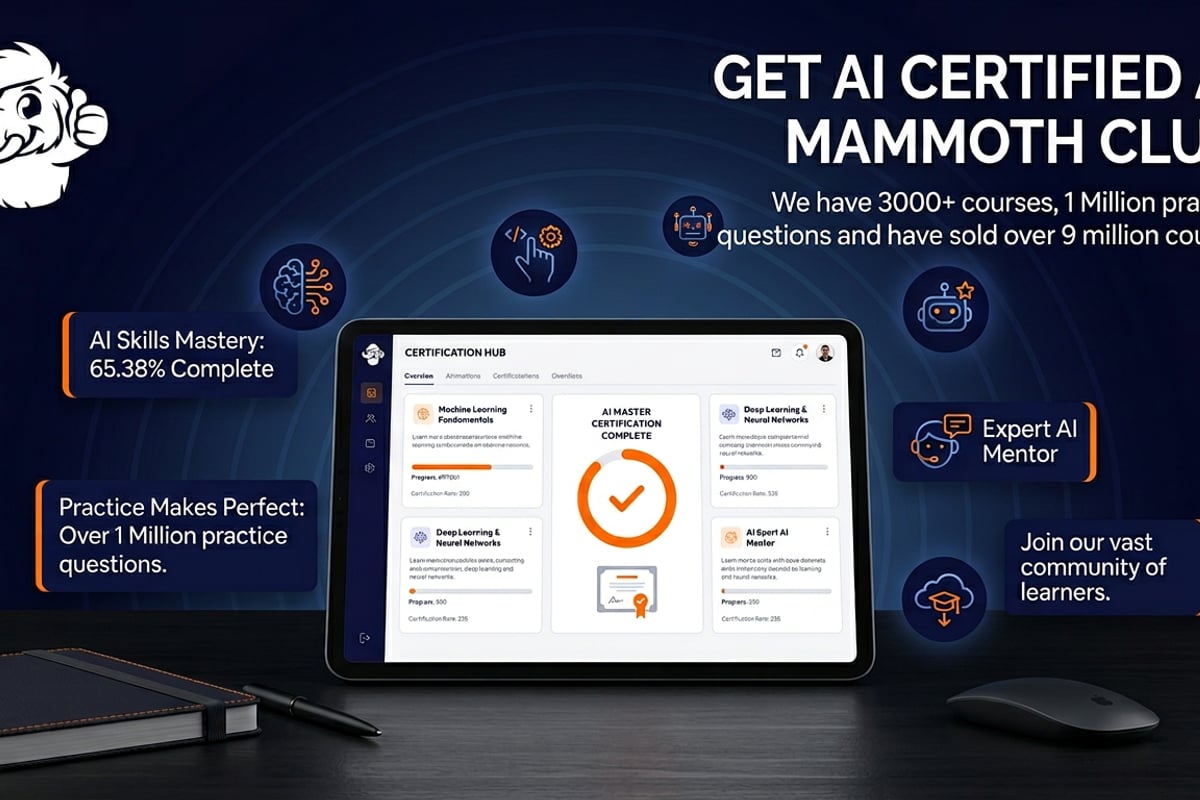
If you're serious about building professional-level AI skills that translate directly to career advancement, Mammoth Club’s AI certification program offers access to over 3,000 courses covering everything from ChatGPT automation to advanced machine learning techniques, with hands-on projects designed for business contexts.
Streamlining Operational Forecasting
Predict inventory needs, staffing requirements, and maintenance schedules using historical patterns. Time series models excel at finding seasonal trends and cyclical patterns in business data.
Business applications of forecasting models:
- Inventory optimization to reduce holding costs
- Dynamic pricing based on demand predictions
- Preventive maintenance scheduling
- Cash flow and revenue projections
Each application follows the same pattern: collect historical data, identify relevant features, train a model, validate accuracy, and deploy for ongoing predictions.
Developing Your Learning Strategy
Random tutorials won't build systematic AI programming skills. You need a structured approach that builds knowledge progressively.
Create a Learning Curriculum
Map out topics in logical order, starting with Python fundamentals and basic statistics before moving to machine learning algorithms.
Recommended learning sequence:
- Weeks 1-2: Python programming basics and data structures
- Weeks 3-4: NumPy and Pandas for data manipulation
- Weeks 5-6: Basic statistics and probability concepts
- Weeks 7-8: Supervised learning algorithms (regression, classification)
- Weeks 9-10: Unsupervised learning (clustering, dimensionality reduction)
- Weeks 11-12: Introduction to neural networks and deep learning
This 12-week timeline assumes 10-15 hours of weekly study. Adjust based on your available time and prior programming experience.

Practice Daily with Small Coding Challenges
Consistency beats intensity in skill development. Thirty minutes of daily practice outperforms sporadic marathon sessions.
Resources like Coursera’s AI learning guides emphasize the importance of regular, hands-on practice with real datasets rather than passive video watching.
Use platforms that offer coding challenges specific to AI and machine learning. Each challenge reinforces concepts while exposing you to diverse problem types.
Build a Portfolio of Projects
Document every project you complete, even simple ones. A portfolio demonstrates practical skills to potential employers or clients far better than certifications alone.
Include the problem statement, your approach, code samples, and results for each project. Host everything on GitHub to show your progression over time.
Common Pitfalls and How to Avoid Them
Every beginner makes similar mistakes when learning AI programming. Recognizing these patterns helps you sidestep months of frustration.
Overfitting Your Models
Overfitting occurs when your model memorizes training data instead of learning generalizable patterns. The model performs perfectly on training data but fails on new examples.
Solutions to prevent overfitting:
- Use larger, more diverse training datasets
- Implement cross-validation during training
- Apply regularization techniques that penalize complexity
- Stop training before the model over-optimizes on training data
Always evaluate model performance on data it has never seen. If training accuracy is 98% but test accuracy is 65%, you've overfit.
Ignoring Data Quality
"Garbage in, garbage out" applies perfectly to AI programming. Poor quality training data produces unreliable models regardless of algorithm sophistication.
Invest time in data cleaning, validation, and augmentation. This work isn't glamorous, but it determines whether your models succeed or fail in production.
Chasing Complexity Too Early
Beginners often jump to deep learning and neural networks before mastering simpler approaches. Complex models require more data, longer training times, and deeper understanding to debug.
Start with linear regression and decision trees. Only add complexity when simpler methods prove insufficient for your specific problem.
Resources for Continued Learning
Learning AI programming is an ongoing journey, not a destination. The field evolves constantly, requiring continuous skill updates.
Structured Online Courses
Formal courses provide systematic coverage of topics with structured assignments. Microsoft’s AI engineer training path offers comprehensive, vendor-neutral education on AI development fundamentals.
Look for courses that emphasize hands-on projects over theoretical lectures. The best learning happens when you're writing code and solving problems.
Books and Academic Resources
The textbook "Artificial Intelligence: Foundations of Computational Agents" by Poole and Mackworth provides deep theoretical grounding in AI concepts. While more academic than tutorial-focused, it builds understanding of why algorithms work, not just how to implement them.
For practical programming guidance, resources like "Artificial Intelligence Programming with Python" offer hands-on roadmaps specifically designed for developers.
Community and Peer Learning
Join AI programming communities on platforms like Reddit, Discord, and specialized forums. Explaining concepts to others reinforces your own understanding while building professional networks.
Contribute to open-source AI projects on GitHub. Reading production code teaches you patterns and practices that tutorials rarely cover.
Advancing to Specialized AI Domains
Once you've mastered fundamental AI programming skills, specialized domains offer opportunities for deeper expertise and higher value work.
Computer Vision Applications
Computer vision involves teaching machines to understand and process visual information. Applications range from facial recognition to medical image analysis to quality control in manufacturing.
Libraries like OpenCV and specialized frameworks built on TensorFlow and PyTorch handle the complex mathematics behind image processing. You focus on preparing image datasets and configuring models for specific recognition tasks.
Natural Language Processing Systems
NLP enables computers to understand, interpret, and generate human language. This powers chatbots, translation services, sentiment analysis, and document summarization.
Modern NLP relies heavily on transformer models like BERT and GPT, which you can access through libraries like Hugging Face Transformers. Fine-tuning pre-trained models for specific tasks has become more accessible than training from scratch.
Understanding AI prompt engineering becomes particularly valuable as you work with large language models, enabling you to extract better results through carefully crafted instructions.
Reinforcement Learning for Decision Systems
Reinforcement learning trains agents to make sequential decisions by rewarding desired behaviors. This approach powers game-playing AI, robotics, and autonomous systems.
The learning curve is steeper than supervised learning, but the applications are fascinating. Start with simple environments like grid worlds before tackling complex simulations.
Measuring Your Progress
Tracking your advancement helps maintain motivation and identifies areas needing additional focus.
Set Concrete Milestones
Define specific, measurable goals for your learning journey. "Learn AI" is vague; "Build a customer churn prediction model that achieves 85% accuracy" is concrete and testable.
Example milestone progression:
| Month | Milestone | Validation |
|---|---|---|
| 1 | Complete basic Python programming | Build 3 data processing scripts |
| 2 | Master NumPy and Pandas | Analyze real dataset with 1M+ rows |
| 3 | Implement first ML classifier | Deploy working text classification model |
| 4 | Build regression model | Create accurate sales forecasting tool |
| 6 | Complete first neural network | Train image classifier with 90%+ accuracy |
Each milestone should include both learning and practical application. Knowledge without implementation isn't mastery.
Contribute to Real Projects
The ultimate validation comes from deploying AI solutions that solve actual problems. Find opportunities within your current job, take freelance projects, or contribute to open-source initiatives.
Real projects force you to handle messy data, unclear requirements, and deployment constraints that tutorials never mention. These challenges accelerate learning dramatically.
Staying Current in a Rapidly Evolving Field
AI programming advances faster than most technology domains. What's cutting-edge today may be obsolete in two years.
Follow Key Research and Industry Developments
Subscribe to AI research newsletters and follow leading practitioners on social media. Resources from organizations like NVIDIA’s AI training platform keep you updated on the latest techniques and tools.
You don't need to implement every new paper, but understanding current directions helps you anticipate where the field is heading.
Experiment with Emerging Tools
When new frameworks or approaches emerge, invest a few hours exploring them through small experiments. Early familiarity creates opportunities when these tools become mainstream.
Research on teaching computers to write code using AI demonstrates how rapidly the field advances. Today's experimental techniques become tomorrow's production tools.
Balance Fundamentals with Innovation
While staying current matters, don't abandon fundamentals for every new trend. Strong grounding in core concepts-statistics, linear algebra, algorithm design-enables you to quickly adapt to new approaches.
The specific frameworks and libraries you use will change. The underlying mathematical and conceptual foundations remain relatively stable.
Learning artificial intelligence programming opens doors to automating complex tasks, building intelligent systems, and solving problems that seemed impossible just years ago. The journey requires consistent practice, hands-on projects, and a focus on practical applications over theoretical perfection. Whether you're enhancing your current career or transitioning into AI development, Prompt Hero.Ai provides step-by-step tutorials and copy-paste prompts that help you apply AI tools like ChatGPT and Claude to real business challenges, turning learning into immediate productivity gains.