If you want to know about AI engineering, start here: it is the discipline of designing, building, evaluating, and operating software systems that use pre-trained AI models, such as large language models, to solve real problems reliably. An AI engineer rarely trains a model from scratch. Instead, they combine existing models with data, prompts, tools, and safeguards so that the output is accurate, repeatable, and safe enough for business use.
That definition separates AI engineering from two neighboring fields. Machine learning research builds new models. Data science analyzes data to find patterns. AI engineering takes the models that already exist and turns them into products and workflows that people can depend on.
What Is AI Engineering, Exactly?
AI engineering is a software engineering practice focused on turning AI models into dependable systems, with the same attention to testing, security, and maintenance that any production software requires.
The word "engineering" matters. A prompt that works once in a chat window is a demo. A prompt that works on ten thousand customer emails, handles odd inputs, costs a known amount, and gets reviewed when it fails is an engineered system. The gap between those two is where most of the discipline lives.
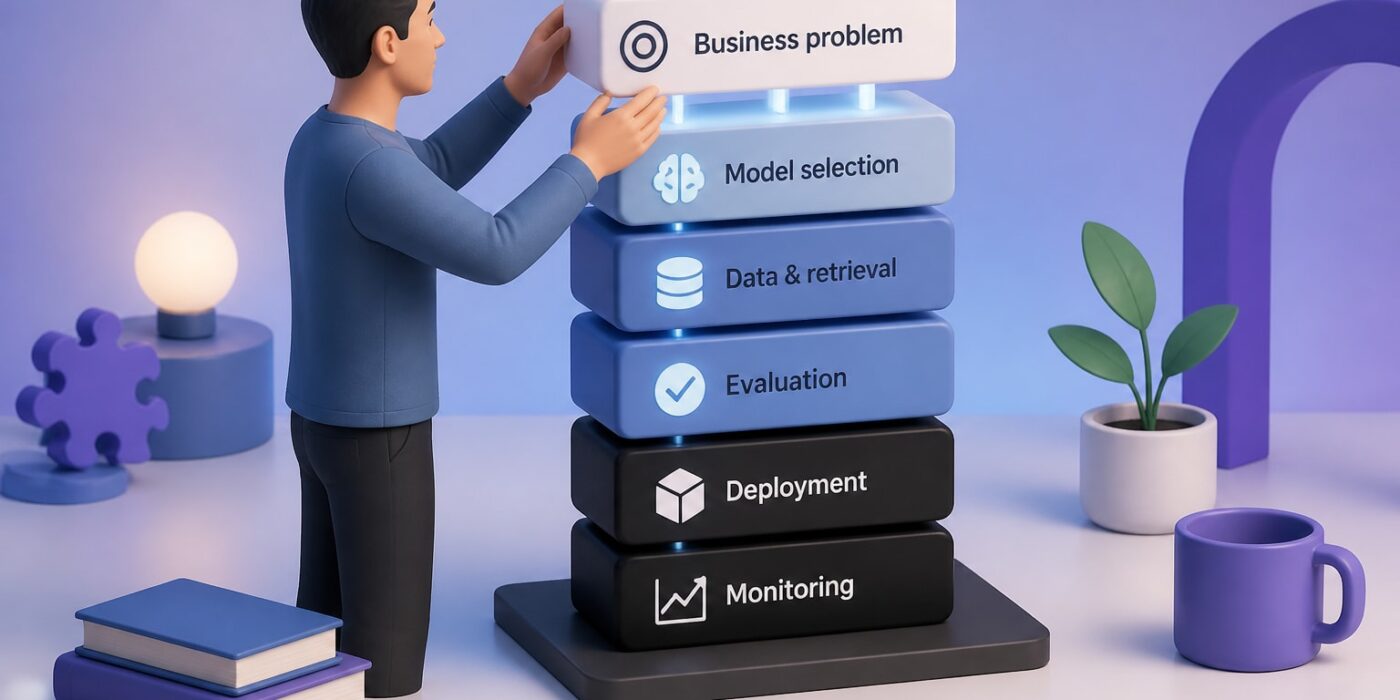
AI engineering usually involves five layers of work:
- Problem framing: deciding whether AI is the right tool and what "good output" means.
- Model selection: choosing among models based on quality, speed, cost, and data-handling terms.
- Context and data: supplying the model with the right information, often through retrieval.
- Evaluation: measuring output quality against a defined standard.
- Operations: deploying, monitoring, securing, and improving the system over time.
A professional who writes structured prompts for ChatGPT or Claude is already practicing the first layers of this. The more your AI use repeats across a team, the more the later layers matter.
How AI Engineering Differs From Related Roles
AI engineering sits between research and everyday tool use, and its closest neighbors are machine learning engineering, data science, and prompt engineering.
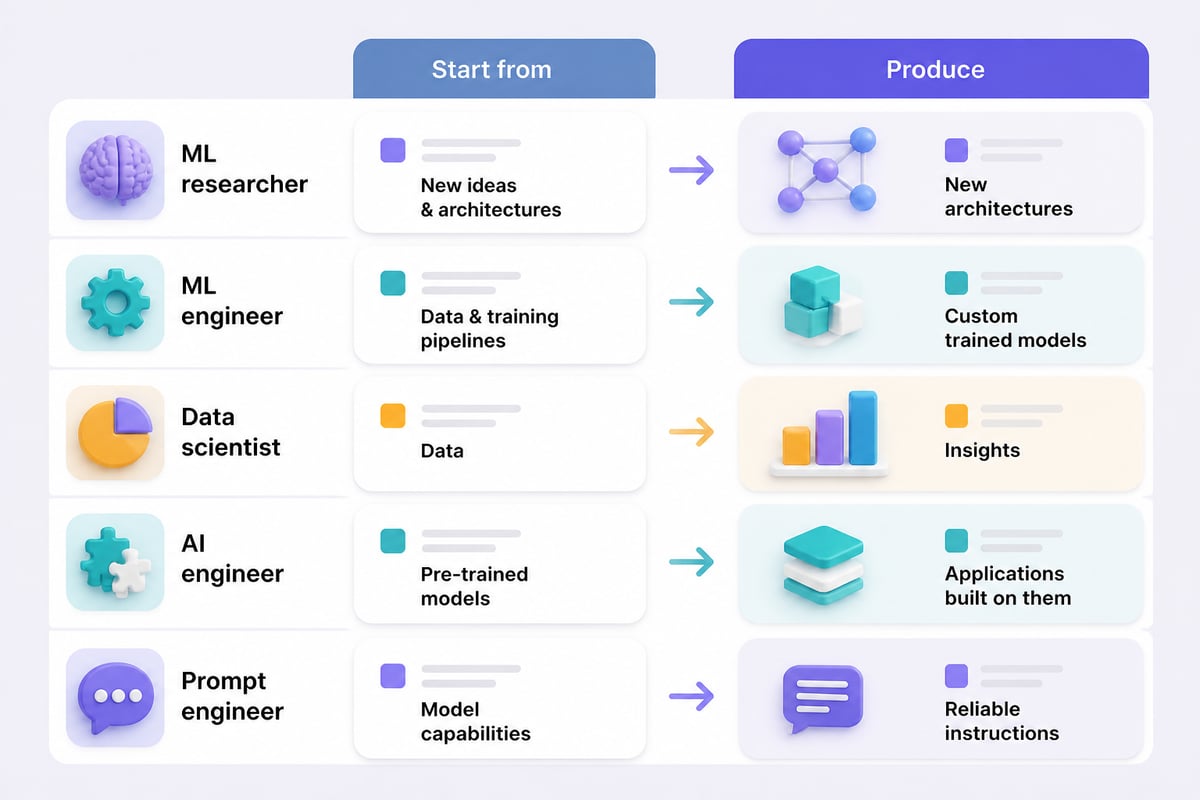
The distinctions come down to what each role produces and what it starts from.
| Role | Starts from | Typically produces |
|---|---|---|
| ML researcher | Open scientific questions | New model architectures and training methods |
| ML engineer | Training data | Trained and deployed custom models |
| Data scientist | Business data | Analyses, forecasts, and insights |
| AI engineer | Pre-trained models | Applications, agents, and workflows built on those models |
| Prompt engineer | A model and a task | Instructions that reliably produce good output |
Prompt engineering is a subset of AI engineering, not a separate profession for most teams. If you want the foundation, the guides on prompt engineering for ChatGPT and ChatGPT prompt engineering cover how instruction design shapes results. AI engineering adds the surrounding system: where the data comes from, how output is checked, and what happens when something goes wrong.
What Does an AI Engineer Actually Do?
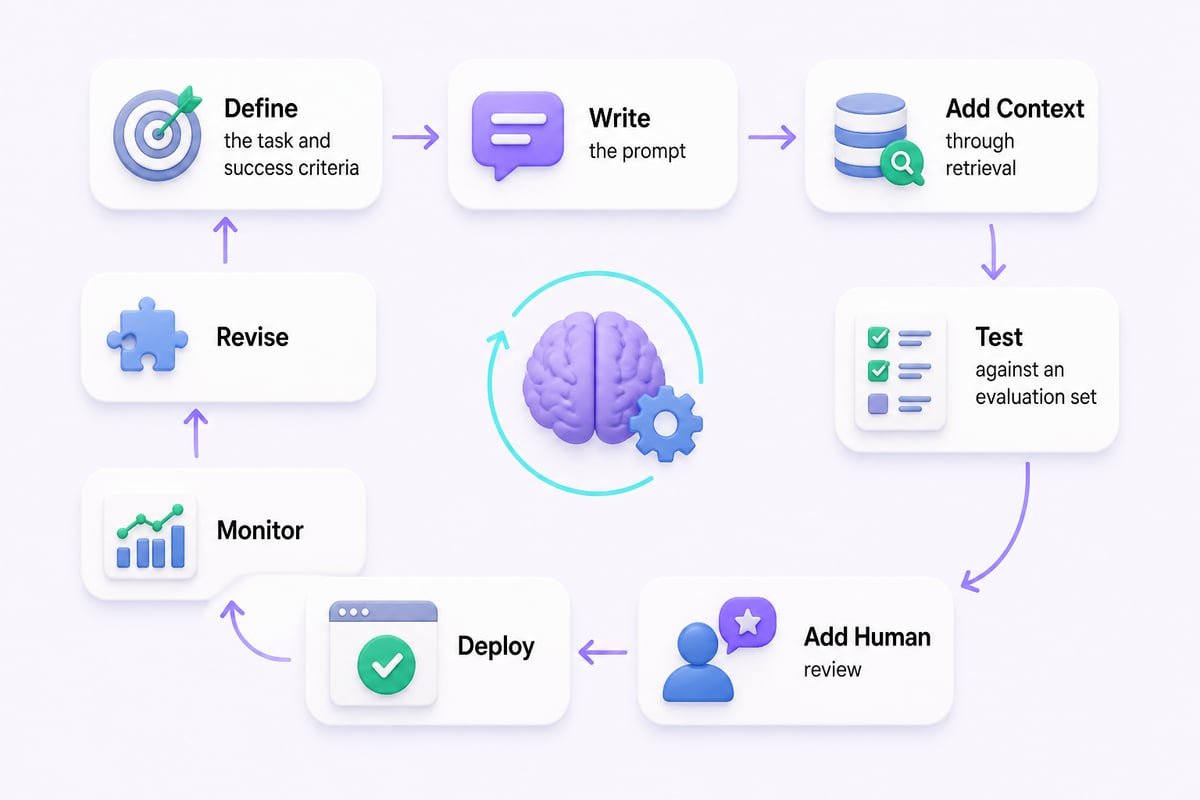
The work of an AI engineer is to build and maintain systems where AI models perform useful tasks inside a business process, which in practice means a repeating cycle of design, testing, and refinement.
A typical week might include several of these activities:
- Interviewing the people who do a task today to learn what a good result looks like.
- Writing and versioning prompts, then testing them against a set of real examples.
- Connecting a model to company documents so answers draw on current, approved information.
- Building a review step where a person approves anything high-stakes.
- Tracking cost, response time, and error rates after launch.
- Updating the system when a model version changes or when users find new failure cases.
A Concrete Example
Consider a finance team that wants AI to draft summaries of vendor contracts. A casual approach is pasting a contract into a chat tool and asking for a summary. An engineered approach looks different.
The team defines the fields that matter: renewal date, termination terms, liability caps, payment schedule. They write a prompt that asks for exactly those fields in a fixed format. They collect twenty past contracts with known correct answers and measure how often the model gets each field right. They add a rule that any contract where the model reports low confidence goes to a human reviewer. After launch, they spot-check a sample every month.
None of that requires training a model. All of it requires engineering judgment, and the result is a process the team can trust and defend.
How AI Engineering Works in Practice
AI engineering works by wrapping a general-purpose model in structure: clear instructions, relevant context, measurable quality checks, and operational controls.
Prompts and Context
The model only knows what it was trained on plus whatever you put in front of it. Good engineering means controlling that input. Common techniques include system instructions that set role and rules, examples that show the desired format, and retrieval, where the system searches your documents and hands the most relevant passages to the model before it answers. This last pattern is often called retrieval-augmented generation, or RAG.
Evaluation
Evaluation is the habit that most distinguishes engineers from casual users. Rather than judging output by feel, you build a small test set of realistic inputs with known good answers, then score each prompt or model change against it. When you edit a prompt, you rerun the set and see whether quality went up or down. Without this, every improvement is a guess, and fixes in one place quietly break another.
Agents and Tool Use
Increasingly, models do more than write text. They call tools: searching a database, filling a spreadsheet, drafting and sending an email. A system that plans and carries out multi-step work with tools is usually called an agent. Microsoft and LinkedIn's 2025 Work Trend Index reported that 81% of surveyed leaders expected AI agents to be moderately or extensively integrated into their company's AI strategy within 12 to 18 months. More agents means more need for people who can constrain what those agents are allowed to do.
Deployment and Monitoring
Once live, the system needs logging, cost tracking, and alerts. Models change, user behavior drifts, and a prompt that worked in March may degrade by autumn. Monitoring is how you notice.
Core Skills in AI Engineering
The core skills of AI engineering combine software fundamentals with a practical understanding of how language models behave, and most can be learned incrementally.
Technical skills
- Programming, usually Python, plus comfort with APIs and basic data handling.
- Prompt design: writing instructions, examples, and constraints that produce consistent output.
- Retrieval and data preparation: cleaning documents, splitting them sensibly, and indexing them for search.
- Evaluation design: building test sets and choosing metrics that reflect real quality.
- Deployment basics: version control, logging, access control, and cost management.
Non-technical skills
- Domain knowledge. Knowing what a correct contract summary, support reply, or sales forecast looks like is half the job.
- Communication. Engineers translate between people who do the work and the system that will assist them.
- Risk judgment. Knowing which tasks can run unattended and which need a human check.
Many professionals reach this skill set from the business side. If you already understand a process deeply, learning to specify it precisely for an AI model is a natural extension, and it is a good reason to start with structured practice. Programs like Mammoth Club's AI certification and training offer a library of courses and practice questions for building those job-ready habits at your own pace.

Why AI Engineering Matters for Business Teams
AI engineering matters because the distance between trying AI and relying on AI is large, and most organizations are still crossing it.
The same Microsoft and LinkedIn report, based on a survey of 31,000 professionals across 31 countries, found that leaders reported AI deployed organization-wide at many companies, while others remained in pilot mode. A pilot proves a tool can work. Engineering is what makes it work every day, for everyone, at an acceptable cost.
Hiring reflects this. In that survey, most leaders said they were considering hiring for AI-specific roles, with the share even higher among leaders at companies Microsoft calls Frontier Firms. You do not need a new job title to benefit, though. Anyone who owns a repeating workflow can apply engineering habits to it.
What Changes When You Think Like an Engineer
- You write down what "good" means before you prompt.
- You keep a library of tested prompts instead of retyping from memory.
- You decide in advance which outputs need human review.
- You record failures and feed them back into the next version.
- You treat a model update as something to test, not something to trust.
These habits are small, and they separate teams that get steady value from AI from teams that get occasional impressive results and frequent surprises.
Risk, Safety, and Governance
Risk management is a core part of AI engineering, because language models can produce confident errors, leak sensitive data, or be manipulated by hostile input.
Frameworks exist to structure this thinking. The U.S. National Institute of Standards and Technology maintains a voluntary AI Risk Management Framework intended to help organizations manage AI risks and build trustworthiness into AI systems. NIST also published a Generative AI Profile, a voluntary companion that helps organizations address trustworthiness in the design, development, use, and evaluation of generative AI. Additional material, including the framework playbook, is collected on NIST's AI RMF resources page.
For a business user, the practical translation looks like this:
- Data handling: know what information may and may not be pasted into an AI tool.
- Accuracy checks: verify figures, names, and citations before they reach a client.
- Prompt injection awareness: treat text from outside sources, such as emails or web pages, as untrusted when an AI system reads it.
- Accountability: name a person responsible for each AI-assisted process.

What Degree and Background Help Most?
A computer science or software engineering degree is the most direct path into AI engineering, but it is not the only one, and demonstrated projects often count for as much as credentials.
Degrees that map well include computer science, software engineering, data science, statistics, and applied mathematics. Mathematics matters less than many people assume for application-level work, though a working grasp of probability and statistics helps you interpret evaluation results.
Professionals from operations, finance, marketing, legal, and similar fields have a different advantage: they know the work. A person who has run a procurement process for ten years can specify an AI-assisted version better than a generalist who has never seen one. Certifications and structured courses can fill the technical gaps without a second degree.
How to Become an AI Software Engineer
To become an AI software engineer, build software fundamentals first, then add model-specific skills through projects that you can show to others.
A realistic path looks like this:
- Learn Python and basic software practices: version control, testing, and working with APIs.
- Learn how language models behave. Practice writing structured prompts and studying where outputs fail. Guides on engineering and AI and engineering in AI give useful framing for how the two fields overlap.
- Build one small system end to end, such as a document question-answering tool over your own files.
- Add evaluation. Create a test set, score your system, and improve it measurably.
- Deploy and monitor it, even if only for yourself or a small team.
- Document what you learned, including failures. A clear write-up of what broke and how you fixed it is strong evidence of skill.
For business professionals who do not plan to write production code, a lighter version applies: master prompt structure, build a personal prompt library, run small tests on your own recurring tasks, and learn the data and risk rules for your organization. The prompt engineering for ChatGPT tutorial is a practical place to practice that loop.
Practical Pros and Cons of Working This Way
Applying engineering discipline to AI use brings clear gains and a few real costs, and knowing both helps you decide how far to go.
Advantages
- More consistent output across people and over time.
- Faster onboarding, since tested prompts and processes can be shared.
- Fewer embarrassing errors because checks are built in.
- Clear evidence of whether a change helped.
Costs
- Upfront time to define quality standards and build test examples.
- Ongoing maintenance as models and needs change.
- Some tasks are too small or too rare to justify the effort.
A sensible rule: invest in engineering for tasks that repeat often, touch customers or money, or involve sensitive data. For one-off brainstorming, a quick chat is fine.
FAQ
What is the highest paying AI job?
Roles that combine deep technical skill with scarce expertise, such as AI research scientist and senior machine learning or AI engineering positions at large technology firms, tend to pay the most. Pay varies widely by company, location, and experience, so check current salary data for your market.
Do I need to know how to code to benefit from AI engineering?
Not to benefit from its principles. Defining quality standards, testing prompts on real examples, and adding human review all work without code. Coding becomes necessary when you want to connect models to your systems or automate workflows at scale.
Is AI engineering different from prompt engineering?
Yes. Prompt engineering focuses on writing effective instructions for a model. AI engineering includes that, plus data retrieval, evaluation, deployment, security, and monitoring of the whole system.
Your next step is small: pick one task you repeat every week, write down what a correct result looks like, and test a structured prompt against five real examples from your own work. If you want guided practice, the Mammoth Club AI certification and training library can help you build the skills, and Prompt Hero.Ai offers practical tutorials with step-by-step instructions, copy-and-paste prompts, and real examples for using tools like ChatGPT and Claude to automate tasks and solve business problems.