
Getting useful answers from ChatGPT isn't about luck. It's about how you ask. Most people type vague questions and get vague answers. But when you master prompt engineering for ChatGPT, you transform the tool from a novelty into a productivity engine. This guide shows you exactly how to structure prompts that deliver consistent, practical results you can use in your work today.
What Makes a ChatGPT Prompt Actually Work
A good prompt has four parts: context, task, constraints, and format. Most people skip straight to the task ("write me an email") without providing the other three. That's why the output feels generic.
Context tells ChatGPT who you are and what situation you're in. Task is the specific thing you need. Constraints set boundaries like length, tone, or what to avoid. Format specifies how you want the output structured.
Here's the difference:
| Bad Prompt | Good Prompt |
|---|---|
| "Write a cold email" | "I'm a B2B sales rep selling project management software to construction companies. Write a 100-word cold email to a project manager highlighting time-saving benefits. Use a friendly but professional tone. End with a question, not a meeting request." |
| "Summarize this article" | "You're a financial analyst. Summarize this earnings report in 3 bullet points focusing only on revenue trends and guidance changes. Skip background information." |
The structured approach in prompt engineering for ChatGPT consistently produces better results because you're reducing ambiguity.

The Copy-Paste Framework for Business Prompts
Use this template for any business task. Fill in the brackets with your specific details:
You are a [role/expertise].

I need you to [specific task] for [audience/purpose].

Context: [relevant background information]

Requirements:
- [constraint 1]
- [constraint 2]
- [constraint 3]

Output format: [how you want it structured]

Here's the information: [paste your content/data]
Real Example: Cold Email Outreach
Let's say you're reaching out to marketing directors about a webinar platform. Here's the prompt:
You are a B2B email copywriter specializing in SaaS.

I need you to write a cold email for marketing directors at mid-size tech companies.

Context: We offer a webinar platform that integrates with HubSpot and reduces setup time by 60% compared to Zoom Webinar.

Requirements:
- Maximum 120 words
- Conversational, not salesy
- Lead with a pain point about webinar setup complexity
- Include one specific benefit
- End with a soft question, not a calendar link

Output format: Subject line, then email body
Output Example:
Subject: Your team spending 2 hours setting up each webinar?
Hi [Name],
Most marketing teams waste half a day configuring webinar tech, importing attendees, and troubleshooting integrations.
We built a platform that pulls directly from HubSpot and auto-configures everything. One marketing director told us it cut her setup time from 90 minutes to 15.
Does your team currently use Zoom Webinar or another tool for demand gen events?
[Your name]
This output is immediately usable. That's what effective prompt engineering for ChatGPT delivers.
Role Assignment: Why It Changes Everything
When you tell ChatGPT "You are a [specific role]," the model adjusts its knowledge base, vocabulary, and approach. This technique dramatically improves relevance.
Generic prompt: "How do I improve my website's loading speed?"
Role-based prompt: "You are a senior web performance engineer. Analyze why my WordPress site loads in 4.2 seconds and give me the top 3 fixes that will have the biggest impact. Prioritize solutions I can implement without a developer."
The role creates context that shapes every part of the response. The engineer version will mention Core Web Vitals, lazy loading, and CDN configuration. The generic version gives you obvious advice like "compress images."
Try these role assignments for common business tasks:
- Financial analysis: "You are a CFO reviewing quarterly performance"
- Customer service: "You are a customer success manager with 10 years of experience"
- Product development: "You are a product manager conducting user research"
- Content strategy: "You are a content strategist focused on B2B SEO"
Research on prompt engineering techniques shows that role assignment increases output specificity by establishing clear expertise boundaries.
Chain-of-Thought Prompting for Complex Problems
For tasks requiring reasoning or multiple steps, tell ChatGPT to show its work. This "chain-of-thought" approach reduces errors and makes outputs verifiable.

Example: Pricing Strategy Analysis
You are a pricing strategist for SaaS companies.

I'm considering three pricing tiers for my team collaboration tool: $15/user, $29/user, and $49/user.

Walk me through your reasoning step-by-step:
1. What factors should determine feature distribution across tiers?
2. What's the psychological impact of these specific price points?
3. Which tier should I design as my "intended" choice?
4. What's one risk with this structure?

Think through each question before answering the next one.
The "think through each question" instruction activates sequential reasoning. You'll get a structured analysis instead of generic pricing advice.
For professionals looking to deepen their understanding of AI applications beyond prompting, Mammoth Club offers comprehensive AI certification with over 3,000 courses covering practical implementation strategies. The training goes beyond basic prompting to cover automation, integration, and advanced AI workflows for business professionals.

Few-Shot Learning: Teaching by Example
When you need consistent formatting or a specific style, show ChatGPT 2-3 examples. This "few-shot" technique is more reliable than lengthy descriptions.
Task: Generate product update email subject lines
You are an email marketing specialist.

Write 5 subject lines for a product update email announcing a new mobile app feature.

Use this style:

Example 1: "Your dashboard just got faster (iOS update inside)"
Example 2: "New: Export reports directly to Google Sheets"
Example 3: "We added dark mode (because you asked 847 times)"

Maintain the same tone, length, and structure. Focus on the benefit, not just the feature name.

The new feature is: Real-time collaboration on mobile devices
The examples teach voice, length, and structure more effectively than saying "be casual but informative."
Constraint Stacking for Precision
The more specific your constraints, the more useful your output. Stack multiple requirements to narrow the response.
Email Response Framework
You are a customer support specialist.

Write a response to this customer complaint: [paste complaint]

Constraints:
- Acknowledge their specific frustration about delayed shipping
- Explain what happened without making excuses
- Offer a concrete solution (refund or 20% off next order)
- Keep it under 100 words
- Use their name twice
- End with a question to confirm their preference

Tone: Empathetic but efficient, like you're genuinely solving their problem
Each constraint eliminates potential variations. You're not getting a random "good" email. You're getting exactly what you specified. This is where prompt engineering for ChatGPT becomes a precise business tool rather than a suggestion generator.
Negative Prompting: What to Avoid
Telling ChatGPT what NOT to do is often as important as the task itself. This prevents common AI writing problems.
You are a technical writer creating API documentation.

Explain how to authenticate using OAuth 2.0 for our REST API.

Do NOT:
- Use marketing language or hype
- Include information about other authentication methods
- Assume the reader knows what bearer tokens are
- Write in first person

Do:
- Define technical terms in parentheses on first use
- Include a code example in Python
- Keep sentences under 20 words
- Use active voice
These negative constraints prevent the verbose, overly enthusiastic tone that makes AI writing obvious. You can learn more about humanizing AI outputs to make content feel more natural.
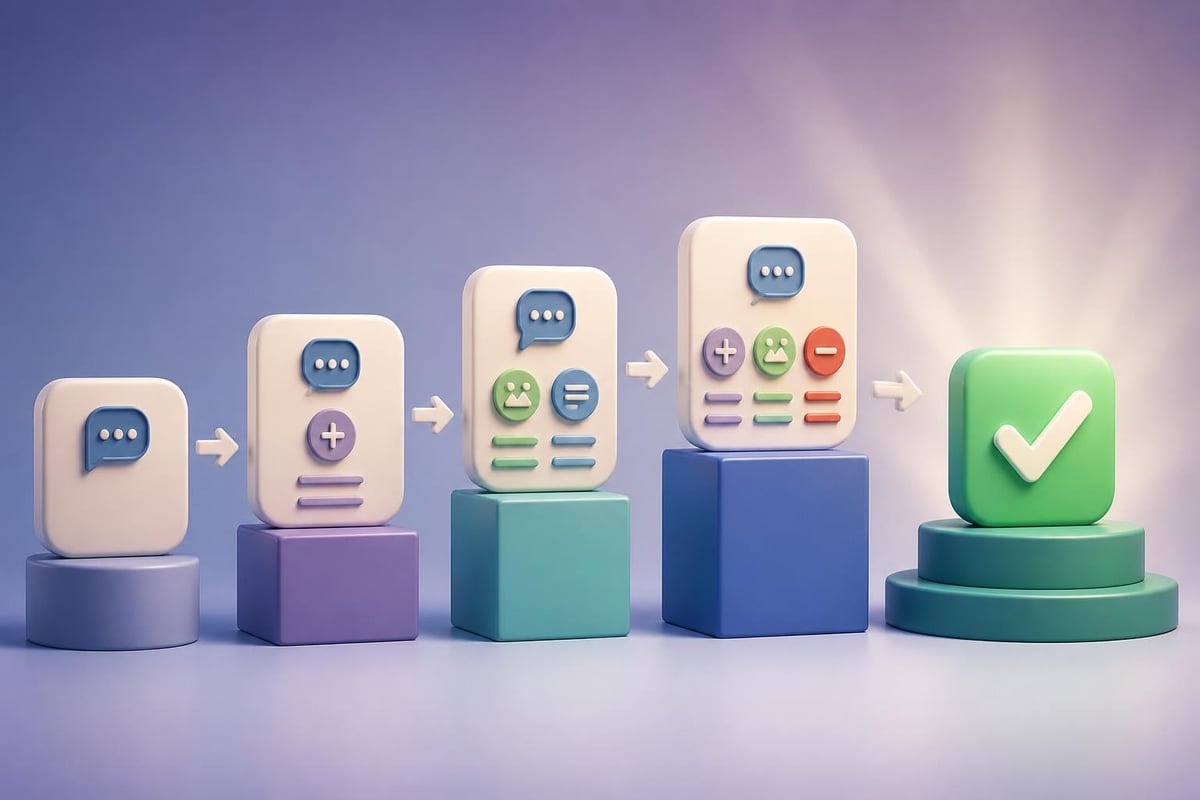
Iterative Refinement: The Follow-Up Prompt
Your first prompt rarely produces perfect output. Professional prompt engineering for ChatGPT involves strategic follow-ups.
Initial output: Too formal
Follow-up: "Rewrite this with a more conversational tone, like you're explaining it to a colleague over coffee."
Initial output: Too long
Follow-up: "Cut this to 150 words maximum. Remove the introduction and focus only on the three main steps."
Initial output: Missing key point
Follow-up: "Add a section about data security concerns and how we address them. Place it after the pricing discussion."
Build a refinement library for your common needs:
- "Make this more concise without losing key details"
- "Adjust the reading level for non-technical executives"
- "Add specific metrics or numbers to support each claim"
- "Reorganize this with the most important information first"
Template Variables for Reusable Prompts
Create prompt templates with bracketed variables you can swap out. This builds a library of reliable prompts for recurring tasks.
Meeting Summary Template
You are an executive assistant creating meeting notes.

Summarize this [meeting type] meeting from [date].

Attendees: [list names]

Focus on:
- Decisions made (if any)
- Action items with owners
- Unresolved questions

Ignore: Small talk, off-topic discussions

Format:
## Key Decisions
[bullet list]

## Action Items
[name]: [task] - Due: [date]

## Open Questions
[numbered list]

Transcript: [paste recording transcript or notes]
Save this template. Next meeting, you just fill in the brackets. That's 30 seconds of work instead of crafting a new prompt each time.
Industry-Specific Prompt Patterns
Different industries need different approaches. Here are proven patterns:
| Industry | Effective Pattern | Example Use Case |
|---|---|---|
| Legal | "Analyze based on [jurisdiction] and cite specific regulations" | Contract review, compliance checks |
| Healthcare | "Consider patient privacy (HIPAA) and avoid medical advice" | Documentation, patient communication |
| Finance | "Include risk factors and regulatory considerations" | Investment analysis, reporting |
| Education | "Adapt to [grade level] reading level and learning objectives" | Lesson planning, assessment creation |
Academic research on medical applications of prompt engineering shows that domain-specific constraints significantly improve accuracy and relevance.
Output Format Control
Specify exactly how you want information structured. ChatGPT can output tables, bullet lists, numbered steps, JSON, or custom formats.
Competitive Analysis Prompt
You are a market research analyst.

Compare these three project management tools: Asana, Monday.com, ClickUp

Create a comparison table with these columns:
- Feature
- Asana
- Monday.com
- ClickUp
- Winner (and brief why)

Evaluate these features only:
1. Automation capabilities
2. Reporting/analytics
3. Mobile app quality
4. Price (per user/month for team plan)
5. Learning curve

Use "✓" for strong, "○" for moderate, "✗" for weak. Keep explanations under 10 words.
This produces a scannable, decision-ready table instead of paragraphs of prose. Format specification transforms ChatGPT from a writing tool into a data organization system.
Persona-Based Prompting for Marketing
When creating customer-facing content, define your audience as specifically as possible.
You are a content strategist writing for SaaS founders.

Create a LinkedIn post about our new integration with Salesforce.

Target audience persona:
- Title: CEO or VP of Sales
- Company size: 50-200 employees
- Pain point: Sales and marketing data live in separate tools
- Tech savvy: Moderate (uses SaaS daily, not a developer)
- Communication preference: Results-oriented, minimal jargon

Post requirements:
- Lead with a relatable frustration
- One clear benefit of the integration
- Include a specific use case
- 150 words maximum
- End with a question to drive comments

Avoid: Buzzwords like "synergy," "revolutionary," "game-changing"
The persona details guide tone, vocabulary, and focus. This approach connects better than "write a LinkedIn post about our Salesforce integration." For more guidance on AI-powered content creation, explore practical tutorials that walk through real-world applications.
Context Window Management for Long Documents
ChatGPT has a context limit. For long documents, break your task into chunks with clear instructions.
For a 10-page report:
- First prompt: "Summarize pages 1-3 focusing on methodology"
- Second prompt: "Summarize pages 4-7 focusing on findings"
- Third prompt: "Summarize pages 8-10 focusing on recommendations"
- Final prompt: "Combine these three summaries into a single executive summary, 200 words maximum"
This staged approach maintains accuracy better than pasting the entire document and hoping for coherent analysis.
Debugging Bad Outputs
When ChatGPT produces unhelpful responses, diagnose the issue:
- Too generic? Add constraints and specific context
- Wrong tone? Use role assignment and example outputs
- Missing information? Ask it to expand specific sections
- Too long? Specify word count and priority order
- Factually uncertain? Ask it to distinguish between facts and assumptions
Prompt engineering for ChatGPT is an iterative skill. Each bad output teaches you what constraint was missing. Applying Dale Carnegie’s communication principles can also improve how you frame requests to the AI.
Cross-Functional Prompt Library
Build a shared library of tested prompts for your team. Here are starter prompts by function:
Sales:
- Cold email generator (with persona and product variables)
- Objection response frameworks
- Follow-up sequence creator
Marketing:
- Social media post variants
- Ad copy tester (multiple headline options)
- Content outline generator
Operations:
- Process documentation writer
- Meeting note summarizer
- Email response drafter
Product:
- Feature specification documenter
- User story generator
- Release note writer
Store these in a shared document with the structure: Prompt name, template, variables to customize, example output. This turns individual prompt engineering skill into team capability.
Version Control for Prompts
Track what works. When you find a prompt that consistently delivers, save it with notes:
- Prompt name: "Customer complaint response – shipping delays"
- Success rate: 9/10 usable with minor edits
- Best for: Shipping, delivery, fulfillment issues
- Doesn't work well for: Product defects, billing issues
- Last updated: March 2026
- Version notes: Added "acknowledge specific frustration" constraint after generic responses
Treat your prompt library like code. Version it, test it, improve it. This systematic approach is what separates casual ChatGPT users from professionals who extract real business value. If you're interested in expanding your AI skills systematically, Coursera offers structured training on prompt engineering fundamentals.
Combining Prompts for Workflows
Chain multiple prompts together for complex workflows.
Content creation workflow:
- Research prompt: "List 10 common objections to switching from spreadsheets to project management software"
- Outline prompt: "Create a blog post outline addressing these objections, organized from easiest to hardest to overcome"
- Draft prompt: "Write the 'Cost concerns' section of this outline, 300 words, including a cost comparison table"
- Edit prompt: "Revise this section to be more concise, under 200 words, keeping the table"
Each prompt builds on the previous output. This staged approach produces better final content than asking ChatGPT to "write a blog post about switching from spreadsheets to project management software."
For developers working with ChatGPT on technical projects, research on improving code quality through prompt patterns offers valuable frameworks. Similarly, if you're learning programming with AI assistance, check out resources on learning Python with AI for practical applications.
Mastering prompt engineering for ChatGPT transforms AI from a curiosity into a reliable business tool that saves time and improves output quality. The techniques in this guide work because they reduce ambiguity, provide clear constraints, and give ChatGPT the context it needs to be genuinely useful. Ready to implement these strategies with hands-on practice and real examples? Prompt Hero.Ai provides step-by-step tutorials and copy-paste prompts designed specifically for professionals who want to automate tasks, boost productivity, and solve actual business problems with AI.