
AI prompt engineering determines whether you get brilliant results or useless nonsense from ChatGPT, Claude, and similar tools. The difference between "write a blog post" and a well-structured prompt can save hours of editing and revision. This tutorial shows you exactly how to engineer prompts that produce professional, accurate outputs on the first try.
What AI Prompt Engineering Actually Means
AI prompt engineering is the practice of structuring your instructions to get specific, high-quality outputs from large language models. Instead of typing whatever comes to mind, you follow patterns that align with how these models process information.
Think of it as the difference between asking a coworker "do something with the report" versus "convert the Q1 sales report into a 5-slide PowerPoint deck highlighting our top 3 products by revenue."
Why Most Prompts Fail
Most people write prompts like text messages. They're vague, assume context the AI doesn't have, and leave formatting decisions to chance.
Common problems include:
- No clear role or context for the AI to operate from
- Missing output specifications like length, format, or tone
- Vague instructions that could be interpreted multiple ways
- No examples showing what good looks like
- Ignoring constraints like audience level or technical requirements
Research shows that specific, structured prompts dramatically improve AI performance, while generic instructions like "act as an expert" can actually degrade output quality.

The 5-Part Prompt Framework
Every effective prompt contains five elements. You don't always need all five, but knowing the framework helps you diagnose why a prompt isn't working.
Part 1: Role Assignment
Tell the AI what expertise to draw from. This activates relevant training data and sets the tone.
Examples:
- "You are a senior email marketing specialist."
- "You are a technical documentation writer for software developers."
- "You are a customer service trainer with 10 years of retail experience."
Part 2: Task Definition
State exactly what you need done. Be specific about the transformation you want.
Examples:
- "Convert these meeting notes into action items with owners and deadlines."
- "Rewrite this product description for a B2B audience in manufacturing."
- "Generate 5 subject line variations for this promotional email."
Part 3: Context and Constraints
Provide background information and boundaries. This is where ai prompt engineering separates amateurs from professionals.
Include:
- Audience details (who will read/use this)
- Length requirements (word count, character limits)
- Tone specifications (formal, casual, technical)
- Must-include elements (specific points, keywords, disclaimers)
- Must-avoid elements (jargon, certain phrases, topics)
Part 4: Output Format
Specify exactly how you want the information structured. This eliminates back-and-forth revisions.
Format options:
- Bullet lists vs. numbered lists vs. paragraphs
- Tables with specific columns
- Email templates with subject line and body
- Code blocks with language specification
- Markdown headings and structure
Part 5: Examples (When Needed)
For complex or unusual tasks, show the AI what good looks like. This is called few-shot prompting.
Provide 1-3 examples of the desired output. The AI will match the pattern, style, and format.
Copy-Paste Prompts for Common Tasks
Here are production-ready prompts you can use immediately. Customize the bracketed sections for your specific needs.
Email Response Generator
You are a professional customer service representative.

Task: Write a response to the customer email below.

Context:
- Customer tier: [Premium/Standard/Free]
- Issue severity: [High/Medium/Low]
- Company policy: [Brief policy statement]

Tone: Professional, empathetic, solution-focused

Output format:
- Subject line
- Email body (150-200 words)
- Clear next steps

Customer email:
[Paste customer email here]
Example output:
Subject: Resolved: Billing Issue – Account #47382
Hi Jennifer,
Thank you for reaching out about the duplicate charge on your March statement. I've reviewed your account and can confirm this was a processing error on our end.
I've issued a full refund of $49.99, which will appear in your account within 3-5 business days. I've also added a $10 credit to your account as an apology for the inconvenience.
To prevent this from happening again, I've flagged your account for our billing team to review during our next audit cycle.
Next steps:
- Check your email for the refund confirmation (sent separately)
- Reply to this email if you don't see the refund by April 7, 2026
- Your $10 credit will automatically apply to your next invoice
Thanks for your patience while we sorted this out.
Best regards,
Michael Chen
Customer Success Team
Content Repurposing Prompt
You are a content strategist specializing in multi-platform content.

Task: Transform the blog post below into 5 LinkedIn posts.

Requirements:
- Each post: 100-150 words
- Include a hook in the first sentence
- End with a question to drive engagement
- Extract different insights from the source material
- Professional tone, accessible language

Source content:
[Paste blog post here]
Meeting Notes to Action Items
You are an executive assistant skilled at distilling meetings into clear action items.

Task: Convert these meeting notes into a structured action plan.

Output format (markdown table):
| Action Item | Owner | Deadline | Priority | Dependencies |

Requirements:
- Only include actionable items (exclude general discussion)
- Infer deadlines based on urgency indicators in notes
- Mark priority as High/Medium/Low
- Note dependencies between tasks

Meeting notes:
[Paste notes here]
Advanced Techniques That Improve Results
Once you master basic structure, these techniques handle edge cases and complex requirements.
Chain-of-Thought Prompting
For tasks requiring reasoning or multi-step logic, explicitly ask the AI to show its work.
Pattern:
"Think through this step-by-step. First, [step 1]. Then, [step 2]. Finally, [step 3]. Show your reasoning for each step."
This approach is particularly effective for conducting systematic literature reviews or analyzing complex business scenarios.
Negative Prompting
Tell the AI what NOT to do. This is especially useful when you've gotten unwanted elements in previous outputs.
Examples:
- "Do not use jargon or technical terms."
- "Do not include an introduction or conclusion paragraph."
- "Do not suggest solutions that require additional software purchases."
Conditional Instructions
Create if-then logic for handling variations in input.
Pattern:
"If the customer email includes a refund request, acknowledge it and explain our 30-day policy. If it's a technical issue, ask for their operating system and browser version before suggesting fixes."
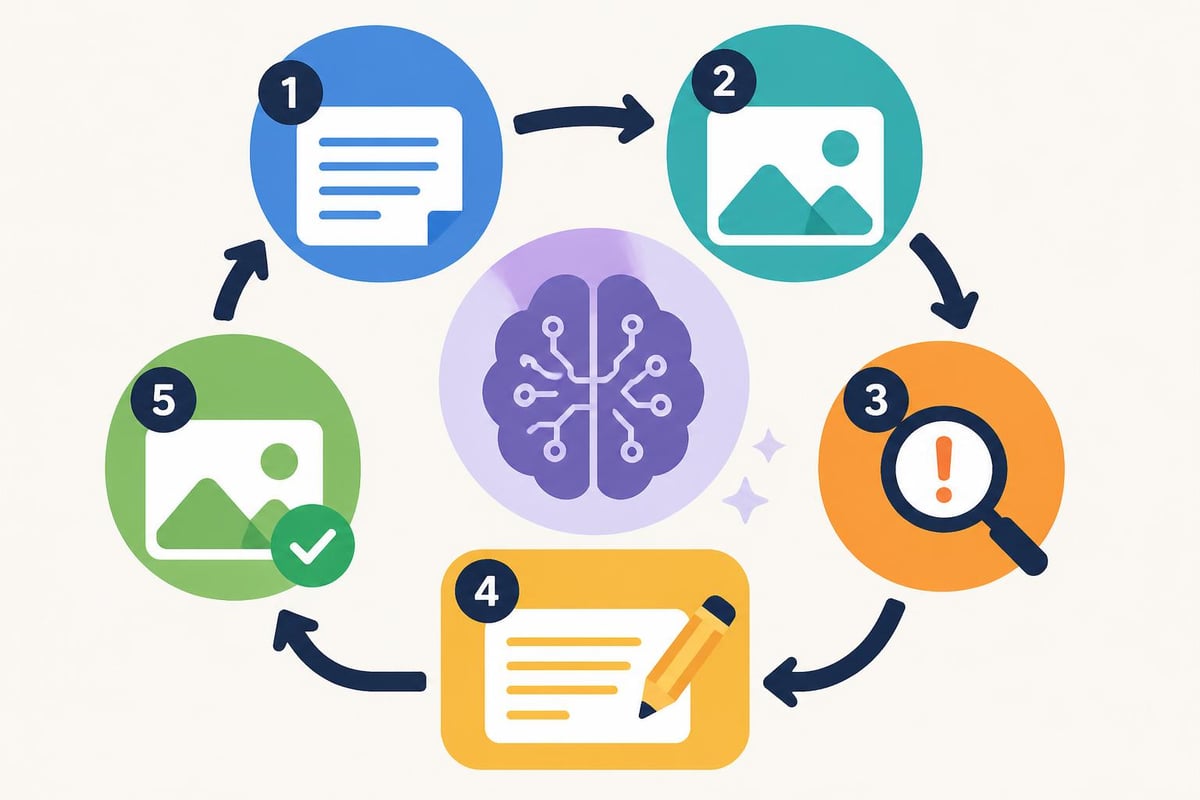
Iterative Refinement
Start broad, then add constraints based on what you get back. This is faster than trying to perfect the prompt before testing.
Process:
- Run a basic version
- Identify what's wrong or missing
- Add one specific constraint
- Test again
- Repeat until satisfactory
If you're creating video content to promote your services, tools like AdsRaw can help you turn AI-generated scripts into realistic video ads without hiring creators, making it easy to test different messaging approaches quickly.
Industry-Specific Applications
AI prompt engineering works differently across contexts. Here's how to adapt for specific use cases.
E-Commerce and Product Content
For online merchants, especially those on platforms like Shopify, prompt engineering can transform how you create product descriptions, customer service responses, and marketing copy. The Talk Shop community discusses practical applications of AI tools for e-commerce operations, from automating routine customer inquiries to optimizing product listings.
E-commerce prompt template:
You are an e-commerce copywriter specializing in [product category].

Task: Write a product description for [product name].

Target customer:
- Demographics: [age, income, location]
- Pain points: [specific problems]
- Shopping behavior: [online research habits, price sensitivity]

Requirements:
- Highlight 3 key benefits (not features)
- Include one customer objection and address it
- 150-200 words
- SEO keywords: [list 3-5 keywords]
- End with a soft call-to-action

Product details:
[Specifications, materials, dimensions, etc.]
Marketing and Content Creation
Marketing teams need variety and volume. Template prompts with variable sections let you generate options quickly.
| Task Type | Key Prompt Elements | Common Mistakes to Avoid |
|---|---|---|
| Ad copy | Audience pain point, offer, CTA, character limit | Being too clever instead of clear |
| Blog outlines | Target keyword, reader intent, competing articles | Skipping competitive analysis context |
| Social posts | Platform norms, engagement goal, brand voice | Using same prompt across all platforms |
| Email campaigns | Segment characteristics, campaign goal, A/B test variable | Not specifying subject line separately |
Technical Documentation
For developer-focused content, precision matters more than creativity.
Documentation prompt:
You are a technical writer creating API documentation.

Task: Document this API endpoint.

Required sections:
1. Brief description (one sentence)
2. HTTP method and URL pattern
3. Request parameters (table format: name, type, required/optional, description)
4. Example request (JSON)
5. Example response (JSON)
6. Possible error codes (table format: code, meaning, suggested fix)

Technical level: Assume intermediate developer familiar with REST APIs but new to our platform.

Endpoint details:
[Paste technical specifications]
The systematic review published in International Journal of Educational Technology demonstrates how prompt engineering enhances educational outcomes, particularly in creating clear instructional materials.

Testing and Measuring Prompt Performance
You can't improve what you don't measure. Track these metrics to refine your ai prompt engineering skills.
Quality Metrics
- First-try success rate: Percentage of prompts that produce usable output without revision
- Edit time: Minutes spent revising AI output vs. writing from scratch
- Consistency: Whether the same prompt produces similar quality across multiple runs
- Specificity score: How closely output matches detailed requirements
A/B Testing Prompts
Run experiments comparing prompt variations. Change one element at a time.
Test variables:
- Role definition (generic vs. specific)
- Length of context provided (minimal vs. comprehensive)
- Output format specification (loose vs. rigid)
- Example inclusion (with vs. without)
- Constraint specificity (general guidelines vs. detailed rules)
Keep a prompt library of what works. Document which prompts succeed for which tasks and why.
Common Mistakes and How to Fix Them
Even experienced users make these errors. Recognizing them speeds up your learning curve.
Mistake 1: Overloading with Instructions
Problem: Cramming 15 requirements into one prompt creates confusion.
Fix: Break complex tasks into sequential prompts. Get the core content right, then refine in a second prompt.
Mistake 2: Assuming Context
Problem: The AI doesn't know your company, industry norms, or previous conversations (unless you're in a continuing chat).
Fix: Include all necessary context in every prompt, or explicitly reference previous outputs if continuing a conversation.
Mistake 3: Ignoring Output Formatting
Problem: You get a wall of text when you needed a table or bullet list.
Fix: Specify the exact format using examples or explicit structure descriptions. For more best practices on prompt structure, review industry guidelines that emphasize formatting clarity.
Mistake 4: No Quality Criteria
Problem: The AI delivers something technically correct but practically useless.
Fix: Define success criteria. "This email should reassure the customer, acknowledge their frustration, and provide a specific timeline for resolution."
Mistake 5: Single-Shot Perfectionism
Problem: Spending 30 minutes crafting the "perfect" prompt before testing.
Fix: Start with a basic prompt, see what happens, iterate. Speed beats perfection in ai prompt engineering.
Building Your Prompt Library
Create reusable templates for recurring tasks. This compounds your efficiency over time.
Organization System
Categories to track:
- Task type (email, content, analysis, code, etc.)
- AI model optimized for (ChatGPT-4, Claude, etc.)
- Success rate and date last tested
- Typical use case and context
- Variations for different scenarios
Template Variables
Use bracketed placeholders for elements that change.
Example:
"You are a [ROLE]. Write a [CONTENT_TYPE] for [AUDIENCE] that [PRIMARY_GOAL]. Include [REQUIRED_ELEMENTS]. Avoid [EXCLUDED_ELEMENTS]. Length: [WORD_COUNT] words."
Save this structure, then fill in variables based on the specific task.
Version Control
When you improve a prompt, save both versions. Sometimes "improvements" work for one use case but break another.
Track changes like:
- v1.0: Original prompt
- v1.1: Added tone specification
- v1.2: Changed from bullets to table format
- v2.0: Complete restructure with examples
For inspiration and working examples, explore the tutorial collection at Prompt Hero where you'll find tested prompts across various professional scenarios.
Integration with Real Workflows
AI prompt engineering delivers ROI when it fits seamlessly into existing processes.
Email Triage and Response
Workflow:
- Morning: Run prompts to categorize incoming emails by urgency and type
- Batch process: Generate draft responses for common inquiry types
- Human review: Edit for personalization and accuracy
- Send with tracking to measure customer satisfaction
Time savings: 60-70% reduction in email handling time for routine inquiries.
Content Production Pipeline
Workflow:
- Research phase: Use prompts to summarize competitor content and identify gaps
- Outlining: Generate multiple structure options, pick the best
- First draft: Prompt for section-by-section content
- Editing: Human adds expertise, examples, and brand voice
- Optimization: Prompt for meta descriptions, social posts, email teasers
Quality maintenance: Human expertise where it matters (strategy, unique insights), AI for heavy lifting (research synthesis, structural variations).
Ongoing Training and Skill Development
The field evolves rapidly. Mastering ai prompt engineering requires continuous learning. Training programs like Mammoth Club provide structured courses and practice questions to help professionals stay current with AI tools and techniques, building job-ready skills for ChatGPT, Claude, and emerging models.
Customer Support Automation
Workflow:
- Customer submits inquiry through form or email
- AI categorizes issue and sentiment
- Prompt generates draft response based on category
- Support agent reviews, personalizes, sends
- AI logs resolution for knowledge base building
Metrics: Response time drops from 4 hours to 45 minutes average.
Prompts for Specific Business Functions
Different departments need different approaches to ai prompt engineering.
Sales Prompts
Cold outreach personalization:
You are a B2B sales development representative.

Task: Write a personalized cold email.

Prospect research:
- Company: [Name]
- Industry: [Sector]
- Recent news: [Any relevant developments]
- Role: [Job title]
- Likely pain points: [Based on industry and role]

Email requirements:
- Subject line under 50 characters
- First sentence references something specific about their company
- Second paragraph connects their situation to our solution
- Keep to 100 words total
- End with a specific, low-commitment ask
- Professional but conversational tone

Our solution:
[Brief description of what you offer]
HR and Recruiting Prompts
Job description generator:
You are an HR specialist creating inclusive, effective job descriptions.

Task: Write a job description for [Job Title].

Company context:
- Industry: [Sector]
- Company size: [Employee count]
- Culture: [Brief description]
- Remote policy: [In-office/Hybrid/Remote]

Requirements:
- Start with a compelling 2-sentence company description
- List 5-7 key responsibilities
- Separate must-have vs. nice-to-have qualifications
- Include salary range: [Range]
- Mention 3-4 specific benefits
- Use gender-neutral language
- Avoid requiring "rock stars" or "ninjas"
- 300-400 words total

Role details:
[Paste role requirements and responsibilities]
Finance and Analysis Prompts
Data interpretation:
You are a financial analyst preparing insights for non-financial executives.

Task: Explain the trends in this data.

Data:
[Paste table or summary statistics]

Requirements:
- Identify 3 most significant trends
- Explain what's causing each trend (if data supports inference)
- State business implications for each
- Recommend one action item per trend
- Use plain language (no financial jargon)
- Format as bullet points with brief explanations

Context:
- Time period: [Dates]
- Industry benchmarks: [If available]
- Previous period performance: [If available]
Looking at practical applications of prompt engineering across different fields, research shows that structured approaches consistently outperform ad-hoc prompting, especially in specialized domains.
The Future of Prompt Engineering
As models improve, prompt engineering evolves. Understanding the trajectory helps you invest learning effort wisely.
Emerging Patterns
Multi-modal prompting: Combining text, images, and eventually audio/video inputs requires new structuring approaches.
Model-specific optimization: Different AI models respond better to different prompt structures. Claude prefers conversational context, while GPT-4 handles rigid templates well.
Automated prompt generation: Tools are emerging that help you build better prompts by analyzing your goals and suggesting structures. However, understanding fundamentals remains crucial.
Skills That Remain Valuable
Regardless of technical changes:
- Clear communication of requirements and constraints
- Domain expertise to evaluate output quality
- Critical thinking to spot AI hallucinations or errors
- Iteration mindset to refine based on results
The creative applications of prompt engineering in AI art generation demonstrate how prompt skills transfer across different AI tools and use cases, making this a durable professional capability.
Industry Standards Development
As ai prompt engineering matures, expect:
- Standardized templates by industry and use case
- Quality certification programs for prompt engineers
- Integrated testing and version control tools
- Prompt marketplaces for buying and selling proven templates
- Regulatory guidance for high-stakes applications (legal, medical, financial)
TechTarget's guide to prompt engineering best practices outlines emerging industry standards that are gaining adoption across enterprise environments.
Mastering ai prompt engineering transforms AI tools from unpredictable novelties into reliable productivity assets. Start with the five-part framework, build your template library, and iterate based on real results. Whether you're handling customer emails, creating marketing content, or analyzing business data, structured prompts consistently outperform casual requests. Ready to put these techniques into practice? Prompt Hero.Ai offers step-by-step tutorials, tested prompts, and real examples designed for professionals who need immediate, practical results.