
Artificial intelligence has transformed from a theoretical concept into a practical skill that professionals across industries need to master. Whether you're automating business workflows, building predictive models, or creating intelligent chatbots, understanding how to program AI systems gives you a competitive edge. This artificial intelligence programming tutorial walks you through the essential concepts, tools, and techniques you need to start building AI applications that solve real problems.
Understanding AI Programming Fundamentals
AI programming differs significantly from traditional software development. Instead of writing explicit rules for every scenario, you create systems that learn patterns from data and make decisions based on those patterns.
The core components of AI programming include machine learning algorithms, neural networks, and data processing pipelines. These elements work together to transform raw information into intelligent predictions and actions.
Key Programming Languages for AI Development
Python dominates the AI programming landscape due to its extensive libraries and readable syntax. The language offers frameworks like TensorFlow, PyTorch, and scikit-learn that handle complex mathematical operations behind simple commands.
Other languages have specific advantages:
- Python: Best for machine learning, deep learning, and rapid prototyping
- R: Excellent for statistical analysis and data visualization
- Java: Ideal for enterprise-scale AI applications
- Julia: Optimized for numerical computing and high-performance tasks
- C++: Necessary for performance-critical AI systems

The GeeksforGeeks AI tutorial provides comprehensive coverage of these foundational concepts, including problem-solving methods and search algorithms that underpin modern AI systems.
Setting Up Your AI Development Environment
Before diving into code, you need the right tools configured properly. A well-structured development environment saves hours of troubleshooting and lets you focus on building models.
Start with Anaconda, a distribution that bundles Python with essential AI libraries. This package manager simplifies dependency handling and creates isolated environments for different projects.
Essential Libraries and Frameworks
Your artificial intelligence programming tutorial toolkit should include these core libraries:
| Library | Purpose | Best For |
|---|---|---|
| NumPy | Numerical computing | Array operations, linear algebra |
| Pandas | Data manipulation | Data cleaning, transformation |
| Scikit-learn | Machine learning | Classification, regression, clustering |
| TensorFlow | Deep learning | Neural networks, production deployment |
| PyTorch | Deep learning | Research, dynamic computation graphs |
| Matplotlib | Visualization | Plotting results, exploratory analysis |
Installing these packages is straightforward with pip:
pip install numpy pandas scikit-learn tensorflow matplotlib
The IBM Developer AI tutorials showcase practical implementations using these tools for enterprise workflows and AI agents.
Building Your First Machine Learning Model
Theory only takes you so far. Let's build a practical classification model that predicts outcomes based on input features. This hands-on approach demonstrates the complete AI programming workflow.
Data Preparation and Preprocessing
Every AI project starts with data. Quality data determines model performance more than any algorithm optimization. Your first step involves loading, cleaning, and transforming raw data into a format suitable for training.
Data preprocessing includes:
- Handling missing values through imputation or removal
- Encoding categorical variables as numerical representations
- Scaling features to similar ranges
- Splitting data into training and testing sets
- Addressing class imbalance if present
Real-world datasets rarely arrive clean. You'll spend significant time identifying outliers, correcting inconsistencies, and ensuring your data accurately represents the problem you're solving.
Training and Evaluating Models
Once your data is ready, select an appropriate algorithm. For beginners, start with simpler models like logistic regression or decision trees before advancing to complex neural networks.
The training process involves:
- Feeding training data into the algorithm
- Adjusting internal parameters to minimize prediction errors
- Validating performance on unseen test data
- Tuning hyperparameters to optimize results
Evaluation metrics tell you how well your model performs. Classification tasks use accuracy, precision, recall, and F1-score. Regression problems rely on mean squared error and R-squared values.
Cross-validation prevents overfitting by testing your model on multiple data subsets. This technique provides more reliable performance estimates than a single train-test split.
Neural Networks and Deep Learning Basics
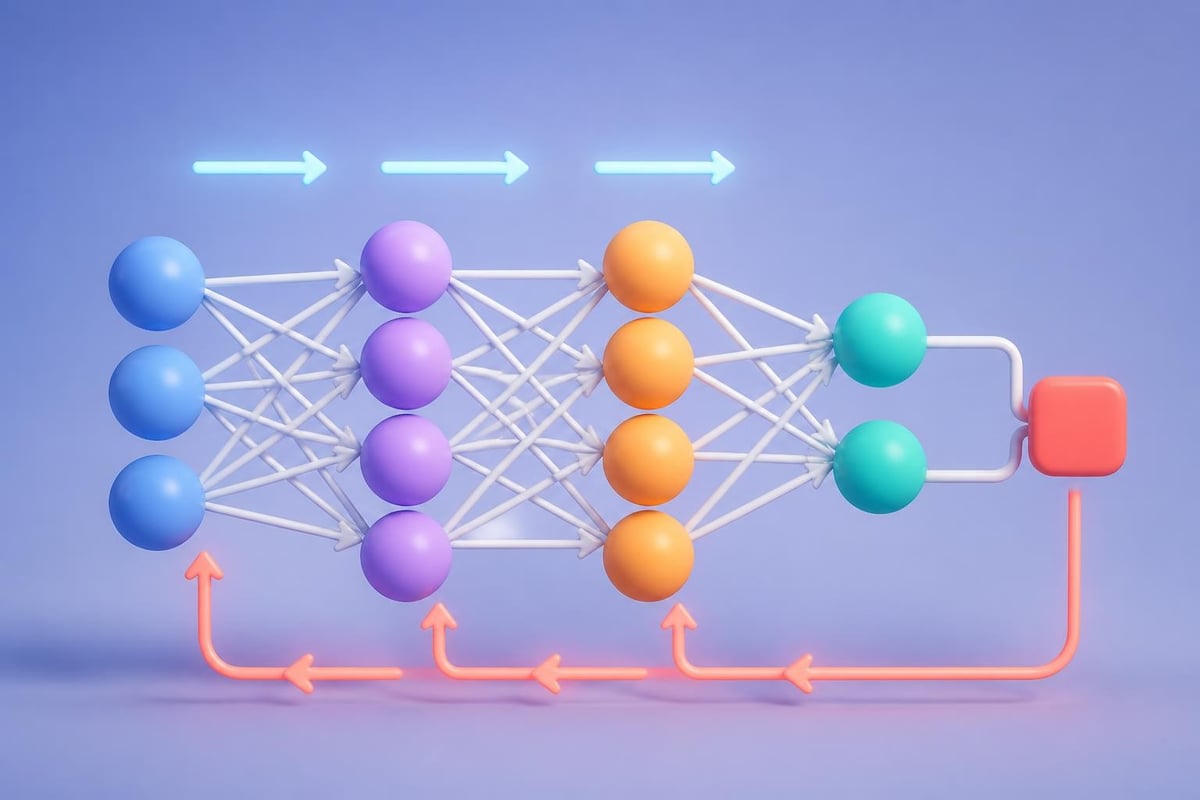
Neural networks represent the cutting edge of AI programming. These architectures mimic brain structure, processing information through interconnected layers of artificial neurons.
Understanding Network Architecture
A basic neural network contains three layer types:
- Input layer: Receives raw features
- Hidden layers: Transform inputs through learned patterns
- Output layer: Produces final predictions
Each connection between neurons has a weight that determines signal strength. During training, the network adjusts these weights to minimize prediction errors through a process called backpropagation.
Activation functions introduce non-linearity, enabling networks to learn complex patterns. Common choices include ReLU for hidden layers and softmax for multi-class classification outputs.
The GeeksforGeeks AI algorithms tutorial explains various techniques that form the backbone of these systems, essential for understanding deep learning mechanics.
Implementing a Simple Neural Network
TensorFlow and PyTorch simplify neural network creation. Here's the conceptual workflow:
- Define network architecture (layer sizes, activation functions)
- Specify loss function and optimizer
- Feed training data in batches
- Monitor training metrics
- Evaluate on validation set
- Deploy the trained model
Training requires careful attention to learning rate, batch size, and number of epochs. Too few epochs means underfitting; too many causes overfitting. Monitoring validation loss helps identify the sweet spot.
Natural Language Processing Applications
NLP represents one of the most practical AI programming domains. These techniques power chatbots, sentiment analysis, translation services, and content generation tools.
Text Processing Techniques
Before feeding text into models, you must convert words into numerical representations. Tokenization splits sentences into individual words or subwords. Vectorization transforms these tokens into numbers.
Modern NLP relies on transformer architectures and pre-trained models like BERT and GPT. These models learn language patterns from massive text corpora, then fine-tune on specific tasks.
Common NLP applications include:
- Sentiment analysis: Determining emotional tone in text
- Named entity recognition: Identifying people, places, organizations
- Text classification: Categorizing documents by topic
- Question answering: Extracting answers from context
- Text generation: Creating human-like content
The Guru99 AI tutorial offers additional perspectives on NLP fundamentals and their practical applications across industries.
If you're serious about mastering these AI programming concepts and building professional-grade applications, structured learning accelerates your progress significantly. Mammoth Club provides comprehensive AI certification and training with access to over 3,000 courses covering everything from Python basics to advanced deep learning architectures, helping you build job-ready skills through hands-on practice.
Computer Vision and Image Recognition
Computer vision enables machines to interpret visual information. This branch of AI programming powers facial recognition, autonomous vehicles, medical imaging analysis, and augmented reality applications.
Image Data Processing
Images are arrays of pixel values. Color images have three channels (red, green, blue), while grayscale images use a single channel. Before training, you need to:
- Resize images to consistent dimensions
- Normalize pixel values (typically 0-1 range)
- Apply data augmentation (rotation, flipping, cropping)
- Split into training, validation, and test sets
Convolutional Neural Networks (CNNs) dominate image recognition tasks. These architectures use specialized layers that detect edges, textures, and patterns hierarchically.
Building an Image Classifier
A typical CNN workflow includes:
| Step | Purpose | Implementation |
|---|---|---|
| Convolutional layers | Feature extraction | Apply filters to detect patterns |
| Pooling layers | Dimensionality reduction | Downsample feature maps |
| Fully connected layers | Classification | Combine features for predictions |
| Dropout | Regularization | Prevent overfitting |
Transfer learning lets you leverage pre-trained models like ResNet or VGG. Instead of training from scratch, you adapt these models to your specific image classification task, saving computational resources and improving accuracy with limited data.
Reinforcement Learning Fundamentals
Reinforcement learning teaches agents to make sequential decisions by rewarding desired behaviors. This approach powers game-playing AI, robotics control, and recommendation systems.
The Agent-Environment Framework
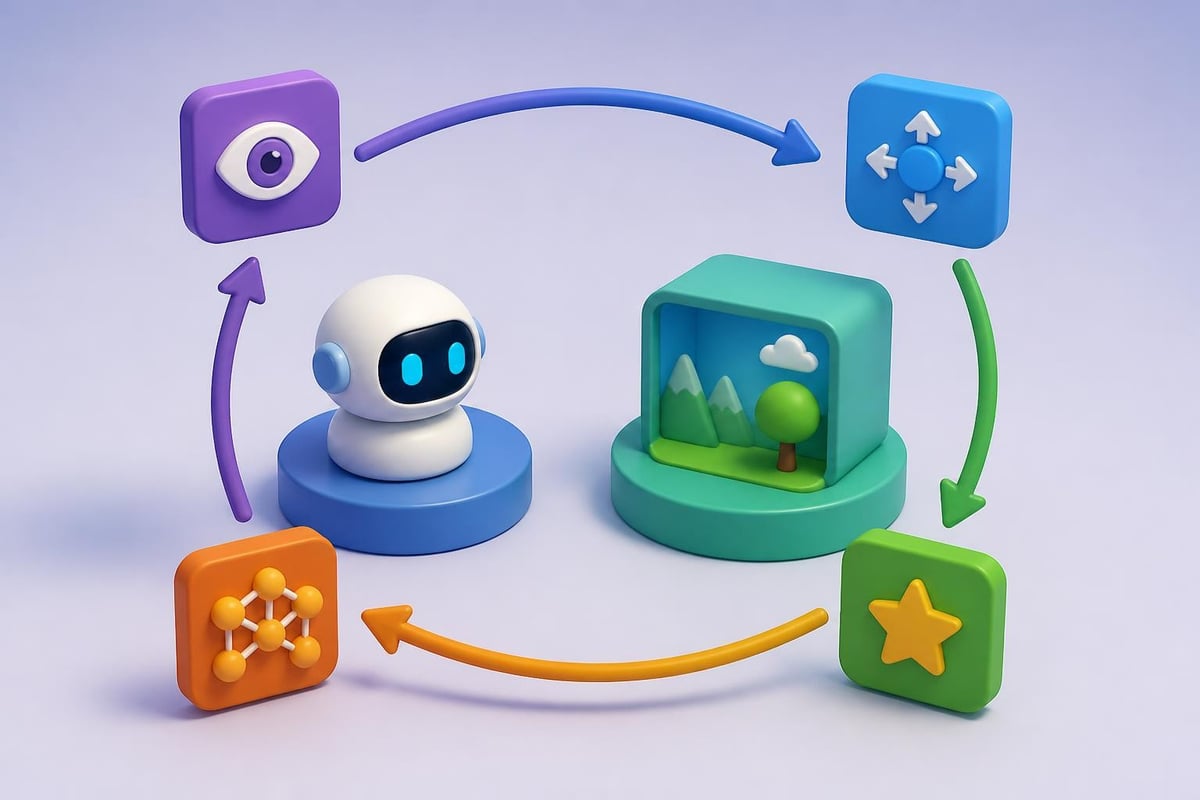
An agent interacts with an environment by taking actions that lead to new states and rewards. The goal is learning a policy that maximizes cumulative rewards over time.
Key components include:
- State: Current situation or configuration
- Action: Choices available to the agent
- Reward: Feedback signal indicating action quality
- Policy: Strategy mapping states to actions
- Value function: Expected future rewards from a state
The GeeksforGeeks Agentic AI tutorial explores building autonomous agents capable of decision-making and task completion, extending beyond basic reinforcement learning concepts.
Q-Learning and Deep Q-Networks
Q-learning maintains a table of state-action values, updating them based on observed rewards. Deep Q-Networks (DQN) replace tables with neural networks, enabling handling of complex state spaces.
This artificial intelligence programming tutorial approach revolutionized game-playing AI, achieving superhuman performance in Atari games and Go. The same principles apply to real-world optimization problems like resource allocation and route planning.
Working with AI APIs and Pre-trained Models
Not every AI project requires building models from scratch. Pre-trained models and cloud APIs provide powerful capabilities without extensive training data or computational resources.
Leveraging Cloud AI Services
Major cloud providers offer AI services accessible through simple API calls:
- Google Cloud AI: Vision, language, translation, speech APIs
- AWS AI Services: Rekognition, Comprehend, Polly, Lex
- Azure Cognitive Services: Computer vision, NLP, decision-making
- OpenAI API: GPT models for text generation and analysis
These services handle infrastructure, scaling, and model maintenance. You focus on integrating AI capabilities into applications through HTTP requests.
Fine-tuning Pre-trained Models
Transfer learning extends pre-trained models to specific domains. You replace the final layers and retrain on your custom dataset, preserving learned features while adapting to new tasks.
Benefits of fine-tuning:
- Requires less training data than building from scratch
- Reduces training time significantly
- Achieves higher accuracy on specialized tasks
- Lowers computational costs
For those exploring generative AI applications, the generative AI tutorial at Prompt Hero.Ai provides practical examples of working with modern AI tools for content creation and automation.
Best Practices for Production AI Systems
Moving AI models from development to production introduces new challenges. Reliable, scalable deployment requires careful planning and ongoing maintenance.
Model Deployment Strategies
Production systems need:
- Version control: Track model iterations and reproduce results
- Monitoring: Detect performance degradation and data drift
- Scaling: Handle varying load efficiently
- Security: Protect sensitive data and prevent attacks
- Explainability: Understand and communicate model decisions
Containerization with Docker ensures consistent environments across development and production. Kubernetes orchestrates containers at scale, managing resource allocation and failover.
Handling Data Drift and Model Retraining
Real-world data changes over time. Data drift occurs when input distributions shift, causing model performance to degrade. Production systems must:
- Monitor prediction accuracy continuously
- Compare incoming data distributions to training data
- Trigger retraining when performance drops
- A/B test new models before full deployment
- Maintain rollback capabilities for failed updates
The TutorialsPoint AI guide covers foundational concepts that remain critical even as you advance to production-grade systems.
Advanced Topics and Specialized Applications
As you progress beyond basic AI programming, specialized domains offer exciting opportunities for innovation and problem-solving.
Graph Neural Networks
Traditional neural networks process grid-like data (images) or sequences (text). Graph Neural Networks (GNNs) handle irregular structures like social networks, molecular structures, and knowledge graphs.
GNNs aggregate information from neighboring nodes, learning representations that capture both node features and graph topology. Applications include:
- Recommendation systems: User-item interaction graphs
- Drug discovery: Molecular property prediction
- Traffic forecasting: Road network analysis
- Fraud detection: Transaction network patterns
Explainable AI and Model Interpretability
Black-box models create trust issues in high-stakes applications. Explainable AI (XAI) techniques reveal how models make decisions:
| Technique | Purpose | Application |
|---|---|---|
| SHAP values | Feature importance | Understand prediction drivers |
| LIME | Local explanations | Explain individual predictions |
| Attention visualization | Model focus | See what inputs matter most |
| Counterfactual explanations | What-if analysis | Show required changes for different outcomes |
Regulatory requirements in healthcare and finance increasingly demand model transparency. Building explainability into your artificial intelligence programming tutorial projects from the start saves significant retrofitting effort.
Practical Projects to Build Your Skills
Theoretical knowledge needs practical application. These projects reinforce concepts while building portfolio pieces that demonstrate competence.
Beginner Projects
Start with manageable scopes:
- Email spam classifier: Text classification with Naive Bayes
- House price predictor: Regression with linear models
- Iris flower classifier: Multi-class classification introduction
- Handwritten digit recognizer: MNIST with simple neural networks
Intermediate Projects
Expand complexity and scope:
- Sentiment analysis dashboard: Analyze Twitter data in real-time
- Recommendation engine: Collaborative filtering for movies or products
- Chatbot: Rule-based or retrieval-based conversational agent
- Object detection: Identify and locate items in images
- Time series forecasting: Predict stock prices or weather patterns
Advanced Challenges
Push your skills with complex implementations:
- Generative adversarial network: Create synthetic images
- Reinforcement learning agent: Train game-playing AI
- Multi-modal learning: Combine text and images
- Neural architecture search: Automate model design
- Federated learning: Train on distributed private data
Each project teaches debugging, optimization, and deployment skills beyond algorithm implementation. You'll encounter data quality issues, scaling challenges, and edge cases that books don't cover.
Community Resources and Continued Learning
AI evolves rapidly. Staying current requires engaging with communities, reading research, and experimenting with new techniques.
Essential Learning Resources
Expand your knowledge through diverse channels:
- Research papers: arXiv publishes cutting-edge AI research daily
- Online courses: Coursera, edX, and Fast.ai offer structured learning
- Podcasts: Stay informed during commutes with AI-focused shows
- Conferences: NeurIPS, ICML, CVPR showcase latest developments
- GitHub repositories: Study implementations from leading researchers
The Graph Neural Networks tutorial on arXiv provides mathematical foundations and practical examples for this emerging architecture type.
Building Your Professional Network
AI professionals benefit from community engagement:
- Contribute to open-source projects
- Participate in Kaggle competitions
- Join local AI meetups and study groups
- Share your projects on GitHub and blogs
- Answer questions on Stack Overflow
These activities build reputation, expose you to different perspectives, and often lead to career opportunities. The AI field values demonstrated skills over credentials alone.
Tools and Platforms for AI Development
Modern AI programming extends beyond code editors. Integrated platforms accelerate development through pre-built components and collaborative features.
Jupyter Notebooks and Development Environments
Jupyter Notebooks combine code, visualizations, and documentation in interactive documents. They're ideal for exploratory analysis, sharing results, and teaching concepts.
Alternatives include:
- Google Colab: Free GPU access, cloud-based notebooks
- Kaggle Kernels: Built-in datasets, community sharing
- PyCharm: Full-featured IDE with debugging tools
- VS Code: Lightweight editor with AI extensions
Each environment offers different trade-offs between power, simplicity, and collaboration features.
Experiment Tracking and MLOps Tools
Production AI requires tracking experiments and managing model lifecycles. MLOps tools streamline these processes:
| Tool | Purpose | Key Features |
|---|---|---|
| MLflow | Experiment tracking | Parameter logging, model registry |
| Weights & Biases | Visualization | Real-time metrics, hyperparameter tuning |
| DVC | Data versioning | Track datasets like code |
| Kubeflow | Pipeline orchestration | Deploy workflows on Kubernetes |
These platforms help teams collaborate, reproduce results, and maintain production models efficiently.
Ethical Considerations in AI Programming
Technical skills alone don't make responsible AI developers. Understanding ethical implications ensures your work benefits society while minimizing harm.
Bias and Fairness
AI models learn from data, including historical biases. Algorithmic fairness requires:
- Auditing training data for representation gaps
- Testing model performance across demographic groups
- Implementing fairness constraints during training
- Monitoring deployed systems for discriminatory outcomes
Bias can appear in hiring algorithms, loan approvals, criminal justice predictions, and healthcare diagnostics. Proactive testing and diverse development teams reduce these risks.
Privacy and Security
AI systems often process sensitive personal information. Privacy-preserving techniques include:
- Differential privacy: Add noise to protect individual records
- Federated learning: Train on decentralized data
- Encryption: Protect data in transit and at rest
- Anonymization: Remove personally identifiable information
Security vulnerabilities like adversarial examples and model extraction attacks require defensive programming and regular audits.
Environmental Impact
Training large models consumes significant energy. Responsible AI programming considers:
- Choosing efficient architectures
- Using pre-trained models when appropriate
- Selecting green cloud providers
- Optimizing hyperparameters to reduce training time
Small improvements in model efficiency multiply across millions of inference requests.
Mastering AI programming opens doors to solving complex problems across every industry, from automating repetitive tasks to building intelligent systems that adapt and learn. This artificial intelligence programming tutorial has covered the essential foundations, practical techniques, and advanced concepts you need to start building real AI applications today. Ready to take your skills further with step-by-step instructions and copy-and-paste prompts for real-world AI tools? Prompt Hero.Ai provides practical tutorials designed specifically for professionals who want to automate tasks and solve business problems using ChatGPT, Claude, and other modern AI platforms.