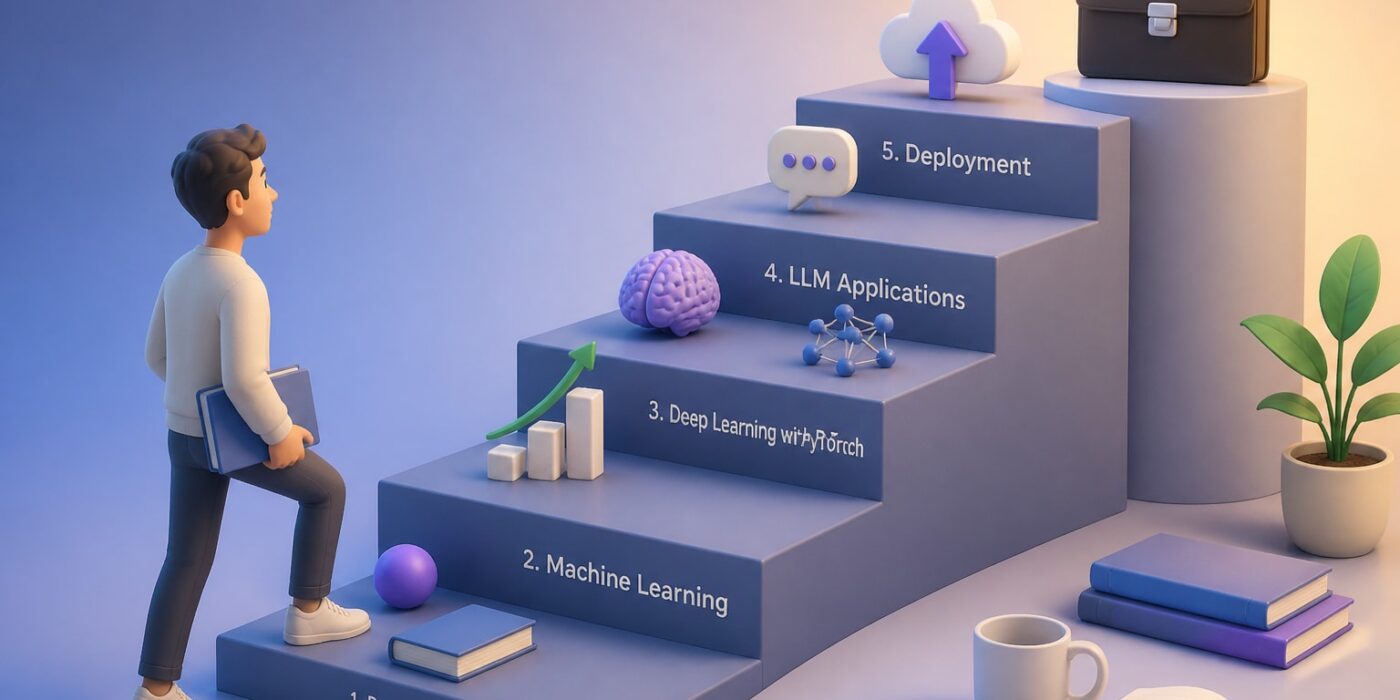
An AI engineer roadmap starts with Python and math, moves through machine learning and deep learning, then adds LLM application skills, deployment and portfolio projects. Learners with some programming background can often reach junior-ready skills in roughly 9 to 12 months of steady part-time study, though the timeline depends on your starting point and weekly hours. The order matters more than the speed: each stage gives you the vocabulary and habits the next one depends on.
This guide walks through every stage, explains what an AI engineer actually does, and shows how to prove your skills with projects that hiring managers can evaluate.
What does an AI engineer actually do?
An AI engineer builds, integrates and maintains software that uses machine learning models, including large language models (LLMs), to solve a business problem. The job sits between data science, which focuses on analysis and experimentation, and software engineering, which focuses on reliable production systems.
Day to day, that usually means some mix of these tasks:
- Choosing or fine-tuning a model for a specific task
- Building data pipelines that feed models clean inputs
- Wrapping models in APIs and applications
- Writing prompts, retrieval systems and evaluation tests for LLM features
- Monitoring model quality and cost after launch
The title varies by company. "Machine learning engineer," "applied AI engineer" and "LLM engineer" overlap heavily. What stays constant is the expectation that you can ship something that works, not just train a model in a notebook.
Which prerequisites should you check before starting?
You need basic programming comfort, high school algebra, and the willingness to read documentation. You do not need a computer science degree or a graduate-level math background to begin.
A quick self-check:
- Programming: Can you write a loop, define a function and read an error message? If not, spend two to four weeks on Python basics first.
- Math: Can you work with percentages, averages and simple equations? That is enough to start; the roadmap below adds linear algebra, probability and calculus in context.
- Tools: Can you use a terminal, install packages and use Git at a basic level? These habits save hours later.
If you come from a business or operations background rather than software, plan extra time for the programming stage. Your domain knowledge is still an asset, because many AI projects fail on problem definition, not on model choice.
The AI engineer roadmap in six stages
A workable AI engineer roadmap has six stages: programming foundations, math and data skills, classical machine learning, deep learning, LLM application development, and deployment. Each stage ends with something you can build, which keeps you from drifting into endless tutorials.
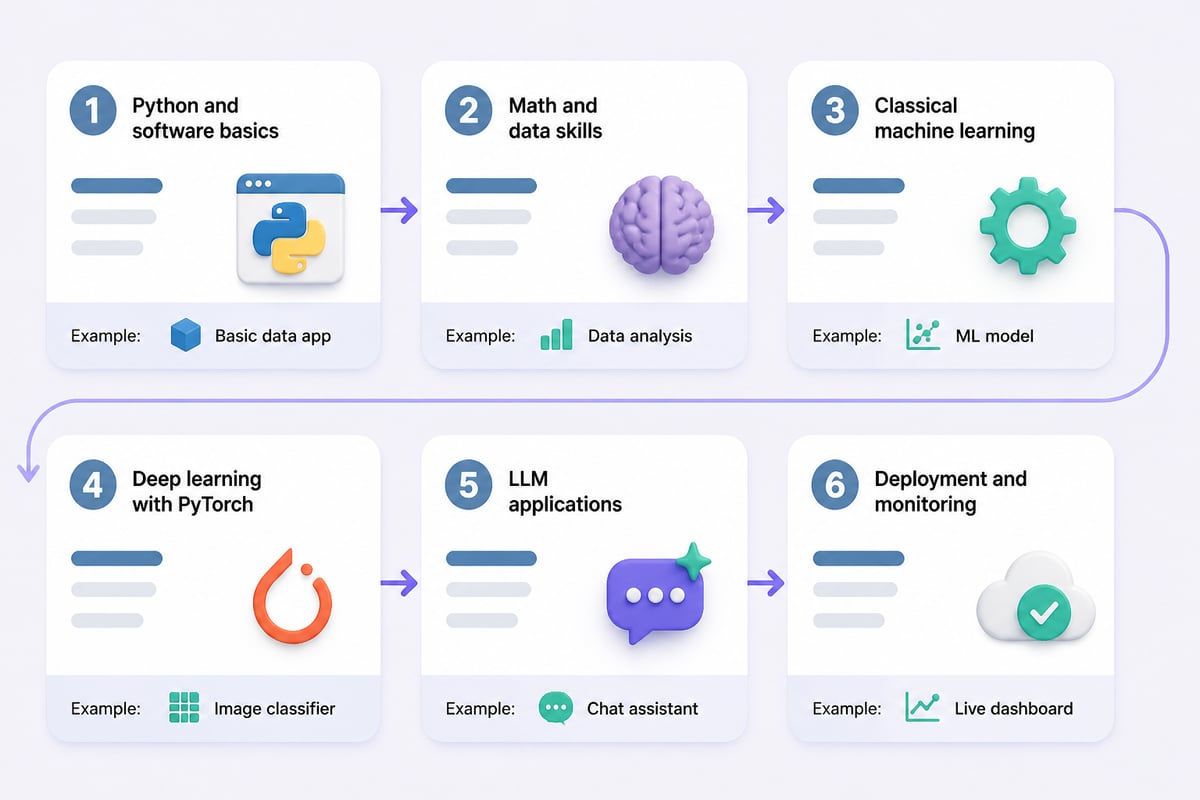
| Stage | Core skills | Typical time | Deliverable |
|---|---|---|---|
| 1. Programming | Python, Git, APIs, testing basics | 4 to 8 weeks | A command-line tool or small API |
| 2. Math and data | NumPy, pandas, SQL, statistics, linear algebra | 6 to 8 weeks | An exploratory analysis notebook |
| 3. Machine learning | scikit-learn, evaluation, feature work | 6 to 8 weeks | A tabular prediction model |
| 4. Deep learning | PyTorch, neural networks, transformers | 8 to 10 weeks | A trained image or text model |
| 5. LLM applications | Prompting, retrieval, agents, evaluation | 6 to 8 weeks | A retrieval-based assistant |
| 6. Deployment | Docker, cloud basics, monitoring | 4 to 6 weeks | A live, monitored app |
Treat the time column as a rough guide for part-time study, not a promise. Skip ahead only when you can complete the deliverable without copying a tutorial line by line.
How should you learn Python and software fundamentals?
Learn Python well enough to write clean, tested, readable code, because every later stage assumes it. AI engineering is software engineering with extra steps, and weak coding habits become the bottleneck faster than weak math does.
Focus on these topics:
- Core Python: data types, functions, classes, list and dictionary comprehensions, error handling
- Working with APIs: calling REST endpoints, handling JSON, managing keys safely
- Git and GitHub: branches, commits and pull requests
- Testing: writing a few unit tests with pytest
- Environments: virtual environments and dependency files
A good checkpoint is building a small tool that calls a public API, processes the response and saves results to a file. If you can do that, add tests and a README, you are ready for stage two.
Which math and data skills are required?
You need working knowledge of statistics, linear algebra and calculus concepts, plus fluent data handling with NumPy, pandas and SQL. Notice the word "working": you must understand what a gradient or a matrix multiplication does, not prove theorems about them.
Prioritize in this order:
- Statistics and probability: distributions, variance, correlation, sampling, and why a model can look accurate and still be wrong
- Linear algebra: vectors, matrices and dot products, since neural networks are built from them
- Calculus basics: derivatives and the chain rule, which explain how models learn
- Data wrangling: cleaning messy data with pandas and querying it with SQL
Pair every concept with code. When you learn what a dot product is, compute one in NumPy. When you learn about variance, calculate it on a real dataset and plot it. Abstract math without application fades quickly.
How do you get started with machine learning?
Start with classical machine learning on tabular data using scikit-learn before touching neural networks. Algorithms like linear regression, decision trees and gradient boosting still power a large share of production systems, and they teach you the discipline that deep learning also requires.
The core ideas to master:
- The difference between supervised and unsupervised learning
- Train, validation and test splits, and why leaking data between them ruins results
- Overfitting and underfitting
- Metrics such as precision, recall and F1, and when accuracy misleads
- Feature engineering and cross-validation
Build one project end to end: pick a dataset, define the prediction target, establish a simple baseline, then try to beat it. The baseline habit is one of the clearest signals of engineering maturity. A fancy model that barely beats "predict the average" is not an achievement.
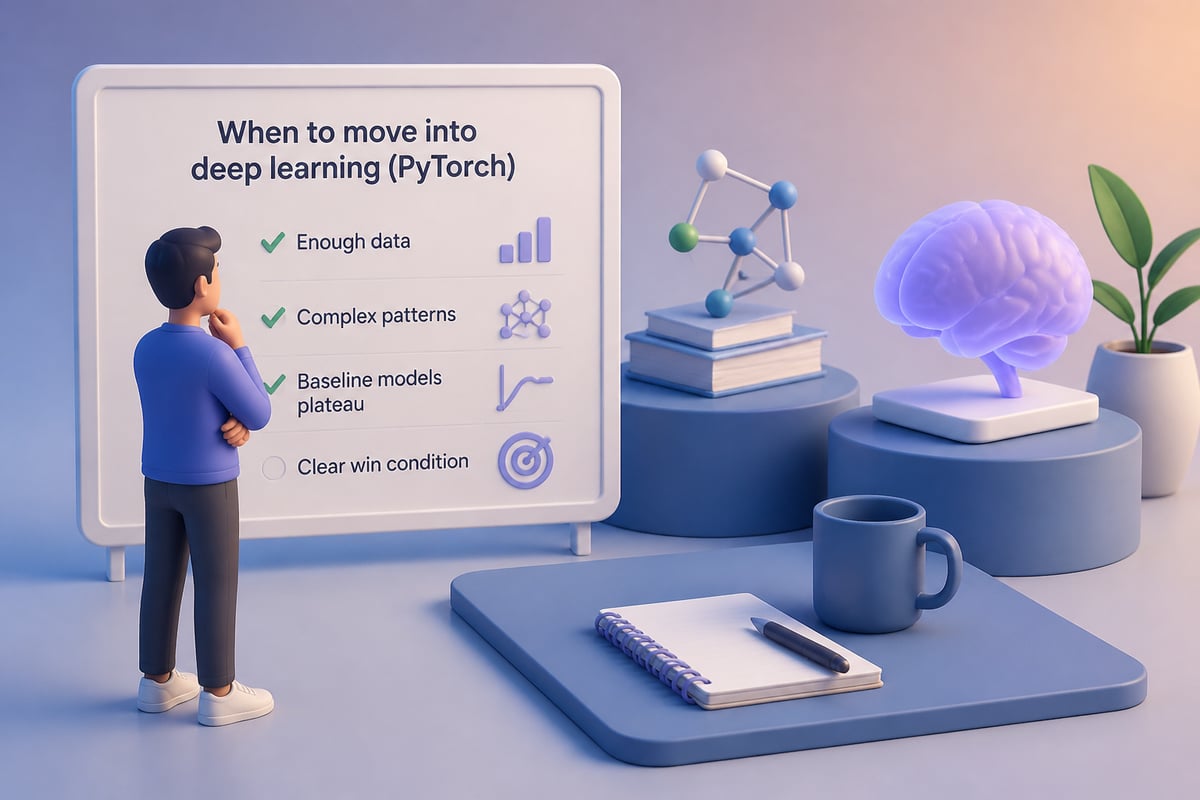
When should you move into deep learning with PyTorch?
Move to deep learning once you can explain overfitting, run cross-validation and read a confusion matrix without help. Deep learning adds capacity and complexity, so the fundamentals from stage three prevent you from mistaking noise for progress.
PyTorch is a sensible default framework. Its official beginner workflow covers tensors, datasets and data loaders, transforms, model building, automatic differentiation, optimization, and saving and loading models, which is a sensible sequence to learn. Its quickstart tutorial explains that training uses a loss function and an optimizer, with batches and repeated epochs adjusting model parameters. Understanding that loop, rather than memorizing library calls, is the real goal. The broader PyTorch tutorial hub also links recipes and examples for training and visualization.
A reasonable learning order:
- Tensors and automatic differentiation
- A feed-forward network on a simple dataset
- Convolutional networks for images
- Sequence models and the transformer architecture
- Fine-tuning a pretrained model instead of training from scratch
Step five matters most for a working career. Most employers want engineers who can adapt existing models, not reinvent them.
How do you build LLM applications as an AI engineer?
LLM application skills mean connecting a pretrained language model to your own data and workflows through prompting, retrieval, tool use and systematic evaluation. This is the stage where many current job postings concentrate, and it rewards both coding ability and clear writing.
Learn these building blocks in sequence:
- Prompt design: system prompts, few-shot examples, structured output formats. The guides on ChatGPT prompt engineering are a practical place to practice writing prompts that behave consistently.
- Retrieval-augmented generation (RAG): splitting documents, creating embeddings, storing them in a vector index and passing relevant passages to the model
- Tool use and agents: letting a model call functions, query databases or trigger actions, with guardrails on what it may do
- Evaluation: building a test set of realistic questions and scoring answers, so you can tell whether a change helped or hurt
Evaluation is the habit that separates hobby projects from professional ones. Without a fixed test set, every prompt tweak is a guess. Even 30 to 50 representative questions with expected answers will catch regressions that manual spot-checking misses.
How do you deploy and monitor AI systems responsibly?
Deploy by packaging your model or LLM feature behind an API, containerizing it with Docker, hosting it on a cloud platform, and monitoring quality, latency and cost after launch. A model that only runs on your laptop has not been shipped.
Cover these practical skills:
- Serving a model through FastAPI or a similar framework
- Building a Docker image and running it locally and in the cloud
- Logging inputs, outputs and errors, with privacy in mind
- Setting alerts for latency spikes, cost overruns and quality drift
Responsible practice is part of the job, not an optional extra. The NIST AI Risk Management Framework is voluntary guidance for incorporating trustworthiness into AI design, development, use and evaluation. NIST also publishes a Generative AI Risk Management Framework Profile as a companion resource for managing generative-AI risks. Reading both gives you a shared vocabulary for conversations about bias, privacy, security and reliability with managers and compliance teams.
Which projects belong in your portfolio?
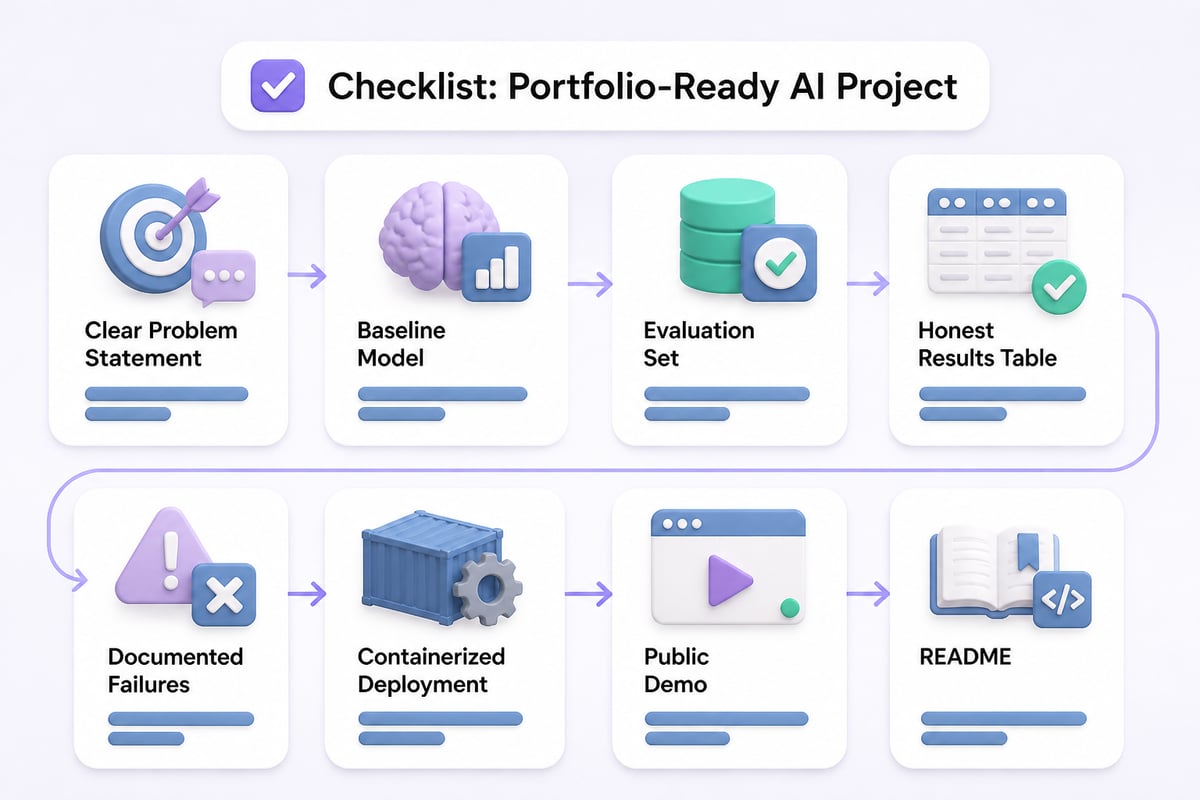
Build three to five projects that each show a different capability, and document the decisions behind them. A portfolio is evidence that you can finish things, so depth and clarity beat quantity.
A balanced set looks like this:
- A classical ML project with a clear baseline, honest metrics and a write-up of what failed
- A deep learning project that fine-tunes a pretrained model on a niche dataset
- A RAG assistant over a real document collection, with an evaluation set and a results table
- A deployed application with a public demo, a Docker setup and a monitoring dashboard
- An automation project that solves a workflow problem, such as triaging support emails or summarizing meeting notes
Hypothetical example: a learner with a finance background builds a retrieval assistant over publicly available regulatory filings, scores it against 40 hand-written questions, and documents which question types it still gets wrong. That write-up shows domain insight, evaluation discipline and honesty about limits, which is more persuasive than a flashy demo with no measurements.
For every project, include a README that states the problem, the approach, the results and the known weaknesses. Hiring managers read these quickly and trust candidates who name their own limitations.
How can prompt skills shorten your learning curve?
Using AI assistants well gives you a faster feedback loop while you study, as long as you use them to understand code rather than to skip understanding. Treat a tool like ChatGPT or Claude as a patient tutor that explains errors, proposes test cases and reviews your code.
Effective study prompts follow a pattern: state your level, paste the code or concept, and ask for a specific kind of help. For example, ask the assistant to explain a stack trace line by line, to quiz you on gradient descent with increasing difficulty, or to review a function for edge cases you missed. Then verify the answer by running the code, because models can produce confident mistakes.
Structured practice helps here. The tutorials on AI for engineering show how to turn vague requests into reliable, repeatable prompts, a skill that carries directly into building LLM features later.
For learners who also want a recognized credential alongside their projects, Mammoth Club's AI certification and training offers courses and practice questions covering how to use tools like ChatGPT and Claude to automate tasks and build job-ready skills. Certificates support a portfolio but do not replace one, so use them to structure your study and fill knowledge gaps.

What mistakes slow down aspiring AI engineers?
The most common mistakes are tutorial hopping, skipping fundamentals, and building projects nobody can evaluate. Each one feels productive in the moment and shows up as a gap in interviews.
- Tutorial hopping: finishing course after course without building anything original. Cap passive study at about half your weekly time.
- Skipping evaluation: reporting a single accuracy number on a dataset you tuned against
- Chasing every new framework: the tool names change often; the underlying ideas of data, loss, retrieval and evaluation change slowly
- Ignoring cost and latency: a prototype that answers well but costs too much per request is not a viable product
- Hiding failures: write down what did not work. It signals judgment.
One more trap: treating the roadmap as strictly linear. You will revisit earlier stages constantly. Writing a RAG pipeline will send you back to pandas and SQL, and that is normal.
How long does it take to become job-ready?
Dedicated part-time learners with some coding experience often need around 9 to 12 months to reach junior-level readiness, while complete beginners may need longer. Full-time study can compress this, but the limiting factor is usually project depth rather than hours.
Entry roles often carry titles such as junior ML engineer, AI developer or applied AI engineer. People moving into AI engineering from adjacent jobs, such as software development, analytics or technical operations, often progress faster because they already have part of the skill set. If you work in a non-technical field, an AI automation role inside your current company can be a realistic first step, since you already understand the business problems worth solving.
Check your readiness with this short test:
- Can you explain your three best projects without notes, including what went wrong?
- Can you build and evaluate a small RAG system in a day?
- Can you read a PyTorch training loop and explain each line?
- Can you deploy a service and describe how you would monitor it?
If you answer yes to all four, start applying. Waiting for perfect readiness is another form of procrastination.
Frequently asked questions
Do you need a degree to become an AI engineer?
No degree is strictly required, though many postings list one. A strong portfolio, demonstrable skills and relevant experience can offset the lack of a formal credential.
Is an AI engineer different from a data scientist?
Yes. Data scientists emphasize analysis, experimentation and insight, while AI engineers emphasize building and operating production systems that use models. The two overlap, and many professionals move between them.
Should you learn machine learning before LLMs?
Learn at least the basics first. Understanding training, evaluation and overfitting makes you far better at judging LLM behavior, even if your daily work centers on prompting and retrieval.
Which programming language should you choose?
Python. Nearly every major AI framework, tutorial and library supports it first, and it is the default language in job postings for this field.
Can you follow this roadmap while working full time?
Yes. Plan 8 to 10 hours per week, protect two longer weekend blocks for project work, and keep each stage's deliverable small enough to finish within a few weeks.
Pick one deliverable from stage one or two today, such as a small script that calls an API and saves the results, and finish it this week before opening another tutorial. When you are ready to practice writing prompts and automating real tasks with ChatGPT and Claude, the step-by-step tutorials and copy-and-paste prompts at Prompt Hero.Ai are built for professionals who learn by doing. If you want a structured certification path to go with your projects, Mammoth Club is one option to explore.