
An AI prompt engineer designs, tests and refines the instructions that large language models receive, so the model returns accurate, consistent and useful output for a specific business task. The role's pay depends heavily on seniority, and it rewards people who combine clear writing, structured thinking and enough technical skill to test prompts at scale.
This guide covers what the work looks like day to day, the skills that matter, realistic salary ranges, how to get hired, and where the job title is heading.
What does an AI prompt engineer do?
The work of an AI prompt engineer is to turn a business need into instructions a language model can follow reliably, then measure whether the results hold up. A 2025 career guide from Thrumos names prompt design, iterative testing, tailoring AI applications to business needs and cross-functional collaboration as the core responsibilities.
In practice, a typical week might include:
- Writing and rewriting system prompts for a customer support assistant
- Building a test set of 50 to 200 real inputs and scoring the outputs against a rubric
- Adding examples, constraints or output formats to reduce errors
- Documenting which prompt version works with which model
- Meeting with product managers, legal or support leads to learn what "good" means for their use case
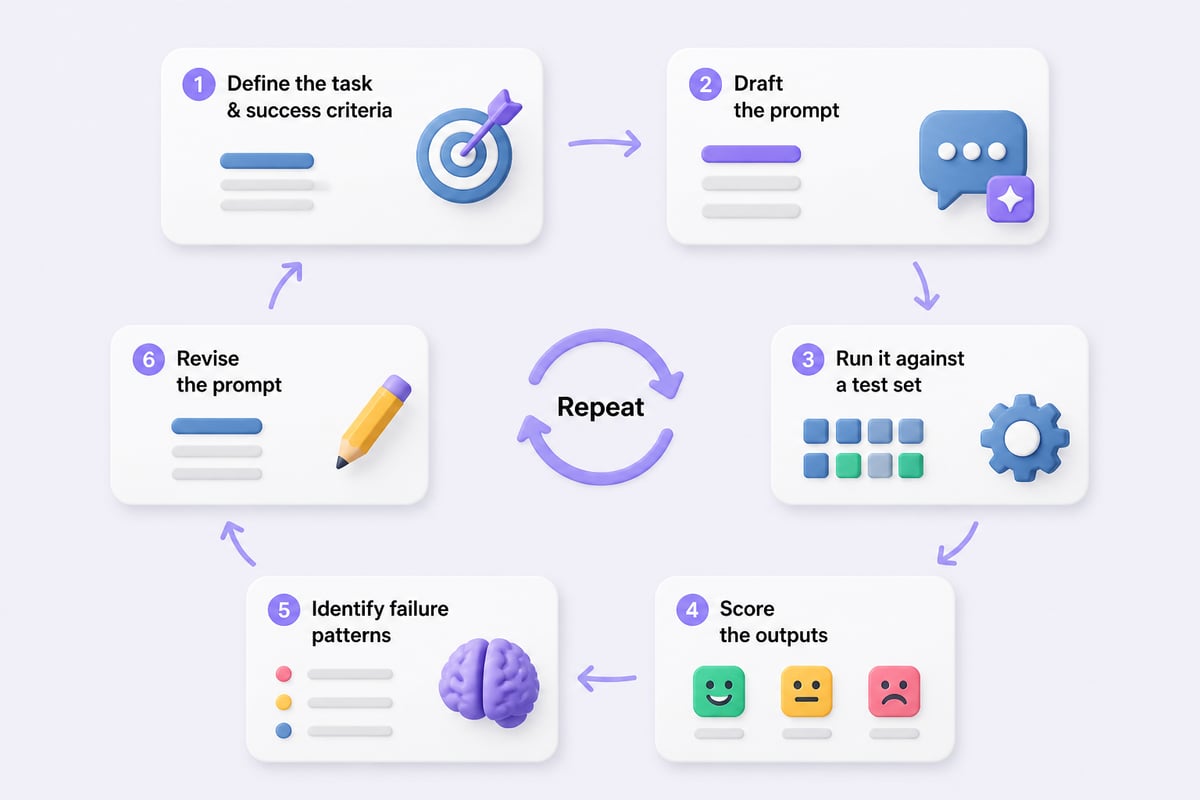
The job is closer to editing and quality control than to coding. You write an instruction, watch where the model fails, and adjust. Then you repeat that loop until the failure rate is low enough to ship.
A concrete example
Say a finance team wants an assistant that summarizes vendor contracts. A first-draft prompt ("Summarize this contract") returns a fluent but inconsistent paragraph. The engineer tightens it: name the role, list the six fields the team cares about (term, renewal date, payment terms, termination clause, liability cap, auto-renewal), require a table, and instruct the model to write "not stated" instead of guessing. Accuracy improves because the prompt now defines the job precisely.
Is prompt engineering a real career or a passing trend?
Prompt engineering is a real skill with real job listings, but the standalone job title is less stable than the skill itself. Many employers now fold the work into roles like AI product manager, AI solutions specialist, conversational designer, content strategist or machine learning engineer.
Here is the honest balance:
| Factor | What it suggests |
|---|---|
| Demand for the skill | Growing, since many teams adopting AI need someone who can get consistent results |
| Dedicated job titles | Fewer than the hype implied, and often paired with other duties |
| Model improvements | Newer models tolerate vague prompts better, so basic prompting is easier than before |
| Business value | Still strong for production systems where reliability, cost and compliance matter |
The practical takeaway: treat prompt engineering as a core skill that makes you more valuable in any role, and as a possible entry point into broader AI work. If you are weighing the long game, this career overview from AI Adda looks at how prompting fits into wider AI system design.
What skills does an AI prompt engineer need?
An AI prompt engineer needs clear writing, an understanding of how language models behave, and the discipline to test changes systematically. IBM lists familiarity with large language models, clear communication, explaining technical concepts, Python, data structures and algorithms, creativity and risk awareness among the relevant skills.
Core skills
- Precise writing. You must say exactly what you mean, including format, tone, length and what to do when information is missing.
- Model literacy. Know the differences between models, what context windows are, why outputs vary, and why a model may confidently state something false.
- Structured testing. Compare prompt versions against the same inputs, track results, and change one variable at a time.
- Domain knowledge. A prompt for legal intake, medical coding or sales email needs someone who understands the field well enough to judge the output.
- Communication. You will explain to non-technical colleagues why a prompt works and what the limits are.
Technical skills that raise your ceiling
Coding is optional for entry-level work, but it widens your options. IBM notes that engineers working on code generation need to understand coding principles and programming languages, while those working with image generators benefit from knowledge of art, photography and film terminology. Python is the most common addition, mainly for calling model APIs, running batch tests and parsing structured output such as JSON.
If you do not code and want to stay in AI, this guide to non-technical AI roles outlines a transition path that includes prompt work.
Which prompting techniques should you know?
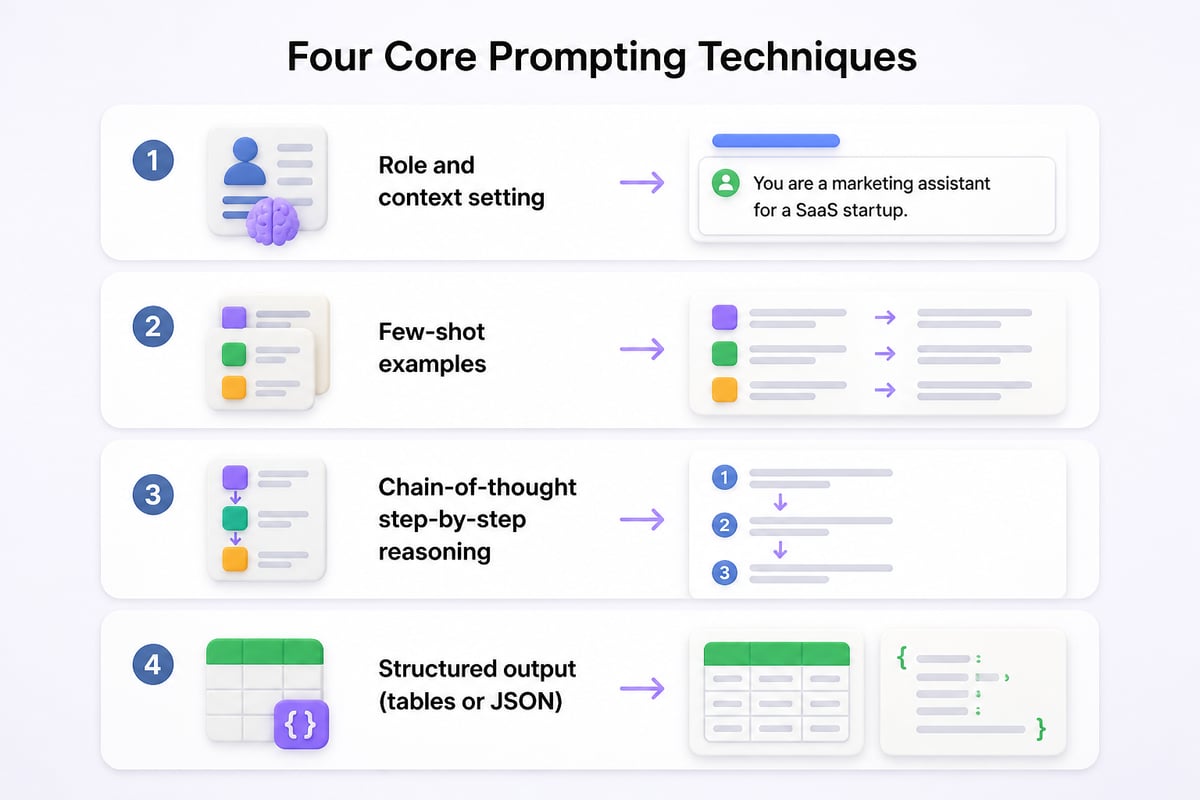
Four techniques cover most real-world work: role and context setting, few-shot examples, step-by-step reasoning and structured output. Learn these before anything exotic.
- Role and context setting. Tell the model who it is, who the audience is and what the goal is. "You are a procurement analyst reviewing a vendor contract for a finance director" beats "summarize this."
- Few-shot examples. Show two or three correct input-output pairs. The model copies the pattern, which is especially useful for classification and formatting.
- Chain-of-thought prompting. IBM describes this as giving a model step-by-step reasoning instructions. It helps on math, logic and multi-part analysis.
- Structured output. Ask for a table, JSON or a fixed template so downstream tools or teammates can use the result without cleanup.
A fifth habit matters just as much: write the failure instruction. Tell the model what to do when it cannot answer ("If the contract does not state a renewal date, write 'not stated'"). This one line prevents a large share of fabricated details.
How much does an AI prompt engineer make?
In the U.S., the Thrumos guide estimates $70,000 to $100,000 at entry level, $100,000 to $150,000 at mid-level, and $150,000 or more at senior level. Treat these as estimates rather than guarantees, because titles and duties vary widely between employers.
Geography changes the picture. The same guide estimates entry-level salaries of €40,000 to €60,000 in Europe and €20,000 to €50,000 in Asia, illustrating how widely estimates vary by region.
What pushes pay toward the top of a range:
- Production experience, meaning prompts that run inside live products
- Python and API skills
- Evaluation experience, such as building test sets and scoring systems
- Domain expertise in regulated or high-value fields like finance, healthcare or legal work
- The ability to connect prompt changes to business results such as hours saved or error rates reduced
How does this compare with other AI engineering salaries?
AI and machine learning engineers who build and train models generally sit higher than prompt-focused roles, because the work requires deeper math, software engineering and infrastructure skills. If salary is your main driver, a path that adds Python, data handling and model evaluation to your prompting skills moves you toward that tier. For background on how these disciplines relate, see this explainer on engineering in AI.
How do you become an AI prompt engineer?
The fastest route is to practice on real tasks, document the results, and show measurable improvement. A degree helps for some employers, but a portfolio of tested prompts often carries more weight in hiring conversations.
- Pick a work problem. Choose something concrete: triaging support tickets, drafting sales follow-ups, summarizing meeting notes or extracting data from invoices.
- Build a baseline. Write a simple prompt and run it on 20 to 30 real examples. Record what fails.
- Iterate and measure. Change one element at a time (role, examples, format, constraints) and score each version against the same inputs.
- Document before and after. Capture the original prompt, the final prompt, the test set and the accuracy or time-saved numbers.
- Learn the model differences. Run the same task across ChatGPT, Claude and at least one other model, and note where each behaves differently.
- Add light technical skills. Learn enough Python to call an API and run a batch of tests automatically.
- Publish your work. A short write-up or a shared folder of case studies gives interviewers something specific to discuss.
For structured practice, a good prompt engineering website with step-by-step tutorials and copy-and-paste prompts speeds up the early learning curve. If you want a formal credential to pair with your portfolio, Mammoth Club offers a library of AI certification courses and practice questions covering tools like ChatGPT and Claude.
Mammoth Club – AI Certification & Training gives you access to 3,000+ courses and over 1 million practice questions, which makes it a practical way to build job-ready AI skills alongside your hands-on prompt projects.

What does a good portfolio piece look like?
A strong portfolio piece shows a business problem, the prompt versions you tried, and a measured result. Hiring managers want evidence of judgment, not just clever wording.
Include these elements in each case study:
- The task and who it serves. One sentence on the problem and the end user.
- Success criteria. For example, "extracts all six contract fields with at least 95% accuracy."
- Version history. Show the first prompt, two or three revisions and the final version, with a note on what each change fixed.
- Test set and scoring method. Describe how many inputs you used and how you graded the outputs.
- Failure analysis. Explain what still goes wrong and how you would handle it in production, such as a human review step.
- Result. Time saved, error rate reduced or consistency improved.
Failure analysis is the part that separates strong candidates. Anyone can show a good output. Showing that you know where the system breaks, and what guardrails you would add, signals the risk awareness IBM lists among relevant skills.

What can you do with prompt engineering outside a dedicated job title?
You can apply prompt engineering skills inside almost any professional role to automate repetitive work, and that is often the quickest way to prove value. A marketing manager who builds a reusable brief-to-draft workflow, an operations lead who standardizes invoice extraction, or an analyst who turns raw survey comments into categorized themes are all doing prompt engineering without the title.
Reusable prompts work like templates. Write the instruction once, mark the variable parts (customer name, document text, date range), and share it with the team. When results drift, you adjust one place instead of dozens of individual chats.
This approach also builds the evidence for a career move. Documented time savings and error reductions from your current job make a stronger case than a course certificate alone. For related ideas on applying AI across disciplines, this guide to AI for engineering shows how practitioners use prompts in technical settings.
What are the pros and cons of this career path?
The role offers fast entry and broad applicability, balanced against title instability and a moving skill baseline.
Pros
- Low barrier to start, since you can practice with free or low-cost tools today
- Skills transfer across industries and across AI vendors
- Strong fit for writers, analysts, support leads and domain specialists
- Clear path to adjacent roles such as AI product, evaluation or solutions work
Cons
- Dedicated "prompt engineer" listings are limited, and many roles bundle the work with other duties
- Model updates can change what works, so prompts need ongoing maintenance
- Basic prompting is becoming easier as models improve, which raises the bar for standing out
- Salary ranges vary widely by region and employer
The safest strategy is to build prompting skill alongside a second strength, such as a domain, Python or data analysis, so your value does not depend on a single job title.
FAQ
What can an AI engineer do?
An AI engineer builds, deploys and maintains systems that use machine learning or large language models, including data pipelines, model integration, evaluation and monitoring. A prompt engineer focuses on the instructions and testing that shape model output, while an AI engineer typically handles the broader software and infrastructure work.
Do you need to code to be a prompt engineer?
Not always. Many entry-level roles emphasize writing, testing and domain knowledge. Python becomes important when you need to run batch tests, call APIs or work on teams that ship AI features inside software products.
Is a degree required?
Requirements vary by employer. Some prefer degrees in computer science, linguistics or a related field, but many hiring teams weigh demonstrated results and a portfolio of tested prompts heavily.
Start this week by picking one repetitive task from your job, writing a baseline prompt, and scoring it against 20 real examples. That single exercise teaches the core loop of the profession. Prompt Hero.Ai provides practical AI tutorials and prompts for real-world use, with step-by-step instructions, copy-and-paste prompts and real examples designed for professionals who want to automate tasks, improve productivity and solve business problems with tools like ChatGPT and Claude. Pair that practice with the structured courses in Mammoth Club if you want a certification to back up your portfolio, and explore the tutorials at Prompt Hero.Ai to turn your first prompts into repeatable workflows.