
The demand for professionals who can build, deploy, and maintain AI systems has exploded. An ai engineer bridges the gap between research and production, turning machine learning models into real-world applications that solve business problems. Unlike data scientists who focus on analysis and experimentation, ai engineers create scalable systems that handle millions of requests daily. This tutorial shows you how to approach AI engineering work, what skills you need, and how to build deployable AI solutions using modern tools.
What an AI Engineer Actually Does
An ai engineer transforms prototype models into production-ready systems. The role combines software engineering principles with machine learning knowledge to create reliable, scalable AI applications.
Daily responsibilities include designing data pipelines, training and fine-tuning models, building APIs for model serving, and monitoring system performance. You'll work with frameworks like TensorFlow and PyTorch, cloud platforms such as AWS or Google Cloud, and deployment tools including Docker and Kubernetes.
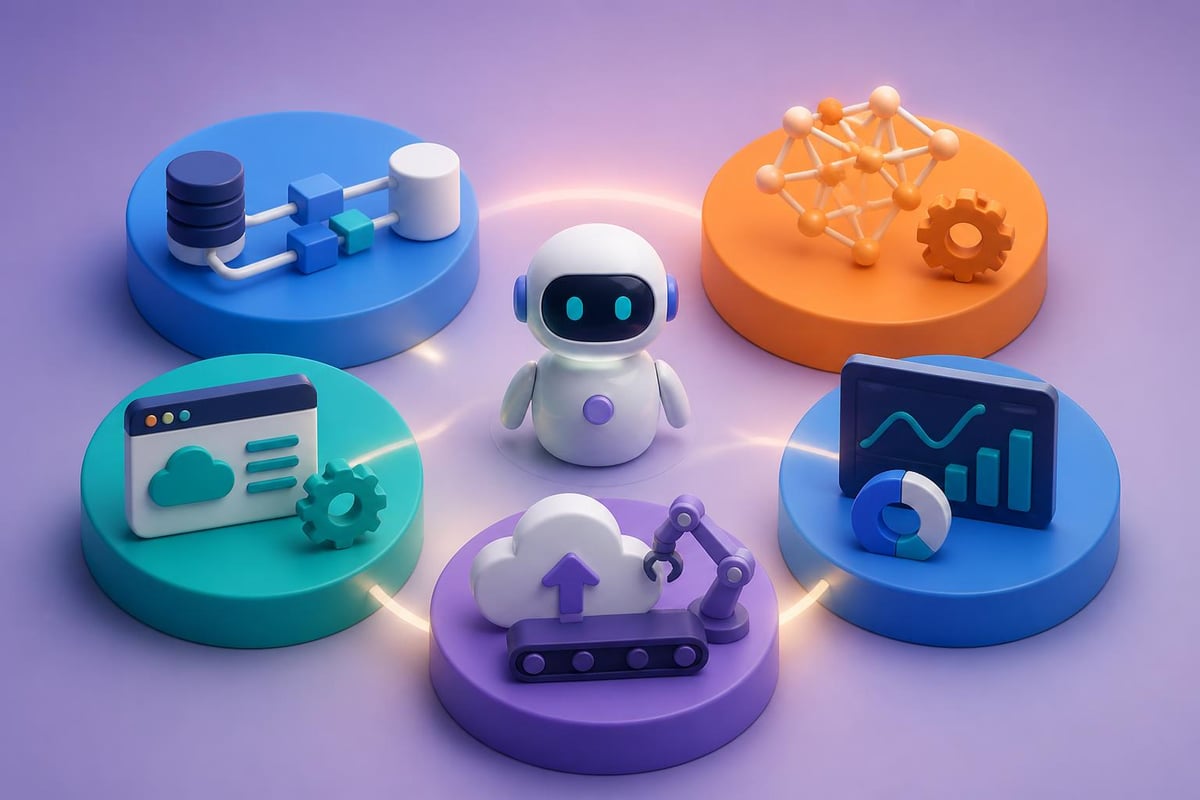
The key responsibilities and essential skills required for AI engineers include both technical expertise and problem-solving capabilities that extend beyond coding.
Core Technical Skills
Every ai engineer needs proficiency in specific technical areas:
- Programming languages: Python (primary), with knowledge of Java, C++, or Go for performance-critical components
- ML frameworks: TensorFlow, PyTorch, scikit-learn for model development
- Cloud platforms: AWS SageMaker, Google Cloud AI Platform, Azure ML
- DevOps tools: Docker, Kubernetes, Git, CI/CD pipelines
- Database systems: SQL and NoSQL databases, vector databases for embeddings
Understanding the blurring boundaries between research and engineering roles helps you position yourself effectively in the rapidly evolving AI job market.
Building Your First Production AI System
This section walks through creating a deployable AI system from scratch. We'll build a text classification API that categorizes customer support tickets.
Step 1: Define the Problem and Requirements
Start by clarifying exactly what your system needs to accomplish. For our example, we need an API that accepts customer messages and returns categories like "billing," "technical," or "account."
Requirements checklist:
- Input format (JSON with text field)
- Expected response time (under 500ms)
- Accuracy threshold (85% or higher)
- Scale requirements (1000 requests per minute)
- Error handling strategy
Step 2: Prepare and Validate Your Data
Quality data determines model performance. Collect at least 1,000 labeled examples per category, ensuring balanced representation across all classes.
Use this ChatGPT prompt to generate synthetic training data when real data is limited:
You are a customer support specialist. Generate 20 realistic customer support messages for [CATEGORY]. Each message should:
- Be 1-3 sentences long
- Sound like real customer language (include typos, informal tone)
- Cover different scenarios within this category
- Vary in complexity and urgency

Categories to generate for: billing issues, technical problems, account questions, product inquiries

Format as CSV with columns: message, category
Example output:
message,category
"my credit card was charged twice for the same order???","billing issues"
"cant login even after resetting password 3 times","technical problems"
"how do i change my email address on my account","account questions"
Step 3: Train and Optimize Your Model
For text classification, fine-tuning a pre-trained model delivers better results than training from scratch. Use this approach:
from transformers import AutoModelForSequenceClassification, AutoTokenizer, TrainingArguments, Trainer
import pandas as pd

# Load your data
df = pd.read_csv('support_tickets.csv')

# Initialize model
model_name = "distilbert-base-uncased"
model = AutoModelForSequenceClassification.from_pretrained(model_name, num_labels=4)
tokenizer = AutoTokenizer.from_pretrained(model_name)

# Tokenize data
def tokenize_function(examples):
    return tokenizer(examples["message"], padding="max_length", truncation=True)

# Training arguments
training_args = TrainingArguments(
    output_dir="./results",
    num_train_epochs=3,
    per_device_train_batch_size=16,
    evaluation_strategy="epoch"
)
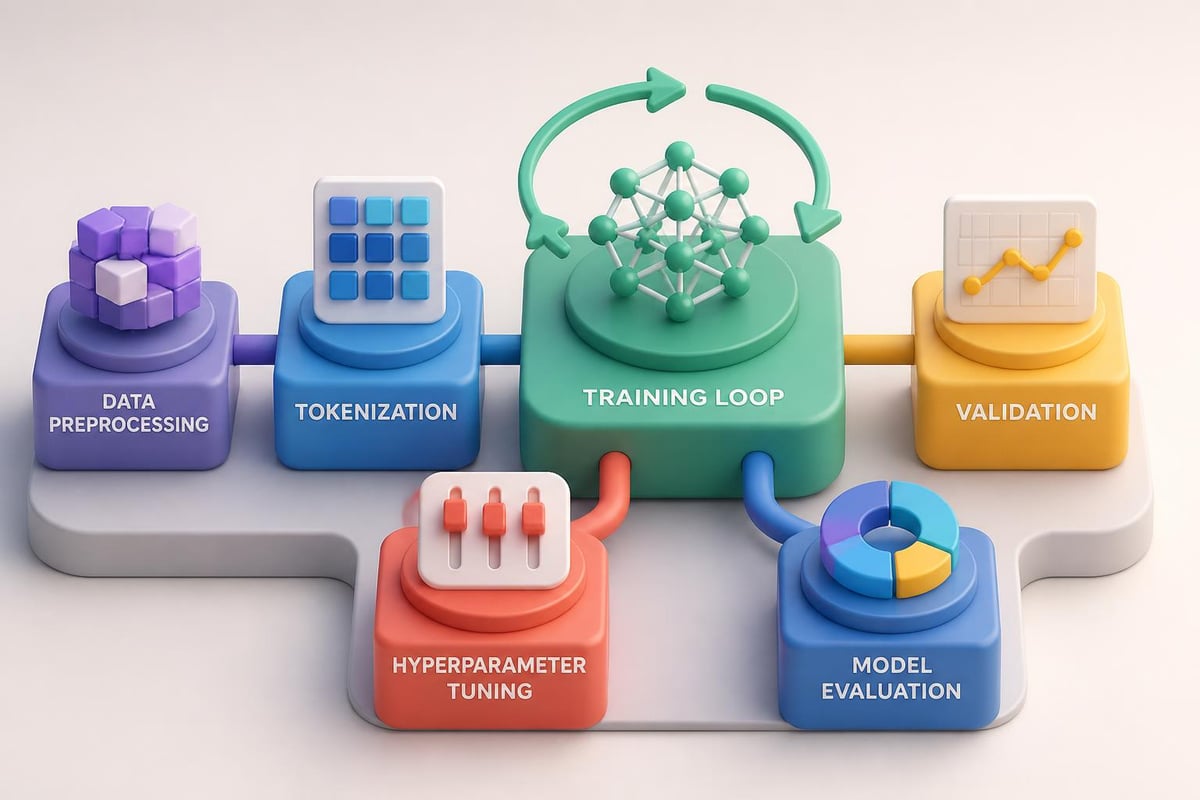
Step 4: Create a Production API
Transform your model into a usable service with FastAPI:
from fastapi import FastAPI
from pydantic import BaseModel
import torch

app = FastAPI()

class SupportTicket(BaseModel):
    message: str

class Prediction(BaseModel):
    category: str
    confidence: float

@app.post("/classify", response_model=Prediction)
async def classify_ticket(ticket: SupportTicket):
    # Tokenize input
    inputs = tokenizer(ticket.message, return_tensors="pt", truncation=True, padding=True)

    # Get prediction
    with torch.no_grad():
        outputs = model(**inputs)
        prediction = torch.nn.functional.softmax(outputs.logits, dim=-1)
        category_idx = prediction.argmax().item()
        confidence = prediction[0][category_idx].item()

    categories = ["billing", "technical", "account", "product"]

    return Prediction(
        category=categories[category_idx],
        confidence=round(confidence, 3)
    )
Example API response:
{
  "category": "billing",
  "confidence": 0.947,
  "processing_time_ms": 124
}
Essential Skills Beyond Coding
Technical skills alone don't make an effective ai engineer. You need business acumen and communication abilities that help you ship valuable solutions.
Understanding Business Impact
Every AI system should solve a measurable business problem. Before building anything, ask:
- What metric will this improve? (revenue, cost reduction, customer satisfaction)
- How will we measure success?
- What's the baseline performance without AI?
- What accuracy level makes this valuable?
Calculate ROI early. If your model saves 2 hours of manual work daily and achieves 80% accuracy, determine whether that justifies the development and maintenance costs.
Prompt Engineering for AI Engineers
Modern ai engineers increasingly work with large language models rather than training custom models. Understanding hard and soft skill requirements for prompt engineers reveals the competencies needed for this emerging specialization.
For system integration, structure your prompts with clear instructions, examples, and output formats:
Role: You are a senior data analyst who extracts structured information from unstructured text.

Task: Extract key product features from customer reviews and return them in JSON format.

Input: [CUSTOMER_REVIEW_TEXT]

Required fields:
- mentioned_features: array of specific product features mentioned
- sentiment: "positive", "negative", or "neutral" for each feature
- confidence: 0-1 score for extraction accuracy

Output format:
{
  "features": [
    {"name": "battery life", "sentiment": "positive", "confidence": 0.9},
    {"name": "camera quality", "sentiment": "negative", "confidence": 0.85}
  ]
}

Return only valid JSON. No additional text.
If you're looking to build comprehensive AI skills systematically, Mammoth Club’s AI certification program offers over 3,000 courses covering everything from foundational machine learning to advanced deployment strategies, with practice questions to validate your knowledge.

Deployment and Monitoring
Getting a model into production is only half the battle. An ai engineer must ensure systems remain reliable, accurate, and performant over time.
Containerization and Orchestration
Package your application with Docker to ensure consistency across environments:
FROM python:3.9-slim

WORKDIR /app

COPY requirements.txt .
RUN pip install --no-cache-dir -r requirements.txt

COPY . .

EXPOSE 8000

CMD ["uvicorn", "main:app", "--host", "0.0.0.0", "--port", "8000"]
Deploy to Kubernetes for automatic scaling and health monitoring:
apiVersion: apps/v1
kind: Deployment
metadata:
  name: ticket-classifier
spec:
  replicas: 3
  selector:
    matchLabels:
      app: classifier
  template:
    metadata:
      labels:
        app: classifier
    spec:
      containers:
      - name: api
        image: ticket-classifier:v1
        ports:
        - containerPort: 8000
        resources:
          requests:
            memory: "512Mi"
            cpu: "500m"
          limits:
            memory: "1Gi"
            cpu: "1000m"
Performance Monitoring
Track these metrics for every production AI system:
| Metric | Target | Alert Threshold |
|---|---|---|
| Response time | <500ms | >1000ms |
| Accuracy | >85% | <80% |
| Error rate | <1% | >5% |
| Request rate | 1000/min | >1500/min |
| Model drift | <5% change | >10% change |
Implement logging to detect model degradation:
import logging
from datetime import datetime

logger = logging.getLogger(__name__)

def log_prediction(input_text, prediction, confidence, actual_label=None):
    log_data = {
        "timestamp": datetime.utcnow().isoformat(),
        "input_length": len(input_text),
        "prediction": prediction,
        "confidence": confidence,
        "actual_label": actual_label
    }

    logger.info(f"Prediction logged: {log_data}")

    # Store in database for drift detection
    if actual_label and actual_label != prediction:
        logger.warning(f"Mismatch detected: predicted {prediction}, actual {actual_label}")
Career Path and Compensation
The ai engineer role offers strong career growth and competitive compensation. Understanding the trajectory helps you plan your development.
Salary Expectations
Compensation varies significantly by experience and location. According to recent analyses of AI engineer salaries, entry-level positions start around $90,000-$120,000 annually, while senior ai engineers earn $150,000-$250,000 or more.
The lucrative compensation packages at major tech companies demonstrate the industry's willingness to invest in AI talent, with total compensation often exceeding base salary by 30-50% when including equity and bonuses.
| Experience Level | Base Salary Range | Total Compensation |
|---|---|---|
| Entry (0-2 years) | $90K – $120K | $100K – $140K |
| Mid (3-5 years) | $120K – $160K | $150K – $200K |
| Senior (6-10 years) | $160K – $220K | $200K – $300K |
| Principal/Staff | $220K – $300K+ | $300K – $500K+ |
Progression Timeline
Most ai engineers follow this career trajectory:
- Junior AI Engineer (0-2 years): Implement existing models, build data pipelines, support senior engineers
- AI Engineer (2-5 years): Design and deploy complete systems, optimize performance, mentor juniors
- Senior AI Engineer (5-8 years): Lead technical projects, make architectural decisions, define standards
- Staff/Principal Engineer (8+ years): Set technical vision, influence product strategy, drive innovation
Tools and Frameworks You Need
Modern ai engineers rely on an expanding toolkit. Industry leaders like Nvidia's CEO emphasize that AI tools are essential for engineering productivity, comparing not using AI to designing chips with paper and pencil.
Development Environment
Set up your workspace with these essential tools:
- Version control: Git with GitHub or GitLab for code management
- Experiment tracking: Weights & Biases or MLflow to track model iterations
- Notebooks: Jupyter for exploration, but migrate to scripts for production
- Testing frameworks: pytest for unit tests, locust for load testing
- Documentation: Sphinx or MkDocs for API documentation
Model Serving Options
Choose the right serving infrastructure based on your requirements:
For low-latency predictions:
- TensorFlow Serving for TensorFlow models
- TorchServe for PyTorch models
- Triton Inference Server for multi-framework support
For general API serving:
- FastAPI (Python, easy to use, good performance)
- Flask (Python, simple but slower)
- gRPC (language-agnostic, high performance)
For managed solutions:
- AWS SageMaker endpoints
- Google Cloud AI Platform predictions
- Azure ML managed endpoints

Continuous Learning Strategies
AI engineering evolves rapidly. Staying current requires deliberate learning strategies beyond formal education.
Research from educational programs for AI engineers highlights the importance of hands-on projects and real-world problem-solving in developing practical skills.
Weekly Learning Routine
Structure your ongoing education:
Monday-Tuesday: Read 2-3 research papers or technical blog posts
Wednesday: Implement a small feature or optimization in a side project
Thursday: Watch a conference talk or technical tutorial
Friday: Write about what you learned (blog, documentation, or notes)
Weekend: Work on a personal AI project or contribute to open source
Project Ideas for Skill Building
Build these projects to develop production-ready skills:
- Real-time sentiment analyzer: Stream Twitter data, classify sentiment, visualize trends
- Document Q&A system: Use RAG (Retrieval Augmented Generation) with company documentation
- Image classifier pipeline: Train on custom dataset, deploy with proper monitoring
- Recommendation engine: Build collaborative filtering system with A/B testing
- Chatbot with memory: Create conversational AI that maintains context across sessions
For step-by-step guidance on working with AI tools and frameworks, explore practical AI tutorials at Prompt Hero.Ai that provide copy-paste prompts and real examples.
Common Challenges and Solutions
Every ai engineer faces similar obstacles when building production systems. Here's how to overcome them.
Challenge 1: Model Performance Degrades Over Time
Solution: Implement automated retraining pipelines triggered by performance metrics. Monitor prediction distribution to detect drift early.
def check_distribution_drift(current_predictions, baseline_predictions, threshold=0.1):
    """Compare prediction distributions using KL divergence"""
    from scipy.stats import entropy

    current_dist = np.histogram(current_predictions, bins=10, density=True)[0]
    baseline_dist = np.histogram(baseline_predictions, bins=10, density=True)[0]

    kl_div = entropy(current_dist, baseline_dist)

    if kl_div > threshold:
        trigger_retraining_pipeline()
        send_alert(f"Distribution drift detected: KL={kl_div:.3f}")
Challenge 2: Slow Inference Times
Solution: Apply model optimization techniques:
- Quantization: Reduce model precision from FP32 to INT8
- Pruning: Remove unnecessary model parameters
- Distillation: Train smaller model to mimic larger one
- Batching: Process multiple requests together
- Caching: Store results for common inputs
Challenge 3: Managing Multiple Model Versions
Solution: Use model registry and versioning:
| Version | Accuracy | Latency | Status | Deployed Date |
|---|---|---|---|---|
| v1.0 | 83.2% | 450ms | Deprecated | 2025-09-15 |
| v1.1 | 85.7% | 420ms | Canary (5%) | 2026-02-20 |
| v1.2 | 86.1% | 380ms | Production | 2026-04-10 |
| v2.0 | 88.3% | 520ms | Testing | 2026-05-15 |
Deploy new versions gradually using canary releases to minimize risk.
Working with Stakeholders
Technical excellence means nothing if you can't communicate value to non-technical stakeholders. An effective ai engineer translates complex systems into business outcomes.
Presenting Results
When sharing model performance, focus on business metrics:
Instead of: "We achieved 87% accuracy with 0.92 F1 score"
Say: "The model correctly handles 87 out of 100 support tickets automatically, saving 35 hours of manual work weekly"
Create dashboards that show:
- Cost savings from automation
- Time saved per week
- Error reduction percentages
- Customer satisfaction impact
Managing Expectations
Be honest about AI limitations:
- Explain confidence scores and when human review is needed
- Define clear success metrics before starting projects
- Communicate that AI systems require ongoing maintenance
- Set realistic timelines (most projects take 2-3x longer than initial estimates)
Use this framework for project proposals:
Problem: [Specific business problem in one sentence]
Current cost: [Time/money spent on manual process]
Proposed solution: [AI system description]
Expected accuracy: [Realistic percentage with confidence interval]
Implementation time: [Conservative timeline]
Ongoing maintenance: [Monthly hours required]
ROI calculation: [Show break-even point]
Becoming an effective ai engineer requires combining technical depth with practical deployment skills and business understanding. The most successful professionals focus on shipping reliable systems that solve real problems rather than chasing perfect accuracy in isolation. Start with small, well-defined projects that demonstrate clear value, then expand your scope as you build confidence and expertise. Ready to accelerate your AI engineering journey with practical, hands-on tutorials? Prompt Hero.Ai provides step-by-step guides, ready-to-use prompts, and real-world examples that help you build production-ready AI systems faster.