Learning artificial intelligence has become essential for professionals looking to stay competitive in 2026, and Python remains the dominant programming language for AI development. An ai with python course provides the foundational skills needed to build machine learning models, automate complex tasks, and create intelligent systems that solve real business problems. Whether you're a complete beginner or an experienced developer looking to transition into AI, choosing the right course can make the difference between frustration and rapid progress.
Understanding What an AI with Python Course Covers
A comprehensive ai with python course typically begins with Python fundamentals before diving into specialized AI libraries and frameworks. The curriculum progression matters because AI development requires both programming proficiency and mathematical understanding.
Core Programming Foundations
Most quality courses start with Python basics, even if you have some programming experience. You'll learn data types, control structures, functions, and object-oriented programming concepts. These foundational elements become crucial when you're debugging machine learning models or customizing algorithms for specific use cases.
Key Python concepts for AI development include:
- List comprehensions and data manipulation techniques
- NumPy arrays for numerical computing
- Pandas dataframes for data analysis
- File handling and API integration
- Error handling and debugging strategies
The transition from basic Python to AI-specific libraries happens gradually. You'll work with matplotlib and seaborn for data visualization before moving into scikit-learn for machine learning implementations. This layered approach prevents the overwhelming feeling that comes from jumping directly into complex neural networks.
Machine Learning Fundamentals
After establishing Python proficiency, an ai with python course introduces machine learning concepts through practical implementation. You'll learn supervised learning with regression and classification algorithms, unsupervised learning through clustering, and model evaluation techniques that determine whether your AI system actually works.
| Learning Type | Common Algorithms | Real-World Applications |
|---|---|---|
| Supervised | Linear Regression, Decision Trees, Random Forests | Price prediction, customer churn, fraud detection |
| Unsupervised | K-Means, DBSCAN, PCA | Customer segmentation, anomaly detection, dimensionality reduction |
| Reinforcement | Q-Learning, Deep Q-Networks | Game AI, robotics, recommendation optimization |
Understanding when to apply each algorithm separates theoretical knowledge from practical expertise. A quality course provides datasets and problems that mirror real business scenarios rather than academic exercises.

Choosing the Right AI with Python Course for Your Goals
Not all courses serve the same audience or learning objectives. Your background, available time, and career goals should inform your course selection.
Beginner-Friendly Options
If you're new to both programming and AI, look for courses that assume zero prior knowledge. DeepLearning.AI’s AI Python for Beginners course taught by Andrew Ng provides an excellent starting point with clear explanations and gradual skill building.
These introductory programs typically span 8-12 weeks with 5-10 hours of weekly commitment. They emphasize hands-on projects over theoretical mathematics, which helps maintain motivation during the challenging early stages.
Academic and University Programs
For learners who prefer structured academic environments, university-backed programs offer rigorous curricula with recognized credentials. Harvard’s CS50’s Introduction to Artificial Intelligence with Python provides comprehensive coverage of AI fundamentals including search algorithms, knowledge representation, and machine learning.
Academic courses excel at building deep theoretical understanding. You'll learn the mathematical foundations behind algorithms, which becomes valuable when you need to customize models or troubleshoot unexpected behaviors. The trade-off is a steeper learning curve and more time investment compared to bootcamp-style programs.
Project-Based Specializations
Professional developers often benefit most from project-focused programs that emphasize building deployable AI systems. Coursera’s Artificial Intelligence with Python: Foundations to Projects specialization guides learners through complete project lifecycles from data collection to model deployment.
Project-based courses typically include:
- Data pipeline creation and management
- Model training with cross-validation
- Hyperparameter tuning and optimization
- API development for model serving
- Performance monitoring and model updating
This approach mirrors actual AI development workflows in business environments. You'll encounter the same challenges faced by data scientists and machine learning engineers, making the transition to professional work smoother.
Essential Tools and Libraries You'll Master
An ai with python course introduces you to the ecosystem of libraries that make Python the preferred language for AI development. Understanding which tools solve which problems accelerates your learning and project development.
Data Manipulation and Analysis
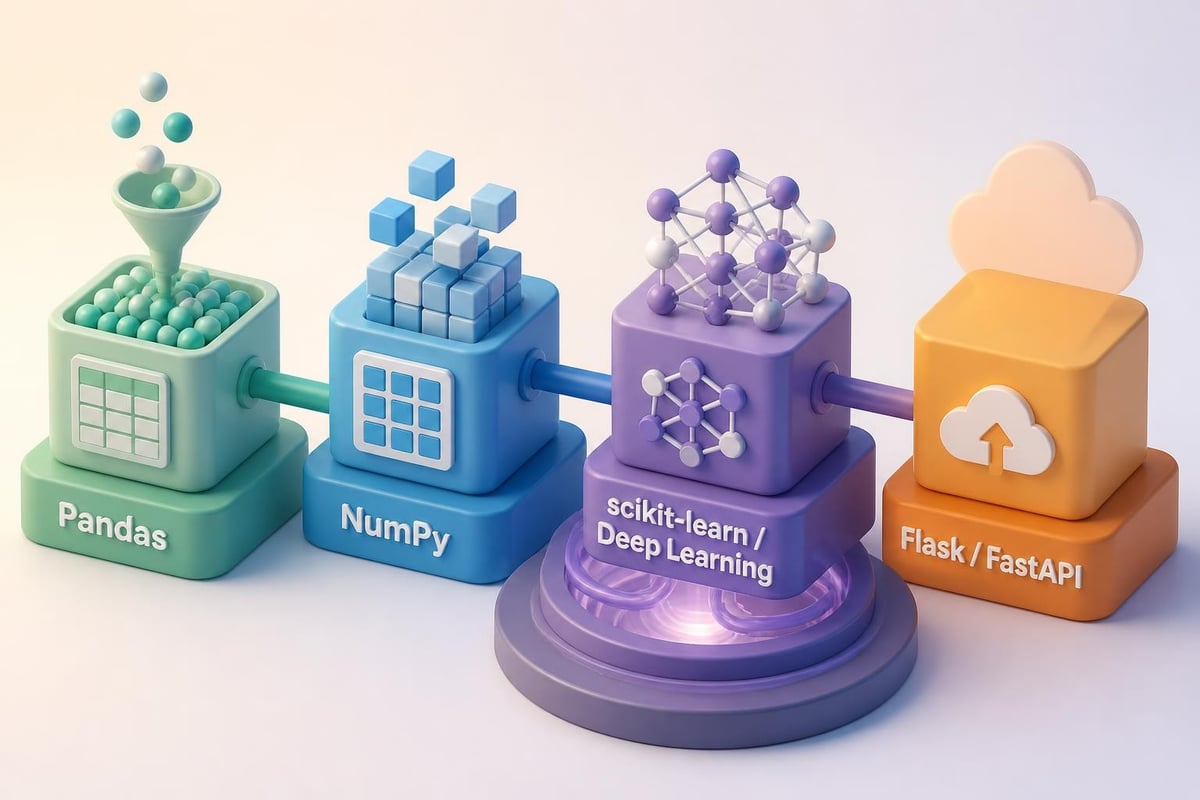
Before building any AI model, you need clean, properly formatted data. Pandas becomes your primary tool for data manipulation, handling everything from CSV files to database connections. You'll learn to filter datasets, handle missing values, create new features, and transform data into formats suitable for machine learning algorithms.
NumPy provides the numerical computing foundation that supports all AI libraries. Its array operations run significantly faster than native Python loops, which matters when processing large datasets or training complex models.
Machine Learning Frameworks
Scikit-learn serves as the standard library for traditional machine learning algorithms. It provides consistent APIs across dozens of algorithms, making it easy to experiment with different approaches. You'll use it for classification, regression, clustering, and dimensionality reduction tasks.
For deep learning projects, TensorFlow and PyTorch dominate the landscape. An ai with python course typically covers at least one of these frameworks in depth:
| Framework | Strengths | Best For |
|---|---|---|
| TensorFlow | Production deployment, mobile integration, extensive ecosystem | Large-scale applications, enterprise projects |
| PyTorch | Research flexibility, intuitive debugging, dynamic graphs | Prototyping, research, custom architectures |
| Keras | High-level API, quick prototyping, beginner-friendly | Rapid development, standard architectures |
Most professionals eventually learn both TensorFlow and PyTorch since each excels in different scenarios. Starting with one provides transferable knowledge that makes learning the second framework much faster.
Practical Applications That Reinforce Learning
Theory without application creates knowledge that fades quickly. The best ai with python course options emphasize building functional AI systems that solve recognizable problems.
Natural Language Processing Projects
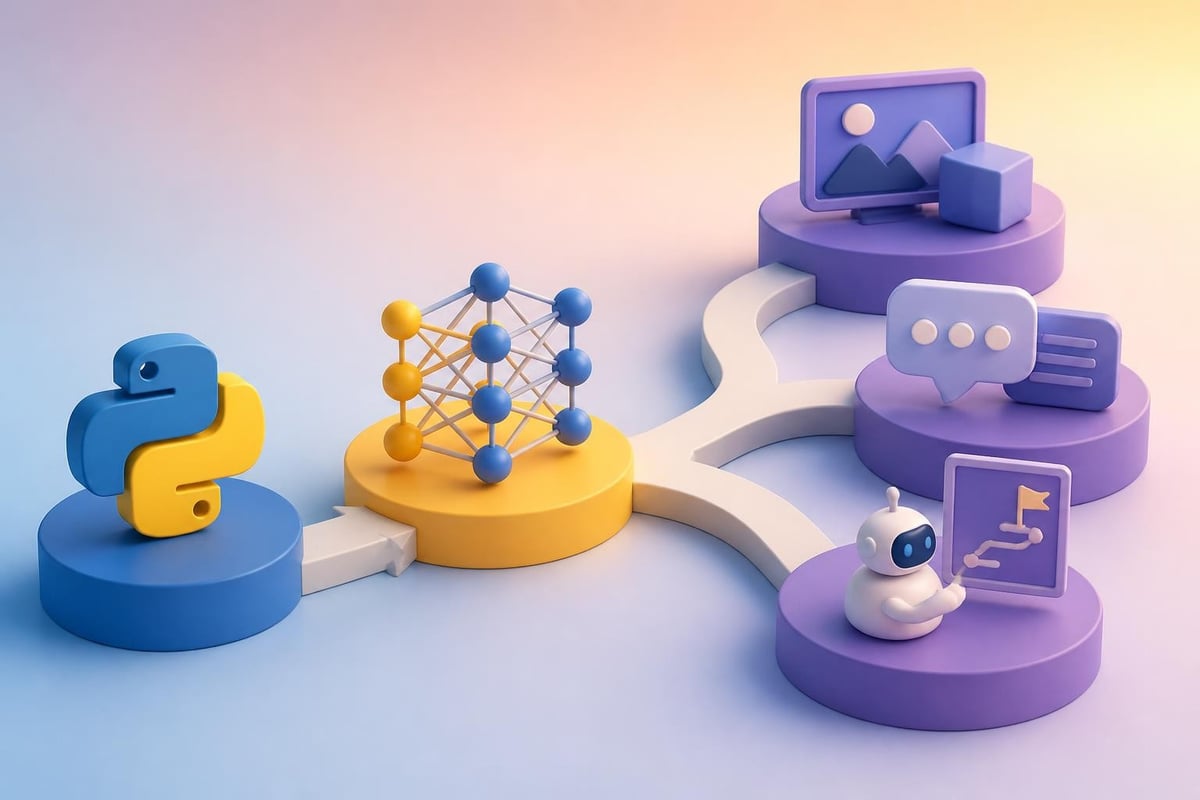
Text analysis remains one of the most accessible AI applications for beginners. You'll build sentiment analyzers that determine whether customer reviews are positive or negative, chatbots that handle basic customer service inquiries, and text classifiers that automatically categorize documents.
These projects introduce concepts like tokenization, word embeddings, and sequence modeling. Working with real text data from sources like Twitter or Reddit makes the learning process more engaging than using cleaned academic datasets.
Computer Vision Applications
Image classification projects teach convolutional neural networks through hands-on implementation. You might build systems that identify dog breeds, detect manufacturing defects, or recognize handwritten digits. Transfer learning techniques let you achieve impressive results without massive datasets or computing resources.
UC San Diego’s Building Machine Learning Systems with Python course provides extensive hands-on experience with computer vision applications alongside other AI domains.
Recommendation Systems
Building recommendation engines teaches collaborative filtering, content-based filtering, and hybrid approaches. These systems power everything from Netflix suggestions to e-commerce product recommendations. The business impact of recommendation systems makes them particularly relevant for professionals looking to apply AI in commercial settings.
Implementation steps for a basic recommendation system:
- Collect user interaction data (ratings, purchases, clicks)
- Create user-item matrices representing preferences
- Calculate similarity scores between users or items
- Generate predictions for unrated items
- Evaluate recommendations using metrics like precision and recall
Understanding recommendation systems provides insights into personalization strategies that drive engagement and revenue across digital platforms.
Advanced Topics and Specialization Paths
Once you complete foundational ai with python course content, specialization paths let you develop expertise in specific AI domains.
Autonomous AI Agents
Modern AI development increasingly focuses on autonomous agents that can plan actions, use tools, and accomplish complex goals with minimal human intervention. Vanderbilt University’s AI Agents and Agentic AI in Python specialization covers this emerging field, teaching how to build systems that go beyond simple prediction to active problem-solving.
These advanced courses explore reinforcement learning, multi-agent systems, and the integration of large language models with external tools and APIs. You'll learn to build agents that can search the web, execute code, and chain multiple AI models together to solve multi-step problems.
Deep Learning and Neural Networks
Specialized deep learning courses dive deeper into neural network architectures. You'll study recurrent neural networks for sequence data, transformers for natural language processing, and generative adversarial networks for creating synthetic data.
The mathematical complexity increases in these advanced topics, but practical implementation remains the focus. You'll learn to fine-tune pre-trained models, implement attention mechanisms, and optimize neural networks for specific tasks.
For those interested in probabilistic programming and Bayesian approaches, exploring tools like Pyro opens new possibilities. Research on Pyro as a deep universal probabilistic programming language demonstrates how Python enables sophisticated statistical modeling alongside traditional AI techniques.
Learning Strategies That Accelerate Progress
Completing an ai with python course successfully requires more than watching videos and reading documentation. Strategic learning approaches determine how quickly you'll move from beginner to capable practitioner.
Hands-On Practice Beats Passive Consumption
Watching tutorials creates familiarity, but typing code yourself builds competence. For every concept you learn, implement it from scratch without copying and pasting. This struggle strengthens neural pathways and exposes gaps in understanding that passive learning conceals.
Effective practice techniques include:
- Recreating projects from tutorials using different datasets
- Breaking working code to understand error messages
- Explaining concepts to others in your own words
- Contributing to open-source AI projects on GitHub
- Participating in Kaggle competitions for real-world challenges
The discomfort of getting stuck and debugging problems produces more learning than smoothly following along with pre-written code. Embrace the struggle as evidence of growth rather than a sign you're not capable.
Building a Learning Portfolio
Document every project you complete, even simple ones. A GitHub portfolio demonstrating your AI capabilities matters more to potential employers or clients than certificates alone. Include detailed README files explaining the problem, your approach, the results, and what you learned.
Your portfolio should showcase progression. Early projects might be simple implementations of standard algorithms using tutorial datasets. Later projects should tackle novel problems using real-world data with custom solutions.
Community Engagement and Support
Join AI and Python communities on Discord, Reddit, and Stack Overflow. Answering other learners' questions reinforces your understanding while building reputation and connections. When you're stuck, well-formulated questions with code examples typically receive helpful responses within hours.
Engineering and AI communities provide valuable perspectives on how AI development intersects with broader technical disciplines, expanding your understanding beyond pure data science.
If you're looking to accelerate your learning with structured certification and unlimited practice resources, Mammoth Club’s AI Certification & Training provides access to over 3,000 courses and more than one million practice questions. This comprehensive platform covers everything from Python fundamentals through advanced AI applications, giving you the breadth and depth needed to become proficient quickly.
Evaluating Course Quality and Credibility
The proliferation of online learning platforms means quality varies dramatically between courses. Distinguishing high-quality ai with python course options from superficial overviews saves time and frustration.
Instructor Credentials and Teaching Style
Examine instructor backgrounds carefully. The best teachers combine academic credentials with practical industry experience. Look for instructors who have published research, contributed to major AI libraries, or built production AI systems at recognized companies.
Teaching style matters as much as expertise. Watch preview videos to assess whether the instructor's pace and explanation style match your learning preferences. Some learners prefer theoretical rigor while others need concrete examples first, abstract concepts second.
Curriculum Depth and Scope
Superficial courses cover dozens of topics without depth, leaving you with terminology familiarity but no implementation capability. Quality programs spend substantial time on fewer topics, ensuring you can actually build working systems rather than just recognize buzzwords.
Check whether the course includes:
- Complete project implementations from start to finish
- Debugging sessions showing how to fix common errors
- Discussion of when algorithms fail and why
- Performance optimization techniques
- Model deployment and production considerations
Courses that skip deployment and focus solely on model training leave a crucial gap in your education. Real AI value comes from systems that run reliably in production, not just high accuracy scores on test datasets.
Student Outcomes and Reviews
Read detailed reviews rather than just star ratings. Look for comments about time requirements, difficulty level, responsiveness of instructors or teaching assistants, and whether the course delivered on its promises. Reviews mentioning specific projects or concepts provide more useful information than generic praise.
Research on AI tutors in programming courses demonstrates how AI-assisted learning can enhance traditional course structures, though human instructors remain essential for complex AI topics.
Common Challenges and How to Overcome Them
Every learner encounters obstacles when studying AI and Python. Anticipating these challenges and having strategies ready prevents frustration from derailing your progress.
Mathematical Prerequisites
AI relies heavily on linear algebra, calculus, and probability theory. Many learners feel intimidated when courses assume mathematical knowledge they don't possess. You don't need a mathematics degree to succeed, but you do need comfort with basic concepts like matrices, derivatives, and probability distributions.
Address math gaps proactively. When you encounter unfamiliar notation or concepts, pause the AI course and spend time with supplementary math resources. Khan Academy, 3Blue1Brown, and StatQuest provide excellent explanations of mathematical concepts in approachable formats.
Debugging Complex Errors
AI code fails in unique ways. A syntax error produces a clear message pointing to the problem line. A machine learning model that trains but produces terrible predictions requires investigation into data quality, feature engineering, algorithm selection, and hyperparameter choices.
Develop systematic debugging approaches:
- Verify data loaded correctly with expected shape and types
- Check for missing values or outliers that could skew results
- Visualize data distributions to spot anomalies
- Start with simple models before trying complex architectures
- Compare your implementation against reference implementations
Research on AI-generated Python code proficiency highlights common pitfalls when working with AI-assisted development, offering valuable insights for debugging your own code.
Maintaining Motivation Through Difficult Sections
AI courses contain inevitably challenging sections where concepts don't click immediately. The temptation to quit peaks during these valleys. Recognize that difficulty indicates you're learning new material rather than reviewing things you already know.
Break challenging topics into smaller pieces. If neural networks feel overwhelming, master perceptrons first. If backpropagation confuses you, work through a simple two-layer network by hand. Small victories during difficult periods maintain forward momentum.
Real-World Applications for Different Professions
An ai with python course provides valuable skills regardless of your industry or role. Understanding how AI applies to your specific field makes learning more immediately useful.
For Business Analysts and Consultants
AI amplifies analytical capabilities by handling data processing tasks that would take weeks manually. You'll build predictive models that forecast sales, identify market trends, and segment customers based on behavior patterns. These insights inform strategic decisions and demonstrate ROI more convincingly than traditional analysis alone.
Focus on courses emphasizing interpretability and business communication. Your stakeholders care about actionable insights, not model architecture details. Learning to translate technical AI outputs into business recommendations becomes as important as building accurate models.
For Software Developers and Engineers
Adding AI capabilities to existing applications creates competitive advantages and new features. You might integrate recommendation systems into e-commerce platforms, add image recognition to mobile apps, or implement chatbots for customer service automation.
Emphasize courses covering API development, model deployment, and performance optimization. Tutorials on AI and machine learning provide practical guidance for integrating AI into production systems rather than just notebook experiments.
For Researchers and Academics
AI accelerates research by automating data analysis, identifying patterns in large datasets, and generating hypotheses for investigation. You might use natural language processing to analyze research papers, computer vision to quantify microscope images, or machine learning to discover relationships in experimental data.
Academic-oriented courses provide stronger mathematical foundations and emphasize reproducibility, publication-quality documentation, and novel algorithm development rather than just applying existing tools.
Setting Up Your Development Environment
Before starting any ai with python course, establishing a proper development environment prevents technical issues from interrupting learning.
Python Installation and Package Management
Install Python 3.9 or newer from python.org or use Anaconda for a data science-focused distribution that includes many AI libraries pre-installed. Anaconda simplifies package management and handles dependency conflicts that frustrate beginners.
Learn to use virtual environments from day one. Each project should have its own isolated environment preventing library version conflicts. The commands python -m venv myenv (standard library) or conda create -n myenv (Anaconda) create isolated environments for your projects.
Development Tools and IDEs
Jupyter Notebooks provide the standard environment for AI development, allowing you to mix code, visualizations, and explanatory text in a single document. Most courses use Jupyter, making familiarity essential.
For larger projects, transition to integrated development environments like VS Code or PyCharm. These tools offer better debugging capabilities, code completion, and project organization features that become important as your projects grow in complexity.
| Tool | Best For | Learning Curve |
|---|---|---|
| Jupyter Notebook | Exploration, visualization, tutorials | Low |
| VS Code | General development, flexibility | Medium |
| PyCharm | Large projects, professional development | Medium-High |
| Google Colab | Free GPU access, collaboration | Low |
Google Colab deserves special mention for beginners. It provides free access to GPUs for training deep learning models, requires no local installation, and saves notebooks directly to Google Drive. Many courses recommend Colab specifically because it removes hardware barriers.
Hardware Considerations
Most ai with python course content runs fine on modest hardware during early stages. You can learn Python fundamentals, data manipulation, and basic machine learning on any modern laptop.
Deep learning models benefit from GPU acceleration, though you don't need to purchase expensive hardware immediately. Cloud platforms like Google Colab, AWS SageMaker, and Kaggle Kernels offer free GPU access sufficient for learning purposes. Invest in hardware only after you've established that AI work will be ongoing and cloud costs become prohibitive.
Certification and Career Impact
Completing an ai with python course provides skills, but credentials and portfolio projects determine career impact.
The Value of Certificates
Certificates from recognized platforms demonstrate commitment and completion but rarely substitute for demonstrated skills. Employers care more about your ability to solve their problems than the certificates on your resume.
Use certificates strategically. They help pass automated resume screenings and demonstrate continuous learning when transitioning careers. Combine them with portfolio projects that showcase actual implementation skills for maximum effect.
Building Demonstrable Skills
Your GitHub repository speaks louder than any certificate. Populate it with well-documented projects showing progression from simple implementations to complex systems. Include projects that solve real problems rather than just tutorial replication.
Strong portfolio projects demonstrate:
- Problem identification and scope definition
- Data collection and preprocessing decisions
- Model selection justification
- Performance evaluation and iteration
- Deployment considerations and limitations
Writing detailed README files explaining your process, challenges encountered, and results achieved shows communication skills alongside technical capabilities.
Career Paths and Opportunities
AI skills with Python open multiple career trajectories. Data scientists build and refine models, machine learning engineers focus on deployment and scaling, AI researchers develop novel algorithms, and countless professionals use AI to augment their primary roles.
The salary premium for AI skills remains significant in 2026, with median salaries for machine learning engineers exceeding traditional software development roles by 20-30%. More importantly, AI capabilities provide career resilience as automation increasingly handles routine tasks.
Choosing the right ai with python course and committing to consistent practice creates the foundation for a valuable skillset that continues growing more relevant. The combination of theoretical understanding and hands-on implementation experience positions you to build AI systems that solve real problems rather than just understand concepts academically. Whether you're looking to transition careers, enhance your current role, or explore AI capabilities, Prompt Hero.Ai offers practical tutorials and ready-to-use prompts that help you apply AI tools like ChatGPT and Claude to automate tasks, improve productivity, and solve business challenges with step-by-step guidance designed for working professionals.