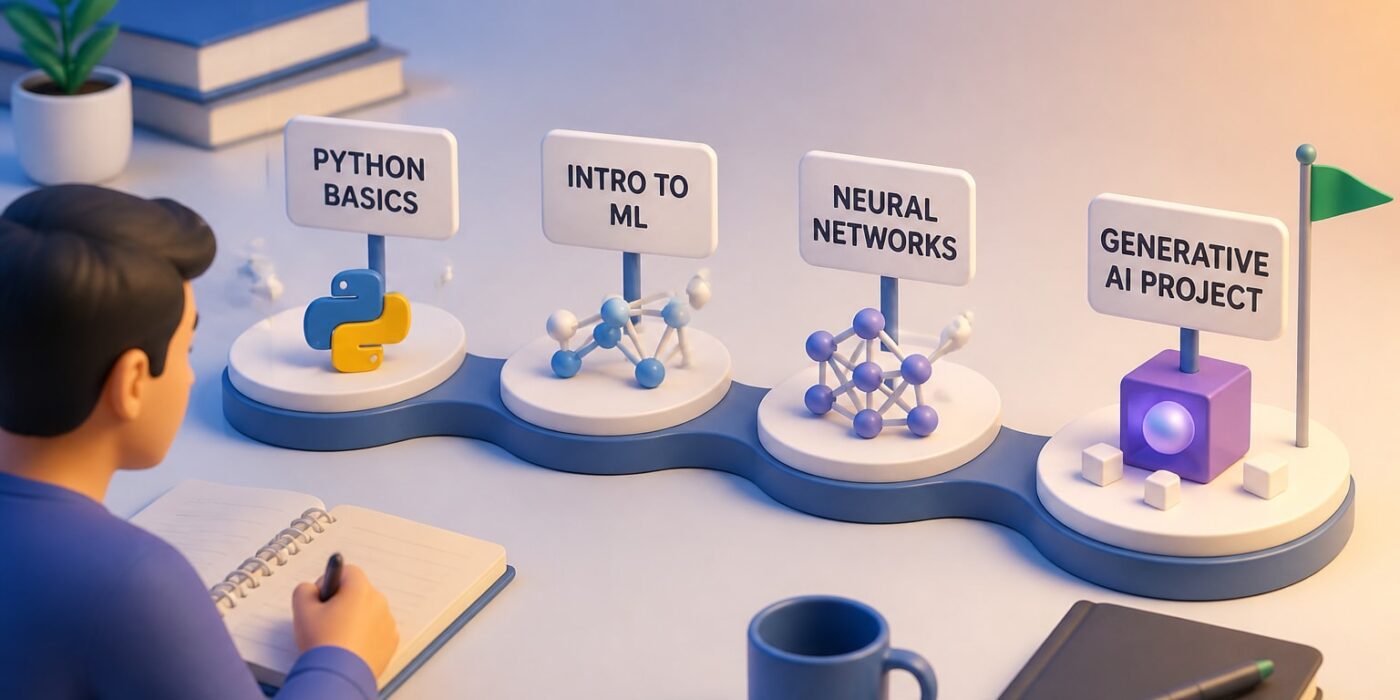
To learn AI programming as a beginner, start with Python, add a structured machine learning course, and build small projects alongside the lessons. Most beginners reach a working foundation in three to six months of steady study, and the main decision is which course matches your starting point and your goal. The list below compares nine options by level, length and cost, followed by a practical study plan and answers to common questions.
How to Choose a Path Before You Pay for Anything
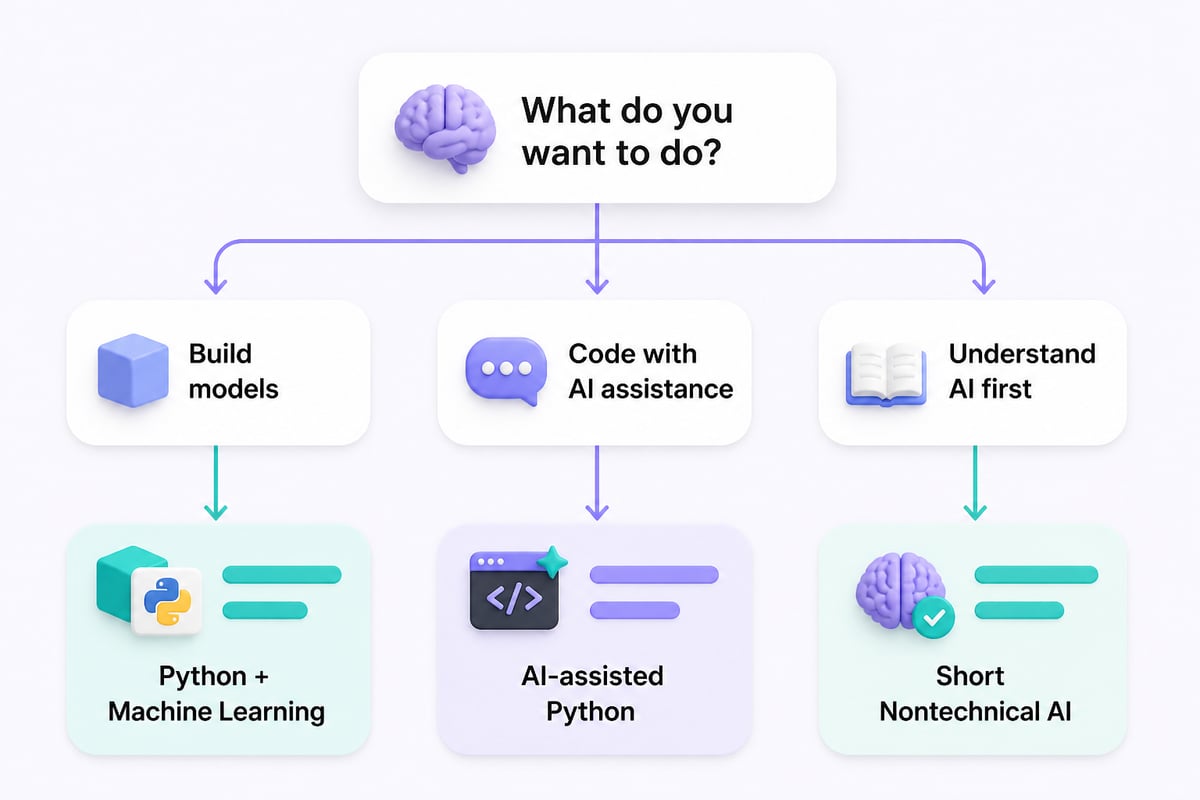
Pick your path by deciding whether you want to build AI models, use AI inside your coding workflow, or simply understand AI before committing to code. Those are three different goals, and each points to different courses.
- Build models: You need Python, NumPy, scikit-learn and eventually TensorFlow. Look at machine learning and deep learning programs.
- Code with AI assistance: You need Python basics plus practice with generative AI tools for writing, testing and debugging code.
- Get oriented first: Short, nontechnical courses give vocabulary and context without requiring programming.
Course length varies widely. The edX AI course guide lists individual courses as typically 2 to 6 weeks and starting at $50, with many available to audit at no cost. The same guide says professional certificates typically take 2 to 10 months and start at $500. Prices and durations change, so check the current figures before enrolling.
1. Machine Learning Specialization (DeepLearning.AI and Stanford Online)
This is a beginner-level, three-course program created with Stanford Online, and it is the most direct route into machine learning with Python. According to DeepLearning.AI, it teaches model building with NumPy, scikit-learn and TensorFlow, and includes 151 video lessons, 32 code examples and 42 graded assignments over an estimated 94h58m of content.
- Key specs: Beginner level, three courses, supervised learning, neural networks, tree methods
- Price: $25 per month billed annually or $30 per month billed monthly (Pro membership, prices in USD, taxes may apply)
- Suits: A structured, hands-on foundation in machine learning and Python over several months of part-time study
- Verdict: The strongest starting point if your goal is to understand how models actually work.
2. Generative AI for Software Development (DeepLearning.AI)
This course teaches you to use generative AI inside real coding workflows, and it suits people who already know a little programming. DeepLearning.AI lists it as beginner level with 31h32m of content, 80 video lessons, eight code examples and 22 graded assignments, and it recommends familiarity with a language such as Python, JavaScript or C#.
- Key specs: Beginner level, Python-based, 31h32m, 22 graded assignments
- Price: About $25 per month billed annually or $30 per month billed monthly
- Suits: Learners with basic programming familiarity who want AI help with writing, testing and reviewing code
- Verdict: A practical second step once you can read and write simple Python.
3. AI Python for Beginners (DeepLearning.AI)
This is a guided introduction to Python that uses AI assistance while you learn, which makes it the gentlest entry for someone who has never programmed. It runs about 11h30m and covers writing, testing and debugging code, plus creating simple AI applications.
- Key specs: Beginner course, 11h30m, Python with AI assistance
- Price: Free for a limited time during the learning platform beta; check the current price before enrolling
- Suits: New programmers who want a short, guided start before a longer machine learning program
- Verdict: The best low-commitment first step for complete beginners.
4. AI For Everyone (DeepLearning.AI)
This course builds AI literacy and covers responsible AI without requiring any programming background. It is listed at 1 to 4 weeks of study.
- Key specs: Beginner course, no programming required, focus on AI literacy and responsible AI
- Price: $49 USD for 180 days of certificate eligibility
- Suits: Getting context on what AI can and cannot do before committing to technical study
- Verdict: Useful for orientation, but it will not teach you to code.
5. Generative AI for Everyone (DeepLearning.AI)
This short course introduces generative AI through hands-on prompt-engineering assignments, with about five hours of study and more than 30 video lessons. It includes six assessments.
- Key specs: About five hours, 30+ video lessons, six assessments, nontechnical
- Price: $25
- Suits: A quick, low-cost introduction to generative AI and prompting
- Verdict: A fast way to get comfortable with prompts before moving to code.
6. Google AI Essentials
This is a brief introductory course with no prior experience required, running about four hours. It explains what AI is and what it can do.
- Key specs: Beginner course, about four hours of study, no prior experience needed
- Price: $49
- Suits: A short general introduction before you start learning to code
- Verdict: A reasonable warm-up, though it stays at the overview level.
7. Generative AI Specialization (Coursera)
This three-course series is self-paced and takes about two months. It assumes you already have basic Python, probability and machine learning knowledge, so it is not a first course.
- Key specs: Three courses, about two months, self-paced
- Price: $59 per month
- Suits: Learners with some technical background who want a flexible, multi-course generative AI program
- Verdict: Worth it only after you have finished a machine learning foundation.
8. Deep Learning Specialization (DeepLearning.AI)
This five-course, intermediate program covers neural networks, computer vision and natural language processing with Python and TensorFlow. It runs an estimated 127h29m with 194 video lessons and 43 graded assignments.
- Key specs: Intermediate level, five courses, 127h29m, TensorFlow
- Price: About $25 per month billed annually or $30 per month billed monthly
- Suits: Learners comfortable with Python and basic linear algebra who want deeper neural network skills
- Verdict: The right next step after the Machine Learning Specialization, not before it.
9. Mammoth Club: AI Certification and Training
Mammoth Club is a subscription that offers 3,000+ courses and over 1 million practice questions, and it covers using AI tools like ChatGPT and Claude to automate tasks and build job-ready skills. It leans toward applied, certification-style learning rather than a single coding curriculum, so it pairs well with one of the Python-focused programs above.

- Key specs: 3,000+ courses, 1 million+ practice questions, AI certification track
- Suits: Professionals who want broad, certificate-oriented training on AI tools alongside a coding course
- Verdict: A good supplement for applied skills and exam practice, best used next to a dedicated Python course.
Comparison of the Eight Courses and Mammoth Club
| Option | Level | Estimated time | Programming needed | Focus |
|---|---|---|---|---|
| Machine Learning Specialization | Beginner | About 95 hours | Learned in course | Python machine learning |
| Generative AI for Software Development | Beginner | About 32 hours | Basic familiarity | AI-assisted coding |
| AI Python for Beginners | Beginner | About 11.5 hours | None | Python with AI help |
| AI For Everyone | Beginner | 1 to 4 weeks | None | AI literacy |
| Generative AI for Everyone | Beginner | About 5 hours | None | Prompting basics |
| Google AI Essentials | Beginner | About 4 hours | None | AI overview |
| Generative AI Specialization | Intermediate | About 2 months | Basic Python and ML | Generative AI |
| Deep Learning Specialization | Intermediate | About 127 hours | Python, linear algebra | Neural networks |
| Mammoth Club | Mixed | Self-paced | None | Applied AI skills, certification |
A Realistic Study Plan to Learn AI Programming
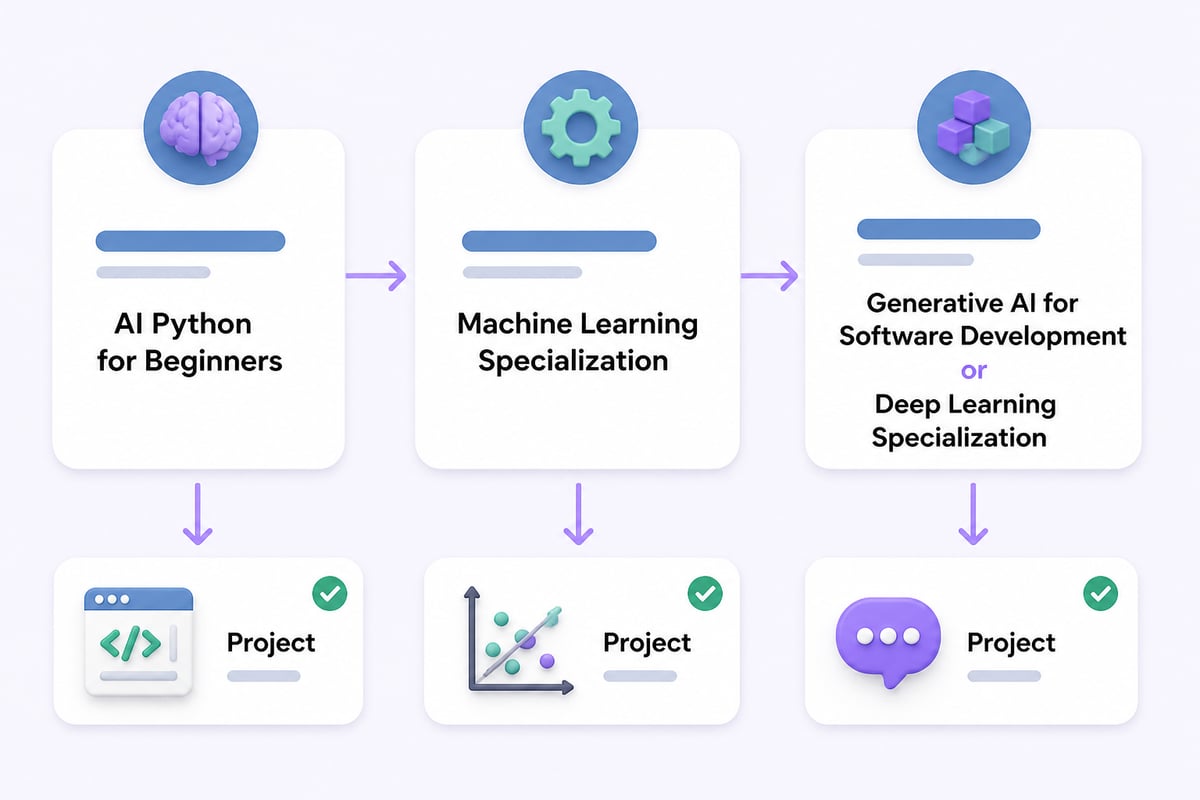
The fastest way to learn AI programming is to alternate short lessons with small projects, rather than finishing courses back to back. A sensible sequence looks like this:
- Weeks 1 to 4: Learn Python basics: variables, loops, functions, lists and dictionaries. Write tiny scripts that clean up a spreadsheet or rename files.
- Weeks 5 to 12: Start a machine learning course. Reproduce each lab in your own notebook instead of only running the provided code.
- Months 3 to 5: Build one project from scratch, such as a model that predicts customer churn from a public dataset.
- Months 5 to 8: Add generative AI work: call a model through an API, write prompts that return structured output, and wrap them in a script.
- Beyond month 8: Choose a specialization, such as deep learning or natural language processing.
Time estimates vary by person, and a course's listed hours rarely include the time you spend debugging your own code. Budget roughly double the listed hours if you are new to programming. For a deeper walkthrough of this sequence, see this guide on how to learn artificial intelligence programming.
The Skill Beginners Underrate: Prompting as a Programming Tool
Writing precise prompts is a real technical skill that shortens your learning curve with code. A vague request like "fix my code" returns vague answers, while a specific one gives you something you can verify.
A useful prompt pattern for learners:
- State your goal and your skill level ("I am a beginner learning scikit-learn").
- Paste the exact error message and the code that caused it.
- Ask for an explanation of the cause before the fix.
- Request one small change at a time so you can test each step.
Treat every AI-generated answer as a draft. Run it, read it line by line, and ask the model to explain anything you cannot describe in your own words. This habit builds understanding instead of dependency, and it is the difference between copying code and learning from it.
Free and Low-Cost Ways to Practice
You can learn a lot before spending money, and a few free habits compound quickly.
- Audit courses: Many catalog courses on platforms like edX can be audited for free, as noted in the edX guide above.
- Browse the catalog: The DeepLearning.AI course catalog lists beginner Python and machine learning learning paths in one place.
- Use public datasets: Pick data you care about, such as sales figures or survey results, so the project holds your attention.
- Keep a learning log: Write two sentences after each session about what you built and what broke.
If you want worked examples that start from an explanation and end in code, the AI and machine learning tutorial and the walkthrough on how to learn AI in Python cover the basics step by step. A useful comparison of course options also appears in Forbes Advisor’s AI course roundup.

Common Mistakes That Slow Beginners Down
Most stalled learners fall into the same few traps:
- Starting with deep learning: Neural networks make little sense without the supervised learning basics.
- Watching without building: Video lessons feel productive, but skills form when you write and break code.
- Skipping the math entirely: You do not need advanced math at first, but basic linear algebra and probability make later courses far easier.
- Chasing every new tool: Pick one language, Python, and one framework at a time.
Frequently Asked Questions
Do I need a computer science degree to learn AI programming?
No. Beginner courses assume no degree, and several listed above start from zero programming experience.
How long does it take to get job-ready?
It depends on your background and target role. Many beginners spend several months on foundations and several more on projects before applying for technical roles.
Is Python the only language worth learning?
Python is the most common choice for beginner AI work because of libraries like NumPy, scikit-learn and TensorFlow, so it is the sensible first language.
Should I learn generative AI or classic machine learning first?
Classic machine learning teaches the underlying ideas, while generative AI gets you building faster. If you can only pick one, start with machine learning basics and add generative AI after your first project.
Are paid courses better than free ones?
Paid programs usually add graded assignments, structure and certificates. Free resources work well for exploration, and many learners combine both.
Your next step is to open a blank Python file today and write a ten-line script that loads a small dataset and prints its summary, then pick one course from the list above to follow. If you also want to use tools like ChatGPT and Claude to automate everyday work while you learn, Mammoth Club offers certification-style training that pairs well with a Python course. For step-by-step tutorials, copy-and-paste prompts and real examples built for professionals, visit Prompt Hero.Ai.