
An AI prompting certificate is a credential showing you completed structured training in writing effective instructions for AI tools such as ChatGPT and Claude. It is worth earning when it comes with graded, hands-on work and when you can pair it with a portfolio of prompts that solve real problems. Many are earned online over a few hours to a few weeks, and entry-level ones generally do not require coding.
The harder question is not whether to get one, but which one. Programs vary widely in depth, assessment, and recognition, so this guide covers what a certificate actually proves, how to compare options, what the study path looks like, and how to make the credential count with employers and clients.
What is an AI prompting certificate?
An AI prompting certificate is proof that you finished a defined course or exam on prompt design, which is the practice of writing inputs that get accurate, useful, and repeatable outputs from a language model. It sits somewhere between a casual online class and a formal professional qualification.
Most programs teach the same core ideas:
- Clear task framing: stating the role, goal, audience, and format you want.
- Context and constraints: supplying source material, tone, length, and rules the model must follow.
- Examples: showing the model one or more samples of a good answer (few-shot prompting).
- Reasoning techniques: asking the model to work step by step, which is covered in more depth in this guide to chain-of-thought prompting.
- Iteration and evaluation: testing prompts, comparing outputs, and refining until results are consistent.
No single body governs these credentials. Universities, cloud vendors, learning platforms, and independent training companies all issue their own, which is why the name on the certificate matters less than what you had to do to earn it.
Is an AI prompting certificate worth it?
It is worth it if you use AI at work and want structured practice plus a visible signal, and it is not worth it if you expect the paper alone to open doors. Employers hiring for AI-heavy roles tend to care about what you can demonstrate: a prompt that cuts a weekly report from three hours to thirty minutes says more than a badge.
Here is a balanced view.
Advantages
- Gives you a structured path instead of scattered tips from videos and threads.
- Forces you to practice, especially when the program includes graded assignments.
- Adds a recognizable line to a resume or LinkedIn profile, particularly if it comes from a known university or vendor.
- Builds a shared vocabulary that helps when you work with teams or developers.
Limitations
- Models change quickly, so specific tricks taught in a course can age out within months.
- Many certificates are completion-based, meaning you pass by finishing videos rather than proving skill.
- Credentials from unknown issuers carry little weight on their own.
The practical answer: treat the certificate as a forcing function for learning and a supporting credential, and put your real effort into building examples you can show.
What should you look for before choosing a program?
Choose a program by checking five things: who issues it, how you are assessed, how much practice it includes, how current the content is, and what it costs in time and money. Run each candidate through the same checklist so the comparison stays fair.
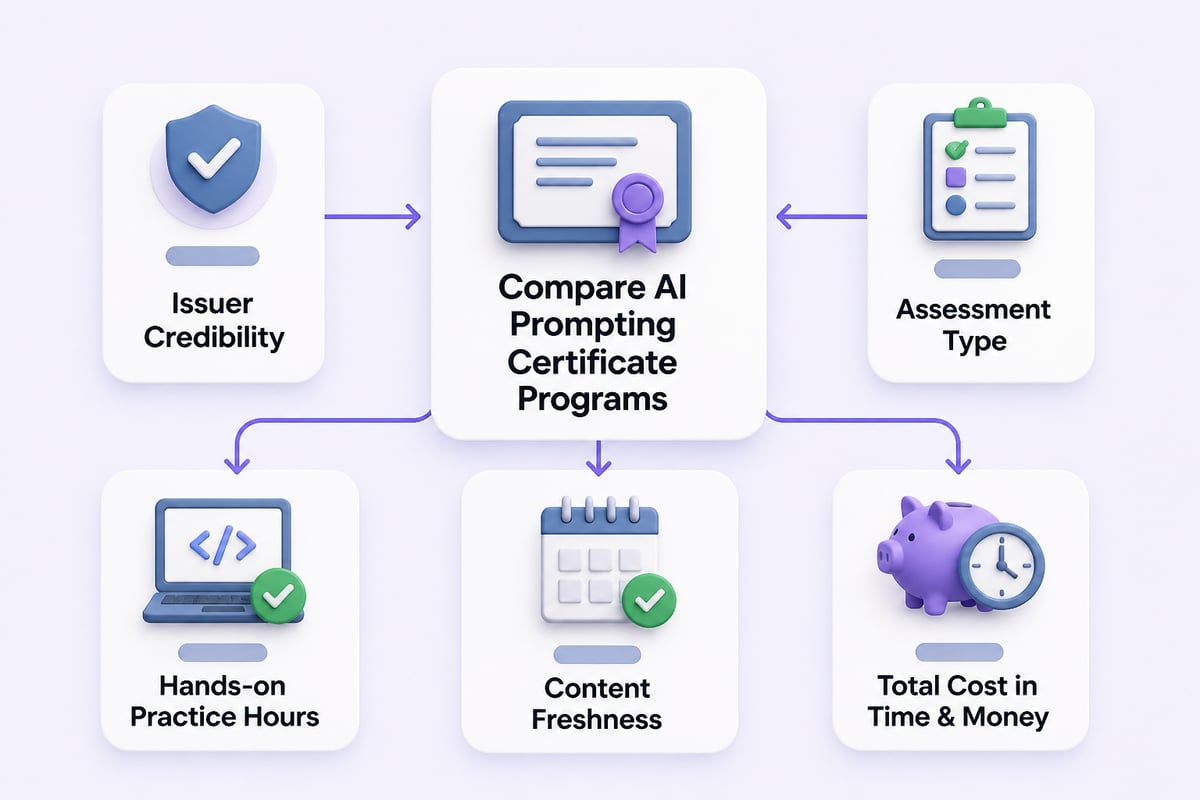
Issuer and recognition
A certificate from a university, a major cloud provider, or a government-backed platform is easier for a hiring manager to place. Independent issuers can still be good, but verify that they publish a syllabus, name their instructors, and offer a way for others to confirm your credential.
Assessment
Look for graded projects, a proctored exam, or reviewed submissions. A quiz you can retake unlimited times proves less than a project where you must design prompts for a realistic scenario and defend your choices.
Practice versus theory
Hours spent writing and testing prompts matter more than hours watching lectures. Some published course listings show the split, which makes this easy to judge. For example, an IIT Madras-associated SWAYAM Plus Prompt Engineering course lists 30 hours of theory and 15 hours of practical work, while a separate SWAYAM Plus certificate program in Prompt Engineering and ChatGPT lists 10 hours of theory and 20 hours of practical work. Two programs with similar titles can lean in opposite directions, so read the hour breakdown.
Freshness and tool coverage
Check whether the course covers more than one model. Skills that transfer between ChatGPT, Claude, and other assistants last longer than tips tied to one interface. Look at the last update date and whether the lessons mention current features such as file uploads, custom instructions, or tool use.
Cost and access length
Price ranges from free to several hundred dollars, and access windows differ. The University of Arizona's AI Essentials course, for instance, offers flexible online study, optional mentor-led live sessions, and 12 months of curriculum access. A long access window helps if you plan to study around a full-time job.
Which types of AI prompting certificate programs exist?
Programs fall into four groups: university-backed courses, vendor and cloud-platform training, learning-marketplace certificates, and subscription libraries that bundle many credentials. Each suits a different goal and budget.
| Type | Typical strength | Typical weakness | Good fit when |
|---|---|---|---|
| University or government-backed | Recognizable issuer, structured assessment | Fixed schedules or enrollment windows | You want a credential employers can verify |
| Vendor or cloud training | Tied to real tools and services | May focus on one platform | Your team already uses that vendor |
| Marketplace certificates | Low cost, self-paced | Quality varies; often completion-based | You want a fast, low-risk introduction |
| Subscription libraries | Many courses for one fee | Less depth per topic | You want several AI credentials over time |
Enrollment windows are worth checking early on scheduled programs, since missing one could mean waiting for the next cohort.
If you want a library approach, Mammoth Club's AI certification and training bundles a large catalog of courses and practice questions, which suits professionals who want to earn several credentials and practice with exam-style questions rather than commit to a single course.
What will you learn, and what skills should it prove?
A solid program should leave you able to write reliable prompts for your own tasks, evaluate the output critically, and explain why a prompt works. Those three abilities are what employers and clients actually pay for.
Skills worth looking for in the syllabus
- Structuring a prompt: role, task, context, constraints, and output format.
- Few-shot and example-driven prompting: teaching tone and format by showing samples.
- Step-by-step reasoning: getting better results on analysis, math, and planning tasks.
- Prompt chaining: breaking a large job into linked steps, each feeding the next.
- Output evaluation: checking for errors, invented facts, and bias before using a result.
- Reusable templates: turning a prompt that worked into a repeatable asset for a team.
A fuller walkthrough of these methods is in this overview of AI prompting techniques, and a compact reference sheet helps while you study: the AI prompting cheat sheet is a good one to keep open.
A skill many syllabi underplay: responsible use
Strong programs also cover verification, privacy, and bias. The AI Literacy Framework describes competencies for engaging with, creating with, managing, and shaping AI. Even though it targets school education, it is a handy lens for adult learners too: a good certificate should teach you not only to create with AI but to manage risk and decide when not to use it.
How do you earn an AI prompting certificate step by step?
You earn one by picking a program, studying on a schedule, building real practice artifacts, passing the assessment, and then publishing proof of your work. The steps below take most people from zero to certified without wasted effort.
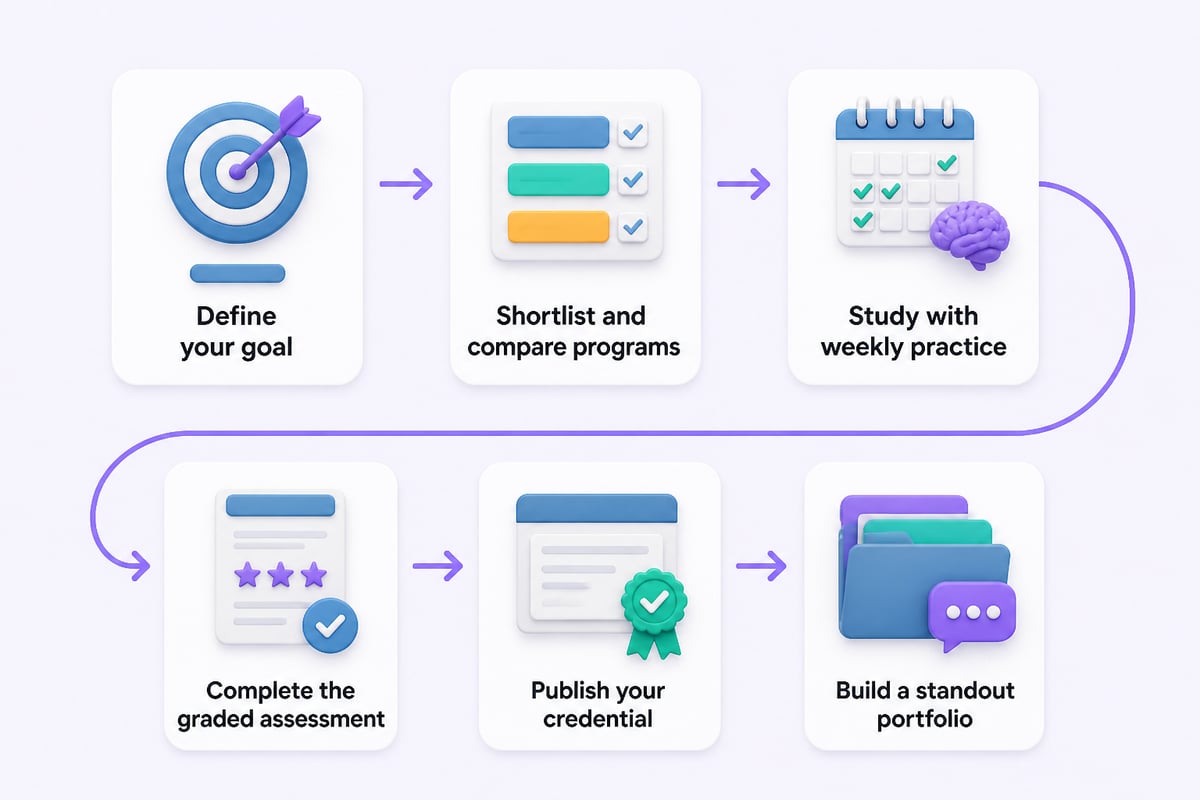
- Define your goal. Decide whether you want a resume credential, better daily productivity, or a path into a technical role. A marketing manager automating campaign briefs needs different depth than a developer building prompt-based features.
- Shortlist two or three programs. Apply the checklist from earlier and eliminate any that lack graded work or a visible syllabus.
- Set a weekly schedule. Short, regular sessions beat marathon weekends. Block time for practice, not just viewing.
- Practice on your own tasks. Every lesson should end with a prompt you test on a real work problem, such as summarizing meeting notes, drafting a client email, or cleaning a spreadsheet.
- Keep a prompt log. Record the prompt, the output, what you changed, and why. This becomes your portfolio.
- Complete the assessment. Read the rubric first so you know what graders reward: clarity, consistency, and evidence of iteration.
- Publish your proof. Add the credential to your profile and attach two or three sanitized examples of prompts you built.
If you prefer to start with free, hands-on lessons before paying for anything, the AI prompting class and the AI prompting engineering course pages are practical places to build the habits a certificate will later test.
How long does it take and what does it cost?
Expect roughly 10 to 45 hours of study for most programs, spread over a few weeks, with costs ranging from free to a few hundred dollars. The published hour counts above show the spread, from roughly 10 to 45 hours depending on the program.
Several factors move the total:
- Your starting point. If you already use ChatGPT or Claude daily, you can skim introductory modules.
- Assessment format. Proctored exams and reviewed projects add preparation time.
- Live sessions. Optional mentor-led sessions, where offered, add hours but speed up feedback.
- Renewal. Some credentials expire or need updating as models change, so ask whether there are recurring fees.
Before paying, check the program's own page for current pricing and refund terms, since these change often.

How do you make the certificate matter to employers and clients?
You make it matter by pairing it with evidence: a short portfolio showing the problem, your prompt, the result, and the time or cost saved. A certificate says you studied; a portfolio says you can deliver.
Hypothetical example: a finance analyst could document a prompt that turns raw monthly variance notes into a structured commentary draft, showing the prompt, its revisions, and what a human must still check.
Practical ways to present your skills:
- Resume: list the credential with the issuer and year, then add a bullet describing a measurable result from a prompt you built.
- Profile: pin a short post explaining one prompt and the lesson behind it.
- Interviews: be ready to live-edit a weak prompt and explain each change.
- Teams: convert your best prompts into a shared template library so your value is visible to colleagues.
Short video walkthroughs also help.
What are the common mistakes to avoid?
The most common mistakes are choosing on price alone, collecting several shallow certificates, and skipping practice. Each one wastes time without improving your results.
- Collecting badges. Three completion-only certificates are worth less than one with a graded project.
- Memorizing templates. Models differ and update; understand why a structure works so you can adapt it.
- Ignoring verification. Never present AI output as fact without checking it, especially for numbers, quotes, and legal or medical claims.
- Pasting sensitive data. Confidential client or company information should not go into a public AI tool unless your organization's policy allows it.
- Stopping at the certificate. The skill fades without regular use, so keep a weekly habit of testing and refining prompts.
If you also plan to move toward technical work, a prompting credential pairs well with foundational coding practice, and this guide on how to learn AI programming outlines a sensible order of topics.
Frequently asked questions
Do I need coding skills to earn an AI prompting certificate?
No, most entry-level programs assume no coding. Developer-focused tracks add API use and scripting, but general-business certificates center on writing clear instructions in plain language.
Is an AI prompting certificate recognized by employers?
Recognition depends on the issuer and the assessment. Credentials from universities, government-backed platforms, and major vendors are easier to verify, while any certificate is stronger when supported by a portfolio of real prompts.
How is prompt engineering different from general AI literacy?
AI literacy covers what AI is, how it works, and its risks. Prompt design is the narrower, hands-on skill of getting good results from a specific tool. A good program touches both.
Will the skills still apply if models change?
The core habits transfer: clear task framing, context, examples, iteration, and checking outputs. Interface-specific tricks age faster, so favor programs that teach principles across more than one model.
Can I learn the same skills without paying for a certificate?
Yes. Free tutorials, cheat sheets, and daily practice can teach the same techniques. A certificate adds structure, accountability, and a verifiable credential, which matters most when you need to show proof to someone else.
How many certificates should I earn?
One well-chosen credential with graded work is usually enough. Add another only if it covers a new area, such as a specific vendor platform or a more technical track.
Your next step is to pick one real task from your week, such as a recurring report or client email, and write, test, and log three versions of a prompt for it before you enroll anywhere. That small portfolio piece will tell you quickly which kind of program you need. If you want guided practice, Prompt Hero.Ai provides step-by-step tutorials with copy-and-paste prompts and worked examples for professionals who want to apply ChatGPT and Claude to everyday business problems.