
Artificial intelligence has become essential for professionals across every industry in 2026, but the cost of learning can feel overwhelming. The good news? You can access world-class AI education without spending a dollar. A free AI tutorial can teach you everything from basic prompt engineering to advanced automation workflows, giving you the skills to transform how you work. Whether you're looking to automate repetitive tasks, analyze data faster, or build AI-powered solutions, free resources are available to help you get started today.
Why Free AI Tutorials Matter More Than Ever
The AI landscape has evolved dramatically over the past few years. Tools like ChatGPT, Claude, and Gemini have become workplace staples, not experimental technologies. Professionals who understand how to leverage these tools gain competitive advantages in productivity, creativity, and problem-solving.
Free AI tutorials democratize access to these critical skills. Traditional education models can't keep pace with AI's rapid evolution, making self-directed learning through quality tutorials the most practical approach. You don't need a computer science degree or expensive bootcamp to become proficient with AI tools.
The Real Value of Quality Free Resources
Not all free tutorials are created equal. The best resources offer:
- Step-by-step instructions that assume no prior technical knowledge
- Copy-and-paste prompts you can immediately use in your work
- Real-world examples from business contexts, not academic exercises
- Updated content reflecting 2026's latest AI capabilities
- Practical applications that solve actual problems
The difference between a mediocre free AI tutorial and an excellent one comes down to practical applicability. Generic overviews might explain what AI is, but they won't help you automate your email responses or analyze customer feedback data.

Getting Started: Your First Steps with AI Tools
Beginning your AI learning journey can feel overwhelming with countless tools and techniques available. Focus on foundational skills first, then build toward specialized applications.
Choose Your Primary AI Tool
Start with one conversational AI platform and master it before branching out. In 2026, the top options include:
| Tool | Best For | Key Strength |
|---|---|---|
| ChatGPT | General tasks, writing, coding | Versatility and accessibility |
| Claude | Long documents, analysis | Context window and reasoning |
| Gemini | Google workspace integration | Multimodal capabilities |
Most professionals should start with ChatGPT because it offers the broadest application range and has the most available learning resources. Platforms like QWE AI Academy provide structured paths from beginner to advanced levels, covering multiple AI tools comprehensively.
Master the Fundamentals of Prompt Engineering
Effective prompting is the core skill that unlocks AI's potential. A well-crafted prompt can mean the difference between useless output and game-changing results.
Basic prompt structure includes:
- Role assignment – Tell the AI what perspective to adopt
- Context provision – Share relevant background information
- Task specification – Clearly state what you need
- Format requirements – Define how you want the output structured
- Constraints – Set boundaries and limitations
For example, instead of asking "Write a marketing email," use: "You are an experienced email marketer. I need a promotional email for our new productivity software aimed at small business owners. The email should be 150 words, highlight three key benefits, include a clear call-to-action, and maintain a friendly but professional tone."
Building Practical AI Skills for Business
Theory only takes you so far. The real value of a free AI tutorial comes from applying what you learn to solve actual problems. Focus on use cases directly relevant to your work.
Automating Repetitive Tasks
AI excels at handling routine work that consumes hours of your day. Common automation opportunities include:
- Drafting email responses based on conversation context
- Summarizing long documents or meeting transcripts
- Generating first drafts of reports and presentations
- Creating social media content calendars
- Analyzing customer feedback for patterns
Resources like Sukrid LearnHub offer complete courses that take you from basic concepts to enterprise-level implementations, perfect for understanding how automation scales.
Data Analysis and Insights
You don't need to learn Python or R to extract insights from data anymore. AI tools can analyze spreadsheets, identify trends, and generate visualizations through conversational prompts.
Practical data analysis workflows:
- Upload your dataset or paste relevant data
- Ask for summary statistics and key trends
- Request specific analyses (correlations, outliers, patterns)
- Generate hypotheses about what the data reveals
- Create action items based on insights
This approach works for sales data, customer surveys, website analytics, and countless other business datasets. The key is asking progressively deeper questions rather than expecting comprehensive analysis from a single prompt.

Advanced Techniques for Professional Applications
Once you've mastered basic prompting and common use cases, advanced techniques multiply your productivity gains. These methods separate casual AI users from professionals who've truly integrated AI into their workflows.
Chain of Thought Prompting
This technique improves AI reasoning by asking it to show its work. Instead of jumping directly to conclusions, you request step-by-step thinking.
Standard prompt: "Should we expand into the European market?"
Chain of thought prompt: "Analyze whether we should expand into the European market. First, list the key factors to consider. Second, evaluate our company's readiness for each factor. Third, identify the top three risks and three opportunities. Finally, provide a recommendation with supporting reasoning."
The additional structure yields significantly better analysis because it forces the AI to consider multiple dimensions before reaching conclusions.
Custom Instructions and System Prompts
Save time by setting default behaviors rather than repeating instructions. Most AI platforms now support custom instructions that apply to every conversation.
Effective custom instructions specify:
- Your role and industry context
- Preferred output formats and structure
- Communication style preferences
- Common constraints or requirements
- Topics you frequently need help with
For instance, a marketing manager might set: "I'm a marketing director at a B2B SaaS company. When I ask for content, default to professional but approachable tone. Always include specific metrics when possible. Prioritize actionable recommendations over theoretical explanations."
Multi-Step Workflows and Iteration
Complex tasks benefit from breaking work into stages rather than requesting everything at once. This iterative approach produces higher quality results.
Example workflow for creating a presentation:
- Generate outline with main topics and key points
- Review and refine structure before proceeding
- Develop detailed content for each section
- Request specific examples or data to support claims
- Polish language and ensure consistency
- Generate speaker notes for each slide
Each step builds on previous work, allowing course corrections before investing time in wrong directions. You can explore comprehensive approaches to AI and machine learning that demonstrate these multi-step methodologies.
Finding the Best Free Resources
The internet overflows with free AI tutorials, but quality varies dramatically. Strategic resource selection saves countless hours of frustration.
Trusted Learning Platforms
Several platforms have established reputations for high-quality, practical AI education:
LearnGO curates top-rated courses from YouTube, Coursera, and MIT, saving you the effort of sorting through thousands of options. Their curation focuses on content from reputable sources with proven educational value.
SuperML stands out by connecting tutorials to real open-source AI products, emphasizing practical applications over pure theory. This approach ensures you learn skills that directly apply to actual tools.
GenAI Mentor provides structured paths through generative AI, from basic concepts to deploying AI products. Their leveled approach helps you build skills progressively without gaps.
Evaluating Tutorial Quality
Before investing time in any free AI tutorial, assess these factors:
| Quality Indicator | What to Look For | Red Flag |
|---|---|---|
| Recency | Published or updated in 2025-2026 | Content from 2022 or earlier |
| Specificity | Concrete examples with actual tools | Vague concepts without applications |
| Depth | Multi-step processes with explanations | Surface-level overviews |
| Accessibility | Clear language, structured progression | Assumes advanced knowledge |
| Practicality | Copy-paste prompts and templates | Pure theory without implementation |
The best free AI tutorial provides immediate value you can apply the same day, not just conceptual understanding you might use eventually.
Industry-Specific AI Applications
While foundational AI skills transfer across contexts, industry-specific applications require specialized knowledge. Tailoring your learning to your field accelerates practical benefits.
AI for Marketing and Content Creation
Marketing professionals use AI for content generation, audience analysis, and campaign optimization. Key skills include:
- Writing compelling copy that matches brand voice
- Generating content variations for A/B testing
- Analyzing campaign performance data
- Creating customer personas from market research
- Developing content calendars and topic clusters
Platforms like Erudiax offer specialized tutorials with practice problems, perfect for developing marketing-specific AI competencies through hands-on learning.
AI for Operations and Project Management
Operations teams leverage AI for process optimization, resource allocation, and risk assessment:
- Automating status reports and project updates
- Analyzing workflow bottlenecks
- Forecasting resource needs
- Creating risk mitigation strategies
- Generating process documentation
The intersection of engineering and AI reveals how technical teams apply these tools to operational challenges.
AI for Customer Service and Support
Customer-facing teams use AI to improve response quality and speed while maintaining personalization:
- Draft responses to common customer inquiries
- Analyze support ticket trends and patterns
- Create knowledge base articles from resolved issues
- Translate communications for international customers
- Generate empathetic responses to difficult situations
The key is maintaining human oversight while letting AI handle routine aspects, freeing your team for complex or sensitive interactions requiring human judgment.

Developing a Structured Learning Plan
Random exploration of AI tools leads to scattered knowledge. A structured approach builds comprehensive skills efficiently.
30-Day AI Mastery Framework
Week 1: Foundations
- Understand how large language models work (conceptually, not technically)
- Learn basic prompt structure and common patterns
- Practice with simple tasks: summarization, rewriting, brainstorming
- Experiment with different AI platforms to find your preference
Week 2: Practical Applications
- Identify five repetitive tasks in your work
- Create prompts to automate each task
- Build a prompt library for frequent needs
- Learn to refine outputs through iteration
Week 3: Advanced Techniques
- Master chain of thought prompting for complex analysis
- Develop multi-step workflows for larger projects
- Practice data analysis with real business datasets
- Create custom instructions for your common use cases
Week 4: Integration and Optimization
- Incorporate AI into daily workflows permanently
- Measure time saved and quality improvements
- Share effective prompts with your team
- Identify next-level skills to develop
Resources like AakuLearn aggregate courses from top universities and companies, providing structured paths perfect for systematic skill development.
Continuous Learning Strategies
AI capabilities evolve rapidly. What works perfectly today might be obsolete in six months. Build continuous learning into your routine:
- Dedicate 30 minutes weekly to exploring new AI features or techniques
- Join AI communities where professionals share prompts and discoveries
- Document your effective prompts in a personal knowledge base
- Test new capabilities as platforms release updates
- Share learnings with colleagues to reinforce your understanding
The most successful AI users treat learning as ongoing rather than a one-time effort. They stay current with platform updates, experiment with new approaches, and continuously refine their skills.
Common Mistakes to Avoid
Even with excellent free tutorials, learners often stumble over predictable pitfalls. Avoiding these accelerates your progress significantly.
Expecting Perfection on First Try
AI outputs require refinement. Your first prompt rarely produces final-quality results. Treat initial outputs as drafts requiring your expertise to polish into finished work.
Effective iteration involves:
- Reviewing output for accuracy and relevance
- Identifying specific improvements needed
- Providing targeted feedback in follow-up prompts
- Repeating until quality meets your standards
This collaborative approach between human judgment and AI capability produces the best results.
Neglecting Context and Specificity
Vague prompts generate vague results. The more context and specific requirements you provide, the better the output.
Weak: "Write about productivity."
Strong: "Write a 500-word article for small business owners explaining how to use time-blocking to manage multiple projects. Include three specific techniques, a real example, and address the common concern about schedule rigidity. Use a practical, encouraging tone."
The additional details dramatically improve relevance and usability.
Forgetting to Verify Information
AI tools can confidently present incorrect information. Always verify facts, statistics, and claims before using AI-generated content, especially for important business communications or decisions.
Verification strategies include:
- Cross-referencing claims with authoritative sources
- Asking AI to cite sources (then checking those sources)
- Using AI as a starting point, not a final authority
- Applying your domain expertise to assess plausibility
- Double-checking numbers and calculations
This critical evaluation prevents embarrassing errors and maintains professional credibility.
Monetizing Your AI Skills
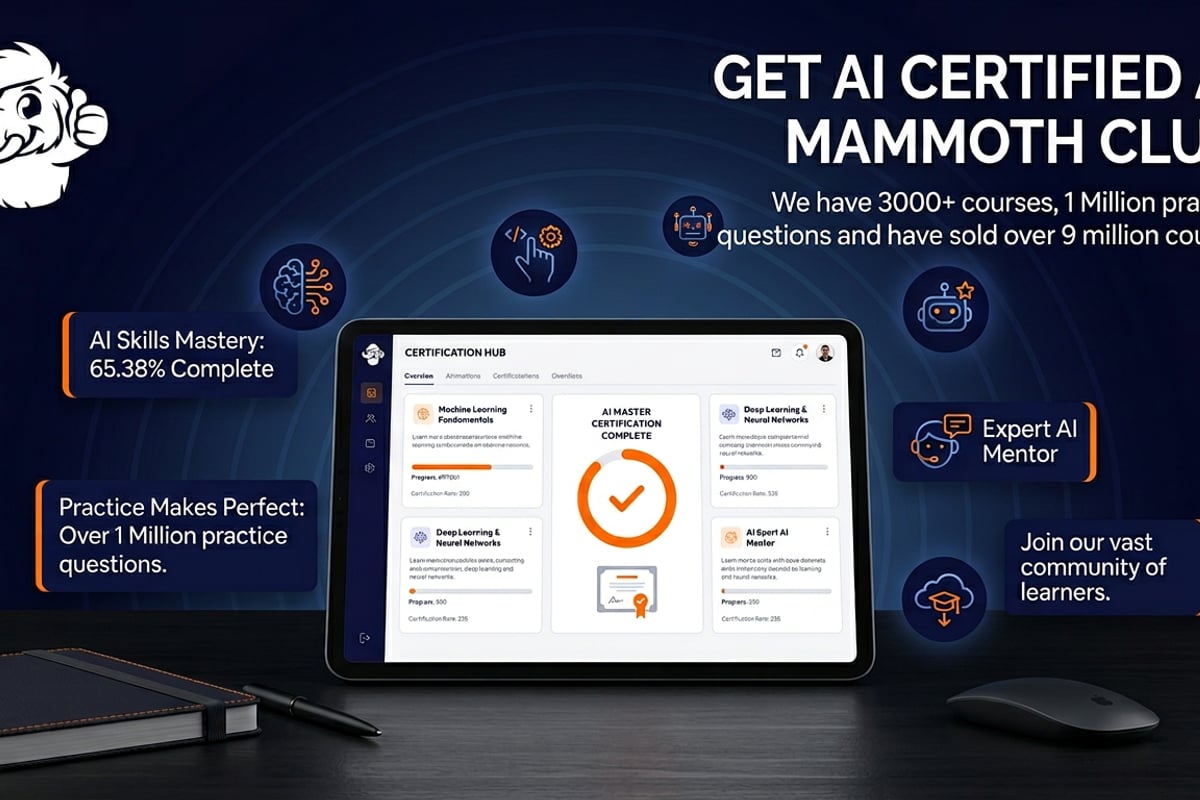
As you develop proficiency with AI tools, opportunities emerge to apply these skills professionally or generate additional income. If you're serious about turning AI knowledge into career advancement or additional revenue, comprehensive training programs can accelerate your journey. Mammoth Club – AI Certification & Training offers access to over 3,000 courses and more than 1 million practice questions, providing structured learning that builds job-ready skills in AI automation and productivity tools.
Career Advancement Opportunities
Professionals with demonstrated AI competency increasingly stand out in hiring and promotion decisions:
- AI Integration Specialist – Help organizations implement AI tools across departments
- Prompt Engineer – Develop and optimize prompts for specific business applications
- AI Trainer – Teach colleagues how to use AI tools effectively
- Process Automation Consultant – Identify and automate workflows using AI
- Content Operations Manager – Oversee AI-assisted content production
These roles didn't exist five years ago but now command competitive salaries because skilled practitioners remain scarce relative to demand.
Freelance and Consulting Services
Your AI skills translate into marketable services:
- AI-powered content creation for businesses lacking in-house expertise
- Process automation consulting to identify efficiency opportunities
- Prompt engineering services for companies using AI tools
- Training workshops teaching teams AI best practices
- AI tool implementation helping organizations adopt new platforms
Many professionals start by offering services to their existing network before expanding to broader markets. The key is demonstrating tangible results through case studies and examples.
Staying Current in a Rapidly Evolving Field
The AI landscape transforms monthly. Tools gain new capabilities, best practices evolve, and novel applications emerge constantly. Maintaining relevant skills requires intentional strategies.
Follow Key Information Sources
Rather than trying to monitor everything AI-related, focus on curated sources providing signal over noise:
- Platform release notes from tools you use regularly (ChatGPT, Claude, etc.)
- AI newsletters summarizing important developments weekly
- Professional communities where practitioners share discoveries
- Tutorial platforms that update content with new techniques
- Industry publications covering AI applications in your field
This focused approach keeps you informed without overwhelming your schedule.
Experiment with New Features Immediately
When platforms release new capabilities, test them promptly rather than waiting. Early experimentation helps you:
- Understand practical applications before they're obvious
- Develop expertise while competition remains limited
- Identify use cases specific to your work
- Share valuable insights with your network
- Maintain cutting-edge skills
Even 15 minutes exploring a new feature provides advantages over those who wait months to try it.
Build a Personal Prompt Library
Document effective prompts as you discover them. Your prompt library becomes a valuable asset that compounds over time. Organize by:
- Use case category (writing, analysis, automation, etc.)
- Industry or department (marketing, operations, sales)
- Complexity level (basic, intermediate, advanced)
- Tool-specific optimizations (works best in ChatGPT vs. Claude)
This organized knowledge base saves enormous time and helps colleagues learn from your experience. You can see examples of specialized applications at Prompt Hero.Ai that demonstrate how organized prompt collections enhance productivity.
Measuring Your AI Learning Progress
Unlike traditional education with grades and certifications, measuring AI skill development requires self-assessment through practical metrics.
Quantitative Progress Indicators
Track these metrics to gauge improvement:
| Metric | How to Measure | Target Improvement |
|---|---|---|
| Time saved | Hours per week on automated tasks | 5-10 hours within 60 days |
| Quality improvement | Revisions needed for AI outputs | 50% reduction in editing time |
| Task automation | Number of workflows using AI | 10+ routine tasks automated |
| Prompt efficiency | Iterations to final output | Average 2-3 refinements maximum |
| Application breadth | Different use cases mastered | 15+ distinct applications |
These concrete measures reveal whether your learning translates to practical benefits or remains theoretical knowledge.
Qualitative Skill Markers
Beyond numbers, certain capabilities indicate genuine AI proficiency:
- You explain AI applications to colleagues clearly and confidently
- You identify automation opportunities others miss
- You troubleshoot poor outputs by diagnosing prompt issues
- You combine multiple AI tools into sophisticated workflows
- You teach others effective AI techniques
When you reach these milestones, you've moved from novice to practitioner.
The Future of AI Learning
The methods for learning AI will continue evolving as rapidly as the technology itself. Several trends will shape how professionals develop AI skills in coming years.
AI-Assisted Learning
Ironically, AI tools increasingly teach people how to use AI tools. Interactive tutoring, personalized learning paths, and real-time feedback create more effective educational experiences than static tutorials.
AI tutors can:
- Answer questions specific to your learning context
- Generate custom practice problems matching your skill level
- Explain concepts multiple ways until you understand
- Track your progress and adapt difficulty accordingly
- Provide immediate feedback on your prompt attempts
This personalized approach accelerates learning compared to one-size-fits-all tutorials.
Specialization and Certification
As AI skills become standard requirements, specialized certifications and credentials will emerge to validate expertise. While general AI literacy remains essential, deep knowledge in specific applications (industry-specific use cases, particular tool mastery, specialized techniques) will command premium value.
The professionals who thrive will combine broad foundational knowledge with deep expertise in applications directly relevant to their work.
Mastering AI through free tutorials opens doors to productivity gains, career advancement, and entirely new capabilities in your professional life. The resources exist today to build world-class AI skills without financial barriers, you simply need to commit to structured learning and practical application. Ready to transform how you work with AI? Prompt Hero.Ai provides step-by-step tutorials, ready-to-use prompts, and real examples designed specifically for professionals looking to automate tasks, boost productivity, and solve actual business problems with AI tools like ChatGPT and Claude.