
An AI prompting certification is a credential that shows you can write, test and refine instructions for large language models such as ChatGPT and Claude, and you earn one by completing a course or passing an exam, often online and sometimes for free. Formats range from a 20-question quiz to a proctored 90-minute test, so the right choice depends on how much proof you need and how much time you can spend.
This guide explains what these certifications cover, how the main options differ, whether they are worth it, and a step-by-step plan for earning one.
What Is an AI Prompting Certification?
An AI prompting certification is a formal record, usually a certificate or digital badge, that confirms you passed a course or exam on writing effective instructions for AI models. It documents skills like structuring a prompt, giving examples, controlling tone and format, and checking outputs for errors.
No single body governs these credentials. Universities, training companies, professional certification bodies and cloud vendors each issue their own, so the name on the certificate matters as much as the content. Some are called "prompt engineering," others "prompt writing" or "prompting practitioner," and the scope varies accordingly.
A few distinctions help when you compare them:
- Course completion certificates prove you finished lessons and quizzes.
- Proctored exam credentials prove you passed a timed, supervised test.
- Vendor credentials test prompting as one part of a broader AI skill set.
What Skills Do These Certifications Test?
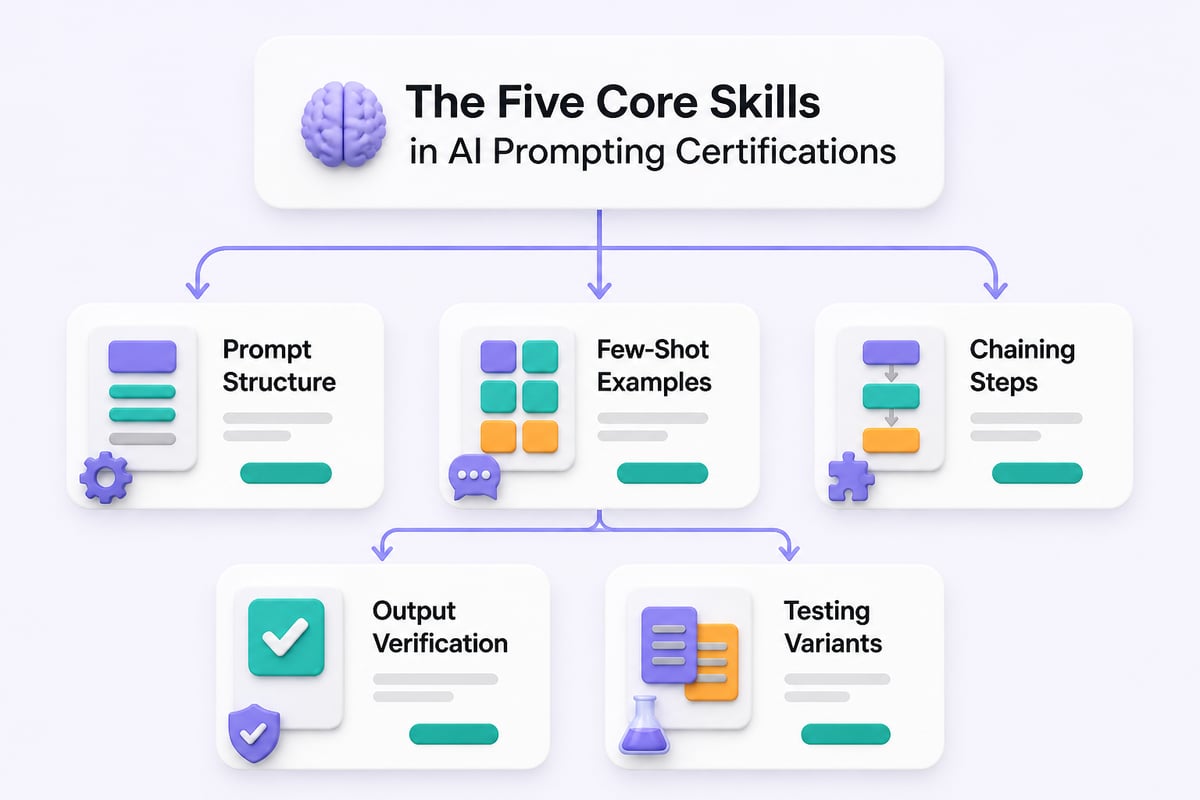
Most programs test the same core skills: prompt structure, few-shot examples, iteration, evaluation of outputs, and applying prompts to real tasks. The depth differs by program, but the foundations overlap heavily.
Learn Prompting's certificate, awarded for course completion through its Plus offering, lists test modules on prompt structure, zero-shot and few-shot prompting, and conversational prompt engineering. Those three topics are a fair baseline for any entry-level credential.
Broader programs go further. The SWAYAM Plus prompt-engineering course from IITM Pravartak describes coverage from LLM fundamentals through prompt pipelines, output evaluation and deployment of AI-assisted applications.
In practice, you should be able to demonstrate these skills after studying:
- Writing a prompt with a clear role, task, context and output format.
- Choosing between zero-shot, one-shot and few-shot approaches.
- Breaking a complex request into steps (chaining).
- Spotting hallucinations and verifying claims.
- Testing prompt variants and recording which performs best.
If you want to practice the structural side before any exam, a reusable AI prompting template gives you a consistent frame to fill in for each task.
Which Certification Options Exist?
Options fall into three groups: free quick-check exams, mid-level proctored practitioner exams, and university or government-backed courses. The table below compares several using only the details published by each provider.
| Credential | Format | Passing bar | Cost notes |
|---|---|---|---|
| CertiProf AI Prompt Writing Professional | 20 multiple-choice questions, 30 minutes, online | 12 correct (60%) | Exam is free; certificate and badge are optional at US$50 |
| AI+ Prompting Practitioner (AI CERTs) | 50 questions, 90 minutes, online proctored | 70% | See the provider page for pricing |
| SWAYAM Plus Prompt Engineering (IITM Pravartak) | 30 hours theory plus 15 hours practical; online-proctored multiple-choice assessment | Set by provider | Open to all; check the course page for fees |
| Learn Prompting certificate | Completion of course modules via Plus | Course completion | See the provider page for pricing |
Free and low-cost entry points
CertiProf's exam is a good example of the low-barrier route. According to CertiProf, the AI Prompt Writing Professional exam is free, online and made of 20 multiple-choice questions in 30 minutes, with 12 correct answers needed to pass. The same page states that the official certificate and digital badge are optional after passing, and claiming them costs US$50.
That structure is useful to know: you can test your knowledge at no cost and decide afterward whether the paper credential is worth buying.
Proctored practitioner exams
The AI+ Prompting Practitioner is a tougher format. AI CERTs lists a proctored online exam with a 90-minute duration and a 70% passing score. Its exam blueprint gives equal weight to several advanced areas, while introduction to prompt engineering carries a much smaller share.
That weighting tells you something: only a tenth of the exam covers basics. Candidates should expect scenario-based, applied questions.
Vendor credentials with prompting built in
Cloud vendors test prompting inside wider AI exams. A 2026 guide from Best AI Certifications notes that the AWS Certified AI Practitioner exam guide includes choosing effective prompt-engineering techniques among its foundation-model application tasks. This route suits people who want a recognized cloud brand and are willing to study general AI concepts alongside prompting.
How Do You Choose the Right One?
Choose based on what you need the credential to prove, how much time you have, and who will look at it. Start with your goal, then match the format.
- You want a quick confidence check: A short, free exam gives you a baseline without commitment.
- You want proof for a hiring manager or client: A proctored exam carries more weight because identity and conditions are verified.
- You want structured learning plus a certificate: A course with theory and practical hours fits better than an exam alone.
- You work inside a specific cloud ecosystem: A vendor credential may be more recognizable to your employer.
Check three things before paying for anything: whether the exam is proctored, whether the syllabus is published, and whether the certificate has an expiry or renewal rule. If a provider's page doesn't state these, ask before you buy.
For a broader look at structured learning paths, our overview of an AI prompting course breaks down what a good curriculum includes.

Is an AI Prompting Certification Worth It?
It is worth it when the credential fills a gap your portfolio can't, and less worth it when you already have visible, working proof of your skills. A certificate signals structured knowledge; a portfolio of prompts that solved real problems signals applied skill. The strongest position is having both.
Pros
- Gives a clear study structure and finish line.
- Provides a shareable badge or certificate for profiles and applications.
- Forces you to learn terminology that appears in job descriptions.
- Low-cost options let you test the waters cheaply.
Cons
- No universal standard, so recognition varies by issuer.
- Multiple-choice formats can test recall more than craft.
- Models change quickly, so specific tactics can date fast.
- Paid certificates add cost on top of study time.
A practical test: ask whether the certification would change a decision someone makes about you. If a client or employer would hire or promote based on a recognized name, invest. If you just want to learn, a free course and your own project work may be enough.
How to Earn an AI Prompting Certification: A Step-by-Step Plan
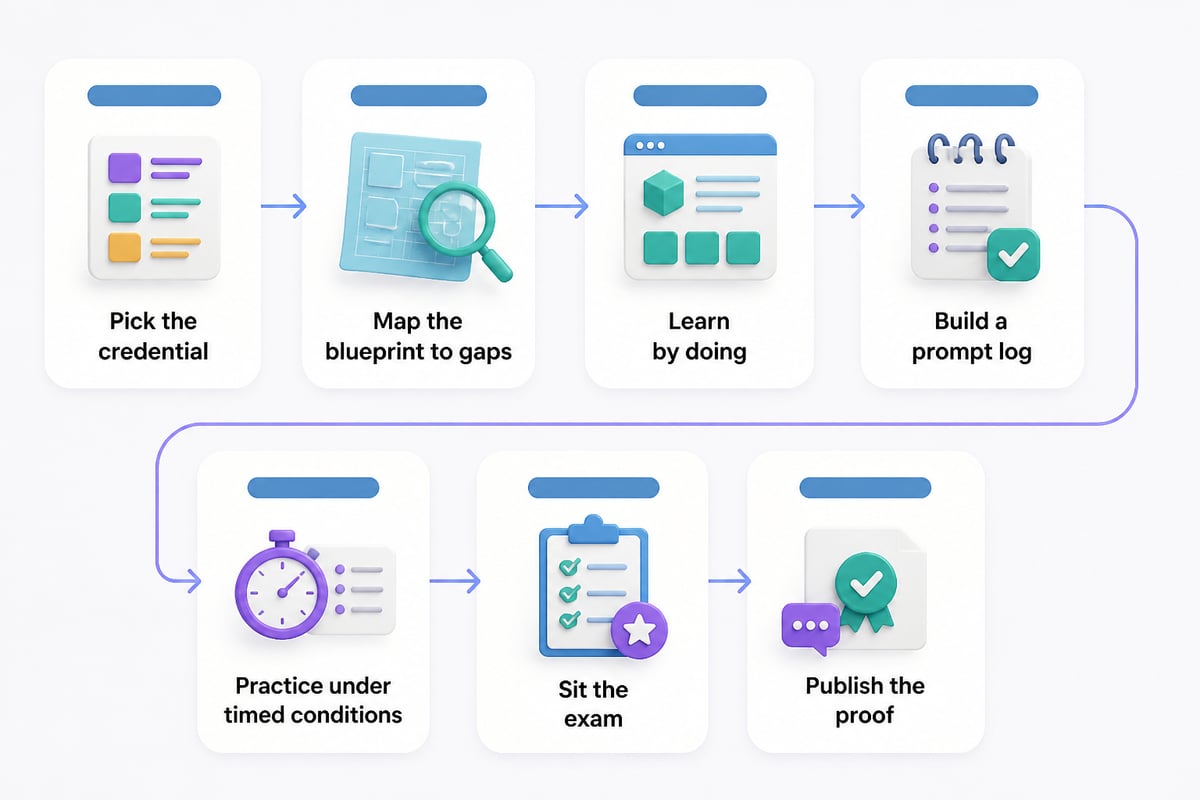
You can earn an AI prompting certification in a few weeks by studying the exam blueprint, practicing on real tasks, and taking a practice run before the real attempt. Follow these steps in order.
- Pick the credential. Use the comparison above and confirm the syllabus, exam length and passing score on the provider's own page.
- Map the blueprint to your gaps. If the exam weights advanced design and optimization heavily, spend your time there, not on introductions.
- Learn by doing. For each topic, run the prompt in ChatGPT or Claude, change one variable, and note the difference in output.
- Build a prompt log. Record the task, the prompt, the result and what you changed. This doubles as portfolio material.
- Practice under exam conditions. Time yourself against the real format, such as 30 minutes for 20 questions or 90 minutes for 50.
- Sit the exam. For proctored tests, check your camera, connection and ID requirements the day before.
- Publish the proof. Add the badge to your profile and link a few log entries showing the skills behind it.
A hypothetical study week
Hypothetical example: a marketing manager preparing for a short exam might spend a few evenings on prompt structure and few-shot examples, using real work such as summarizing customer feedback into themes. Later sessions could go to verifying outputs and iterating on weak results, ending with a timed practice quiz. The aim is to tie each concept to a task already on their desk, so the knowledge sticks.
What Should You Practice Beyond the Exam?
Practice on your own work tasks, because certifications confirm knowledge while daily results build real skill. Exams reward recognizing good technique; jobs reward getting a usable draft on the first or second try.
Three habits close that gap:
- Write prompts for repeatable tasks. Meeting summaries, report drafts and email replies are ideal because you can compare results across weeks.
- Define "good" before you prompt. State the audience, length, tone and format you expect, then judge the output against that standard.
- Keep a failure file. Save prompts that produced wrong or vague answers and note why. Patterns in your failures teach more than successes.
Good AI prompt design comes down to specificity: the more precisely you describe the task, audience and format, the less you need to correct afterward. For a quick primer on the basics behind all of this, see what a prompt AI is and how models interpret instructions.
If you'd like a single place to build certification-style knowledge across several AI tools, Mammoth Club offers AI certification and training with 3,000+ courses and over 1 million practice questions, which suits anyone who wants lots of exam-style repetition alongside tool-specific lessons on ChatGPT and Claude.

How Do You Show Your Certification to Employers and Clients?
Show it alongside evidence: the badge on your profile, plus two or three concrete examples of prompts that saved time or improved quality. A credential opens the conversation; examples finish it.
Useful ways to present your skills:
- Add the certificate or badge to your professional profile and résumé under a certifications heading.
- Write a short case note for each example: the task, your prompt approach, and the result you observed.
- Offer to walk through your prompt log in an interview or client call.
- Keep sensitive company data out of anything you share publicly.
State what the credential covers in plain words. "Passed a 50-question proctored exam on advanced prompt design and optimization" tells a reader more than the certificate's title alone.
Frequently Asked Questions
How long does it take to get an AI prompting certification?
It can take as little as an afternoon for a short exam, such as a 30-minute, 20-question test, or several weeks for a course. The SWAYAM Plus course, for instance, lists 30 hours of theory and 15 hours of practical work, so plan around 45 hours for that route.
Are there free AI prompting certification options?
Yes. CertiProf's AI Prompt Writing Professional exam is free to take, and the certificate and badge are an optional US$50 purchase afterward. Always confirm current terms on the provider's page, since pricing can change.
Do I need to know how to code?
Not for most entry-level credentials, which focus on writing instructions in plain language. Programs that cover prompt pipelines, tool integration or deployment, like the broader SWAYAM Plus syllabus or the AI+ Prompting Practitioner blueprint, include more technical material.
Will a certification get me a job?
On its own, rarely. It supports an application by showing structured learning, but employers still look for proof that you can solve their problems. Pair it with a portfolio of real examples.
How often should I renew or update my skills?
Check each provider's renewal policy. Because AI models change often, reviewing your prompt log and retesting your best prompts every few months is a sensible habit regardless of expiry dates.
What is the difference between a certificate and a certification?
A certificate usually confirms you completed a course. A certification usually confirms you passed an assessment against a standard. Many providers use the terms loosely, so read what is actually required to earn the document.
Your next step is to pick one credential from the comparison above, open its provider page, and write down the exam format and passing score before you commit any money. From there, practice on tasks from your own workday and keep a log of what works. If you want step-by-step tutorials, copy-and-paste prompts and worked examples for ChatGPT and Claude while you prepare, Mammoth Club adds structured certification-style practice, and Prompt Hero.Ai gives you practical lessons you can apply to real business tasks right away.